


Solar Photovoltaic Powered On-Site Ammonia Production for Nitrogen Fertilization



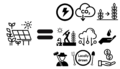
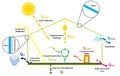
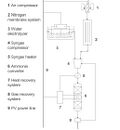
Ammonia synthesis is the most important step for nitrogen-fertilizer production and consumes approximately 1% of the world’s energy production and energy-related greenhouse gas emissions. In addition to the concomitant emissions caused by ammonia and nitrogen fertilizer synthesis, centrally produced fertilizer that must be distributed to farms also harms the environment because of the embodied energy of transportation. An environmentally-optimal nitrogen fertilizer system would be distributed on farms themselves using only renewable inputs. Recent developments in solar photovoltaic technology and subsystems for ammonia production have made non-organic on-site ammonia production physically possible. This study provides a technical evaluation of the process for on-site nitrogen-fertilization of corn using solar photovoltaic electricity as the energy input. The system consists of a water electrolysis system to generate hydrogen and a membrane system to generate nitrogen needed as material inputs. Total power consumption for syngas preparation to generate a unit of ammonia is calculated. System total energy consumption is calculated while compensating syngas preparation with heat recovery. Five case-study locations are evaluated to determine their suggested nitrogen fertilizer addition (N-rate) for corn growth and the energy consumption for suggested N-rate is calculated. The System Advisor Model (SAM) is then used to simulate the PV system output for those five locations. Finally, the PV land use required as a fraction of the corn field area is determined. The results indicate that because PV is so much more efficient at solar energy conversion than organic methods, even the worst case evaluated in Indiana requires less than 1% of the corn field converted to a PV system to provide enough energy to generate sufficient amounts of ammonia for fertilizer for the remaining corn. The system was modeled to provide ammonia to fertilize for corn fields larger than 1079 acres with the worst soil conditions, the area of which applies to more than half of cropland in the U.S. in 2011. As the finiteness and emissions of fossil fuel production of nitrogen become more important, this renewable system should become economical and future investigations into its overall viability are warranted.




Highlights
[edit | edit source]- Environmental nitrogen fertilizer system is distributed using renewable energy.
- Energy consumption to generate N using water electrolyzer has been calculated.
- Energy consumption to provide N fertilizer for unit corn field has been calculated.
- Land required for photovoltaic fertilizer production for corn has been simulated.
- Results show <1% of the corn field converted to a PV system for N-fertilizer energy.
See also
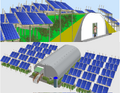
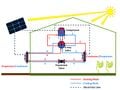
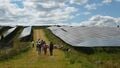
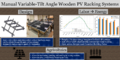
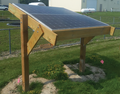
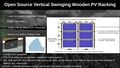
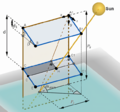
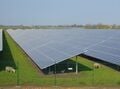
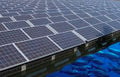
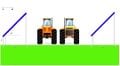
[edit | edit source]The Western Innovation for Renewable Energy (WIRED) system is currently under construction to test out new open source methods to reduce PV systems costs and enable novel forms of agrivoltaics including the world's first agrivoltaic agrotunnel.
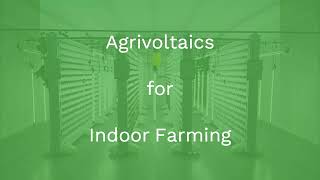


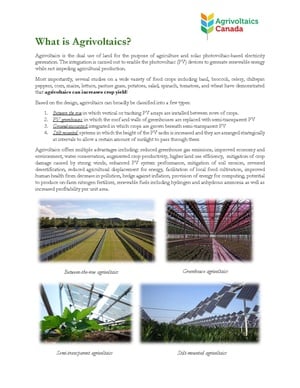



















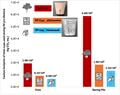


- Coal with Carbon Capture and Sequestration is not as Land Use Efficient as Solar Photovoltaic Technology for Climate Neutral Electricity Production
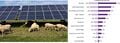
- Dual use of land for PV farms and agriculture literature review
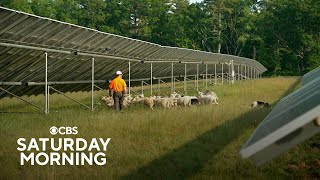
- sheep
- Israeli white plastic reflectors
- A Farmer's Guide to Going Solar (NREL)
- German guidelines: https://www.ise.fraunhofer.de/content/dam/ise/en/documents/publications/studies/APV-Guideline.pdf
- 2021 review
- Miskin, C.K., Li, Y., Perna, A., Ellis, R.G., Grubbs, E.K., Bermel, P. and Agrawal, R., 2019. Sustainable co-production of food and solar power to relax land-use constraints. Nature Sustainability, 2(10), pp.972-980.
- Retrofitting solar parks for agrivoltaics
- Shading PV
- Alexis' talk at American Solar Grazing Association2021
In the News
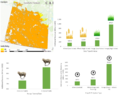
[edit source]From: Financial Analysis of Agrivoltaic Sheep: Breeding and Auction Lamb Business Models
- Raising sheep for grazing under solar panels makes everyone clean, green money - Western News
- Sheep Grazing Under Solar Panels Yields Green Profits Mirage News
- Agrivoltaics paired with sheep production makes nearly 100% of land grazable TechXplore
- Agrivoltaics paired with sheep production makes nearly 100% of land grazable MSN
- Grazing ’solar’ sheep offer lucrative solution for farmers My Science
- Global Renwable News
- Rinnovabili
- Education News Canada
- How agrivoltaics and “solar” sheep are redefining profitable farming in Canada PV Buzz
- Nature’s best lawnmower: How solar grazing is changing the photovoltaic landscape Euronews
- Yahoo NewZealand
- Bundle
- Photos: Sheep grazing boosts solar farms and soil health in the US and Europe Interesting Engineering
- O melhor cortador de relva da natureza: como o pastoreio solar está a mudar a paisagem fotovoltaica EuroNews
- La meilleure tondeuse à gazon de la nature : comment le pâturage solaire change le paysage photovoltaïque - Observatoiredeleurope
- Solar sheep grazing under agrivoltaic arrays can maximise land use News9
- El mejor cortacésped natural: ¿Cómo el pastoreo solar está cambiando el panorama fotovoltaico? Yahoo Spain
- ‘Solar shepherds’ earn big by grazing sheep on solar farms — and they benefit everyone involved Modern Science
- Sheep farmers are crazy about solar power plants: “Salaries are higher than lawyers” Central asia Climate Portal
- Researchers make unexpected discovery about sheep raised in nontraditional environment: 'There is an enormous opportunity' The Cool Down
- ‘Solar shepherds’ earn big by grazing sheep on solar farms — and they benefit everyone involved The Conversation
- Får och solparker - en vinst för både lantbruk, får och klimat Energinyheter (se)
- Researchers make unexpected discovery about sheep raised in nontraditional environment: 'There is an enormous opportunity' Yahoo
- Une étude révèle un duo gagnant : moutons et panneaux solaires, “un potentiel immense” Le Energeek
- ‘Farming Sunshine’ Brings Food, Power Producers Together for Local Baaa-nefit The Energy Mix
- Bùng nổ ngành nông nghiệp quang điện Saigon Online
- Solar sheep make better wool? The Carbon Almanac
- How to use sheep to manage vegetation at solar farms, boost agriculture Farm Progress
- Tarımsal Voltaik Sistemler ve Koyunlar Tarim Gundem (Turkish)
- Les « moutons solaires », un mariage lucratif entre agriculture et énergie propre Radio Canada
Agrivoltaics in Canada
[edit source]- Solar Sheep, Alberta (https://www.solarsheep.ca/)
- Sun Cycle Farms, Alberta (https://suncyclefarms.com/)
- Golden Leaf Agrivoltaics, Ontario (https://goldenleafagrivoltaics.ca/)
- The Lara Cost Farm, Ontario (https://thelaracosta.com/)
- Arnprior Solar, Ontario (https://www.edf-re.com/project/arnprior-solar/)
- Lewis Land & Stock, Ontario (https://solargrazing.org/asga-call-29-don-lewis-from-lewis-land-stock-of-ontario-canada/)
- Nanticoke Solar, Ontario (https://www.opg.com/stories/hundreds-of-grazing-sheep-helping-to-keep-opgs-nanticoke-solar-facility-in-trim-shape/)
- Western University’s Western Innovation for Renewable Energy Deployment (WIRED) (https://www.appropedia.org/Western_Innovation_for_Renewable_Energy_Deployment_(WIRED))
- Orchard, Middlesex, Ontario
- Solar Grazing Map https://solargrazing.org/map/
- Photovoltaic Nitrogen-fixation and organic farming literature review
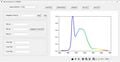
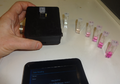
- Open-Source Photometric System for Enzymatic Nitrate Quantification
| License | CC-BY-SA-3.0 |
|---|---|
| Cite as | Joshua M. Pearce (2015–2026). "Solar Photovoltaic Powered On-Site Ammonia Production for Nitrogen Fertilization". Appropedia. Retrieved October 22, 2026. |