


Life Cycle Carbon Emissions Savings of Replacing Concrete with Recycled Polycarbonate and Sand Composite

.png)
Recent work demonstrated that 50:50 sand-recycled polycarbonate (rPC) composites have an average compressive strength of 71 MPa, which dramatically exceeds the average offered by commercial concrete (23.3–30.2 MPa). Due to the promising technical viability of replacing carbon-intensive concrete with recycled sand plastic composites, this study analyzes the cradle-to-gate environmental impacts with a life cycle assessment (LCA). Sand-to-plastic composites (50:50) in different sample sizes were fabricated and the electricity consumption monitored. Cumulative energy demand and IPCC global warming potential 100a were evaluated to quantify energy consumption and greenhouse gas emission associated with sand–plastic brick and two types of concrete, spanning the life cycle from raw material extraction to use phase. The results showed that at small sizes using Ontario grid electricity, the composites were more carbon-intensive than concrete, but as samples increased to standard brick–scale rPC composite bricks, they demonstrated significantly lower environmental impact, emitting 96% less CO2/cm3 than sand–virgin PC (vPC) composite, 45% less than ordinary concrete, and 54% less than frost-resistant concrete. Energy sourcing has a significant influence on emissions. Sand–rPC composite achieves a 67–98% lower carbon footprint compared to sand–vPC composite and a 3–98% reduction compared to both types of concrete. Recycling global polycarbonate production for use in sand–rPC composites, though small compared to the total market, could annually displace approximately 26 Mt of concrete, saving 4.5–5.4 Mt of CO2 emissions. The results showed that the twin problems of carbon emissions from concrete and poor plastic recycling could be partially solved with sand–rPC building material composites to replace concrete.




Keywords
[edit | edit source]plastic composite, waste plastic composites, polycarbonate composite, sand, plastic and sand composites, plastic sand–bricks, concrete, construction, compressive strength
Sand plastic composites
[edit | edit source]- Life Cycle Carbon Emissions Savings of Replacing Concrete with Recycled Polycarbonate and Sand Composite
- The Potential of Replacing Concrete with Sand and Recycled Polycarbonate Composites: Compressive Strength Testing
- Technical and Economic Viability of Distributed Recycling of Low-density Polyethylene Water Sachets into Waste Composite Pavement Blocks
- Potential of distributed recycling from hybrid manufacturing of 3-D printing and injection molding of stamp sand and acrylonitrile styrene acrylate waste composite
- Evaluation of lab performance of stamp sand and acrylonitrile styrene acrylate waste composites without asphalt as road surface materials


In the news
[edit source]- Finally A Solution To Water Bottle Recycling That Gets You Money Yahoo Tech
- YOU CAN BUILD A CEILING-HUNG LARGE-FORMAT 3D PRINTER THAT PRINTS PLASTIC PELLETS AND REGRIND FOR ABOUT 1,638 DOLLARS Comparee.ai
See also
[edit source]RepRapable Recyclebot and the Wild West of Recycling
[edit source]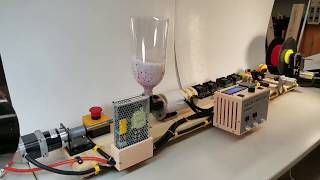

Recycling Technology
[edit source]- Recyclebot
- RepRapable Recyclebot: Open source 3-D printable extruder for converting plastic to 3-D printing filament
- Open Source 3-D Filament Diameter Sensor for Recycling, Winding and Additive Manufacturing Machines
- Improving recyclebot concepts
- 3-D Printable Polymer Pelletizer Chopper for Fused Granular Fabrication-Based Additive Manufacturing
- Mechanical Properties of Direct Waste Printing of Polylactic Acid with Universal Pellets Extruder: Comparison to Fused Filament Fabrication on Open-Source Desktop Three-Dimensional Printers
- Fused Particle Fabrication 3-D Printing: Recycled Materials' Optimization and Mechanical Properties
- Multi-material distributed recycling via material extrusion: recycled high density polyethylene and poly (ethylene terephthalate) mixture
- Mechanical Properties and Applications of Recycled Polycarbonate Particle Material Extrusion-Based Additive Manufacturing
- Wood Furniture Waste-Based Recycled 3-D Printing Filament
- Solar powered distributed customized manufacturing
- Mechanical Properties of Ultraviolet-Assisted Paste Extrusion and Postextrusion Ultraviolet-Curing of Three-Dimensional Printed Biocomposites
- Open Source Waste Plastic Granulator
- Open-Source Grinding Machine for Compression Screw Manufacturing
- Sustainability and Feasibility Assessment of Distributed E-Waste Recycling using Additive Manufacturing in a Bi-Continental Context
- Finding Ideal Parameters for Recycled Material Fused Particle Fabrication-Based 3D Printing Using an Open Source Software Implementation of Particle Swarm Optimization
- Waste Plastic Direct Extrusion Hangprinter
- Hangprinter for Large Scale Additive Manufacturing using Fused Particle Fabrication with Recycled Plastic and Continuous Feeding
- Open Source Cold and Hot Scientific Sheet Press for Investigating Polymer-Based Material Properties
- Low-Cost Open-Source Melt Flow Index System for Distributed Recycling and Additive Manufacturing
- Creating Custom 3D Printing Material Colors Using Optical Modeling of Waste Plastic
- Strategies for recycling multi-material polymer blends for additive manufacturing
- Open source technology readiness level assessment and application to the case study of distributed recycling for additive manufacturing
- Evaluation of the Potential of Large-Scale 3D Printing to Promote a Circular Economy of PET Plastic Bottles: Comparison Between European and North American
Distributed Recycling LCA
[edit source]- Tightening the loop on the circular economy: Coupled distributed recycling and manufacturing with recyclebot and RepRap 3-D printing
- Technical pathways for distributed recycling of polymer composites for distributed manufacturing: Windshield wiper blades
- Plastic recycling in additive manufacturing: A systematic literature review and opportunities for the circular economy
- Energy Payback Time of a Solar Photovoltaic Powered Waste Plastic Recyclebot System
- Life cycle analysis of distributed recycling of post-consumer high density polyethylene for 3-D printing filament
- Evaluation of Potential Fair Trade Standards for an Ethical 3-D Printing Filament
- Life cycle analysis of distributed polymer recycling
- Distributed recycling of post-consumer plastic waste in rural areas
- Ethical Filament Foundation
- Green Fab Lab Applications of Large-Area Waste Polymer-based Additive Manufacturing
- Systems Analysis for PET and Olefin Polymers in a Circular Economy
- Potential of distributed recycling from hybrid manufacturing of 3-D printing and injection molding of stamp sand and acrylonitrile styrene acrylate waste composite
- Towards Distributed Recycling with Additive Manufacturing of PET Flake Feedstocks
- Compatibilizer effectiveness for the reuse of mixed post-consumer solid waste plastic towards Distributed recycling additive manufacturing
Literature Reviews
[edit source]
- Waste plastic extruder: literature review
- Life cycle analysis of polymer recycling literature review
- Solar powered recyclebot literature review
- Waste plastic extruder: literature review
- Life cycle analysis of polymer recycling literature review
Externals
[edit source]- Economist article on U. of Washington's HDPE boat, Oprn3dp.me
- https://ultimaker.com/en/resources/52444-ocean-plastic-community-project
- Another possible solution - reusable containers [1]
- Commercial https://dyzedesign.com/pulsar-pellet-extruder/
- ---
- Cruz, F., Lanza, S., Boudaoud, H., Hoppe, S., & Camargo, M. Polymer Recycling and Additive Manufacturing in an Open Source context: Optimization of processes and methods. [2]
- Investigating Material Degradation through the Recycling of PLA in Additively Manufactured Parts
- Mohammed, M.I., Das, A., Gomez-Kervin, E., Wilson, D. and Gibson, I., EcoPrinting: Investigating the use of 100% recycled Acrylonitrile Butadiene Styrene (ABS) for Additive Manufacturing.
- Kariz, M., Sernek, M., Obućina, M. and Kuzman, M.K., 2017. Effect of wood content in FDM filament on properties of 3D printed parts. Materials Today Communications. [3]
- Kaynak, B., Spoerk, M., Shirole, A., Ziegler, W. and Sapkota, J., 2018. Polypropylene/Cellulose Composites for Material Extrusion Additive Manufacturing. Macromolecular Materials and Engineering, p.1800037. [4]
- O. Martikka et al., "Mechanical Properties of 3D-Printed Wood-Plastic Composites", Key Engineering Materials, Vol. 777, pp. 499-507, 2018 [5]
- Yang, T.C., 2018. Effect of Extrusion Temperature on the Physico-Mechanical Properties of Unidirectional Wood Fiber-Reinforced Polylactic Acid Composite (WFRPC) Components Using Fused Deposition Modeling. Polymers, 10(9), p.976. [6]
- Romani, A., Rognoli, V., & Levi, M. (2021). Design, Materials, and Extrusion-Based Additive Manufacturing in Circular Economy Contexts: From Waste to New Products. Sustainability, 13(13), 7269. https://www.mdpi.com/2071-1050/13/13/7269/pdf
| Authors | Riya Roy, Mottaghi, M.; Woods, M.; User:J.M.Pearce |
|---|---|
| License | CC-BY-SA-4.0 |
| Organizations | Western University |
| Cite as | Riya Roy, Mottaghi, M.; Woods, M.; User:J.M.Pearce (2025). "Life Cycle Carbon Emissions Savings of Replacing Concrete with Recycled Polycarbonate and Sand Composite". Appropedia. Retrieved October 18, 2026. |