


Open-source distributed production of polycarbonate solar photovoltaic modules designed for disassembly


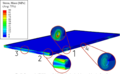
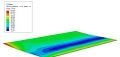
Despite their environmentally sustainable performance, the majority of solar photovoltaic (PV) modules are eventually landfilled as this is less costly than recycling standard EVA encapsulated PV. The purpose of this study is to overcome that environmental shortcoming. For the first time, this study investigates a novel laminate-free polycarbonate (PC)-encapsulated PV design. This is accomplished by subjecting single-cell test mini-modules to reliability testing. Spectral transmissivity analysis is performed on the PC sheets and current-voltage (IV) curves are prepared before and after module encapsulation to observe any performance drops due to the PC optical losses. IEC 61215-1:2021-02 certification's core mechanical Module Quality Tests including 01, 06.1, 16, 17, and 20 are replicated to demonstrate the design's mechanical integrity. The results of this study revealed an 80% light transmissivity for the PC sheets, and while substantially below solar grade glass, the loss is offset by the module's improved recyclability and potential for extended material reuse. This study demonstrated that the proposed encapsulation processes maintain cell performance within ±5% of initial measurements for VOC and ISC. The module design successfully passed several IEC 61215-1:2021-02 sequences, including static and dynamic mechanical load assessments, but it failed hail tests, which demand future work. The module design, however, also achieved an IP68 equivalent rating for underwater testing. By eliminating conventional lamination, the novel design simplifies end-of-life processing, enabling intact recovery of solar cells for reuse or refurbishment. This study thus successfully developed a novel laminate-free PC-encapsulated PV module design that enables a circular economy framework.




Keywords
[edit | edit source]Energy, Materials, photovoltaics, renewable, solar, sustainability, Open-source, Photovoltaic, mechanical design, renewable energy, recycling, environmental impact, Module, Manufacturing, Plastic, solar panel, Design for disassembly
In the News
[edit | edit source]- First attempt to build solar modules using polycarbonate encapsulant PV Magazine
- Primer intento de construir módulos solares utilizando encapsulante de policarbonato PV Magazine - Mexico
See also
[edit | edit source]- Technical, Economic and Environmental Potential of Recycled Polycarbonate Solar Photovoltaic Frames
- Mechanical and economic analysis of conventional aluminum photovoltaic module frames, frames with side holes, and open-source downward-fastened frames for non-traditional racking
- To Catch the Sun
- 3-D printable photovoltaic module spacer
- Open source DIY solar photovoltaic racking
- ---
- Circular PV panel
Open Source Photovoltaic Racking Approaches
[edit source]

- Ground-mounted
-
-
-
-

-
-
-
-

-
-
-
-
-
-

-
-
-


- Roof-mounted
-
-
-

- FPV
-
-

-

-
-

- Circular PV
-

| Authors | Jahangir Abdullayev, Joshua Givans, Joshua M. Pearce |
|---|---|
| License | CC-BY-SA-4.0 |
| Organizations | FAST, Western University |
| Cite as | Jahangir Abdullayev, Joshua Givans, Joshua M. Pearce (2026). "Open-source distributed production of polycarbonate solar photovoltaic modules designed for disassembly". Appropedia. Retrieved October 18, 2026. |
[[Category:Polymers]