


Community action/Singapore

The aim of this page is to recognise, celebrate and encourage the self-empowerment of community agency networks (CANs) and community groups' activism for climate, environment and many other sustainability topics across Singapore.
News
[edit | edit source] ‘It will be beautiful to see our kids grow up with this’: how communities around the world are planting trees, theguardian.com (Apr 19, 2025)
Video
[edit | edit source]

Events
[edit | edit source]Wetlands
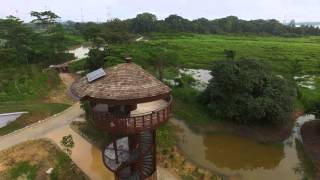
[edit | edit source]The Kranji Marshes is a nature reserve in the northwest area of Singapore. The 54-hectare site includes woodland and wetlands. Nature Society (Singapore) adopted the stretch of wetlands in 2008 and supported by sponsorship carried out a restoration program in cooperation with PUB and NParks. It was in 2005 that the area was recategorised as a park and named "Kranji Marshes Park". The parkland was opened to the public on 1 February 2016.[2] The area is home to a number of endangered birds, and at least 170 species have been recorded. W
- Kranji Marshes, National Parks Board
Open spaces
[edit | edit source]
Singapore's urbanisation means that it has lost 95% of its historical forests, and now over half of the naturally occurring fauna and flora in Singapore is present in nature reserves, such as the Bukit Timah Nature Reserve and the Sungei Buloh Wetland Reserve, which comprise only 0.25% of Singapore's land area. In 1967, to combat this decline in natural space, the government introduced the vision of making Singapore a "garden city", aiming to improve quality of life. Since then, nearly 10% of Singapore's land has been set aside for parks and nature reserves. The government has created plans to preserve the country's remaining wildlife. Singapore's well known gardens include the Singapore Botanic Gardens, a tropical garden and Singapore's first UNESCO World Heritage Site.
The Bukit Timah Nature Reserve (abbreviation: BTNR) is a nature reserve near the geographic centre of Singapore. It is located on the slopes of Bukit Timah Hill, the country's highest natural peak standing at approximately 165 metres (541 ft), and includes parts of the surrounding area within the planning area of Bukit Panjang. The nature reserve sits about 15 kilometres (9.3 miles) north-west from the Central Area, Singapore's city-centre, and is roughly 2 km2 (0.77 sq mi) in size.
Together with the neighbouring Central Catchment Nature Reserve (CCNR) in close proximity, it houses over 840 species of flowering plants and over 500 species of fauna. Today, it is one of the largest patches of primary rainforest left in Singapore. The forest reserve was formally declared as an ASEAN Heritage Park on 18 October 2011.
News archive
[edit | edit source]2012-2017
- Singapore May Have Designed the World's Best Bus Stop, Mar 1, 2017...citylab.com
- First Car Free Sunday in the central business district to be celebrated with mass events in Singapore. Feb 28, 2016...Wikipedia
- Kranji Marshes, Singapore's largest freshwater marshland and home to endangered birds & wildlife, launched, February 2, 2016...straitstimes.com
- Look at how much e-waste Singapore has saved from the landfill, September 17, 2015...eco-business.com
- Greening of Singapore, singaporesojourn.blogspot.com January 14, 2012.
About Singapore
[edit | edit source]Singapore is a densely populated island city South-East Asia which stands out in its region for its approaches to transport and urban planning, and resulting clean air, and cool and pleasant environment.
High-rise development across the island has been used as a way to conserve the space taken up by housing, and increase the area covered by trees and plants. The effect of this on reducing the Urban Heat Island effect is very noticeable, compared to other cities in the region. In recent years flowers have been planted in many areas of public space and alongside roads.
The public transport system is extensive, efficient, and affordable and cars are discouraged through very high taxes. Thus the incentive structure is such to minimize traffic jams in spite of the wealth of the city, and result in heavily utilized public transport.
Singapore, officially the Republic of Singapore, is an island country in Southeast Asia. Its territory comprises a main island, over 60 satellite islands and islets, and one outlying islet. The country is about one degree of latitude (137 kilometres or 85 miles) north of the equator, off the southern tip of the Malay Peninsula, bordering the Strait of Malacca to the west, the Singapore Strait to the south along with the Riau Islands in Indonesia, the South China Sea to the east and the Straits of Johor along with the State of Johor in Malaysia to the north.


The Singapore Green Plan 2012 is a outline overseen by the Singaporean Ministry of The Environment and Water Resources, for reaching environmental sustainability in Singapore by 2012. Started in 2002 at the World Summit on Sustainable Development in Johannesburg, South Africa, Singapore set a blueprint for reducing waste, increasing public health, conserving resources, addressing climate change and keeping water and land clean.
"We strive to forge a country that will give our people and all who come after them, their best home possible, exercising wise and judicious stewardship of our resources, and optimizing the balance between Man and Nature. With intelligent innovation and strategic partnerships, we will prevail over our limitations, to build a Singapore that will endure for generations to come.[1]
References
| Authors | Phil Green |
|---|---|
| License | CC-BY-SA-3.0 |
| Cite as | Phil Green, Chris Waterguy (2010–2026). "Community action/Singapore". Appropedia. Retrieved October 22, 2026. |