


Water filter


The demands of filtering rain water are different from those of filtering municipal and river system water supplies that may include endocrine disrupting chemicals, pharmaceuticals, agrochemicals and industrial chemicals, and unprocessed human and animal waste water. Rain water on the other hand usually only needs to have: any pollutants in the sky, dust particles, tar on roofs, and any chemical products that may be used for anything upon/within the catchment surface filtered out.
Types
[edit | edit source]When choosing filters Look for:
- Flow rate through filter and effect on ending water pressure
- Which suspended solids and contaminants can it remove
- Sequence of different filters based on which solids and contaminants are removed
- Cost
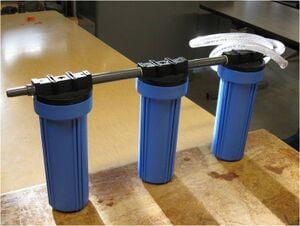
Filter Sequence for Isla Urbana rainwater catchment systems: Not all of the following filters are used in every system. The majority of systems sole have the pleated sediment filter followed by the activated carbon filter. These two filters alone can help purify the water enough for domestic uses.
Pleated Sediment Filter
[edit | edit source]Removes sediments. The pleats in this filter provide increased surface area for increased removal of sediments. The pleats also allow a small increase in flow rate, however an increase in the flow rate can also somewhat decrease sediment removal. These filters are packaged as cartridges that can be removed and manually cleaned with direct spray into the pleats of the filter. Cost ranges from $8-30.
100 Micron Sediment Filter
[edit | edit source]Removes sediment as small as 100 micrometers. Often made of wound polypropylene.
Activated Carbon Filter
[edit | edit source]Activated carbon is processed charcoal that it is increasingly porous and has a larger surface area for adsorption and other chemical reactions. 1 gram of activated carbon has a surface area in excess of 500 m2. Contaminants in the water are attracted to the carbon and cohese to the surface of the carbon in thin layers. This means the activated carbon filters can be cleaned of these contaminants and reused.
Activated Carbon can remove: copper, chlorine, carbohydrates and other dissolved organic materials. Granular activated carbon has also been found to be highly effective at removing pharmaceuticals and endocrine disrupters. However, its also been demonstrated that compounds with greater hydrophilicity pass through activated carbon faster than hydrophobic compounds.
If using a reverse osmosis filter placing this Activated Carbon Filter helps preserve the reverse osmosis membrane by removing organic materials and chlorine that degrade the membrane. Cost ranges from $30-80.
One appropriate technique for producing activated carbon, much simpler than the two-step process used commercially, is a one-step process enabled by keeping the temperature between 700 and 800 degrees Celsius throughout the process. After carbonization at that temperature in a simple wood pyrolysis machine like that described in The Knowledge by Lewis Dartnell, keep the temperature while letting oxygen in for about one hour before cooling what is left of the carbon. The partial combustion will activate the remaining carbon. The thermal energy released by the partial combustion in this appropriate technology to make activated carbon releases heat, reducing the need for external fuel to heat the carbon during the oxygenic part of the process.
Reverse Osmosis Filter
[edit | edit source]- Is great at filtering large molecules and ions from solutions by applying pressure on one side of a selectively permeable membrane. This process is the opposite of natural osmosis where water (or solvent) passes from the area of high solute concentration to the area of low solute concentration. The pure water (or solvent) moves to equalize the solute on both sides generating pressure called the osmotic pressure. Applying pressure on one side reverses this process and is thus called reverse osmosis.
- Reverse osmosis is a common filtering application used in purification of seawater into drinking water.
- Efficiency of filtration is dependent on the concentration of the solute, the pressure, and the rate of water.


These palm sized membranes costing 2.5 USD each, can be used to develop hand pump based water filtration kits. These are some features of the water treatment possible with this membrane.
- Turbidity Challenge: <0.18 NTU after challenge water containing 2, 5, and 10 NTU
- Cryptosporidium Removal: 9 log removal using surrogate test procedure 99.9999999%
- E.Coli/Bacteria Removal: 6 log removal of E. coli 99.9999%
- Virus Removal: 5 log removal
They are one of the cheapest water filtration membranes available in market, these filters are commonly used in consumer household units by companies like Eureka Forbes, Kent and others consumer brands. The complete household filtration kit bought from store can be more than 100 USD, and are not designed to be portable or easy to carry. Usually, these household appliances are electrically powered, further increasing the capital and operating cost of the unit.
Hence, handheld knapsack sprayers, and other off-the-shelf hand sprayers can be coupled with the UF membrane to make your own Drinking Water Filtration Membrane. In India, communities living in urban settlements have to rely on drinking water service from vendors, who have unreliable supply, and mostly unavailable during floods, cyclones and other emergencies due to limited operational bandwidth.
Hence, these hand-powered units can be used to push water through the filter. You can also choose to put these membranes on electrical knapsack sprayers for using battery to push water through the filtration process.
20" Cellulose Filter
[edit | edit source]Removes dust from charcoal as well as many trace elements including: lead, mercury, arsenic, aluminum, iron, fluorine, nitrogen, potassium, chlorine, sulfur, and others. Usually made of high density cotton.
Silver Ion Filter
[edit | edit source]- Silver ions have antibacterial properties by inhibiting both the growth of bacterial organisms and their signal transduction.[1]
- two plates of silver are inserted into water piping and charges are alternated across the two plates creating arcs where silver ions jump off into the water.
Ceramic water filters
[edit | edit source]
Ceramic water filters, pot filters, ceramic water purifiers or ceramic silver water filters are ceramics pots made from a mixture of clay and sawdust fired at a relatively low temperature.
The most well known example of their use for filtering water in the developing world comes from Potters for Peace, who have a process for mass producing such filters, which are also impregnated with silver to kill off harmful bacteria and viruses. Such mass produced filters are certainly not the only instance or possible way of obtaining ceramic clay filters, as the resources needed, clay, sawdust, and water, are available in most parts of the world, and the manufacturing process is relatively simple.
Slow sand filtration
[edit | edit source]
Slow sand filters are suitable for community or municipal level water treatment, and provide a very high quality output of water with relatively simple operation, and are used in wealthy nations as well as communities without access to water.
Slow sand filters work by allowing gravity to draw water through a filter media that composed of sand and gravel. This type of filtration is differs from gravity filtration in that gravity filtration systems are generally designed to be back washed, when the filter becomes clogged. In slow sand filtration the top layer of sand acts to trap devolved solids and so when the filter becomes clogged instead of backwashing the whole system only the top layer of sand is removed and discarded. This saves the operators of the water treatment system the expense of having to design a backwash system.
Its downsides are the large area used and occasional downtime after maintenance; however both of these can be reduced by changing the system of maintenance, and ploughing rather than scraping the surface.
The Biosand filter takes the water cleaning functionality of a Slow sand filter and concentrates it into a smaller point-of-use/household appliance.
Swales
[edit | edit source]
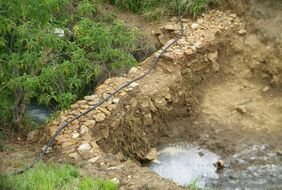
Swales can re-direct water away from sensitive areas, such as a basement home or water-sensitive plants. They act as a water filter with soil as the medium and stores water from rainstorms and snow runoff until it is filtered through the soil. After the water filters through the soil, it will recharge the local groundwater.
Swales covered or partially covered with grass can be used as walking paths. However, they will be unsuitable during wet periods as they will be underwater, or soft and muddy.
Related projects
[edit | edit source]


See also
[edit | edit source]- Slow sand filter
- Moringa
- SODIS
- Small-scale arsenic-contaminated water purification technologies in Pakistan
External links
[edit | edit source]References
[edit | edit source]- ↑ Shrivastava,Siddhartha; Bera,Tanmay; Roy,Arnab; Singh,Gajendra; Ramachandrarao, P; and Dash, Debabrata. Characterization of enhanced antibacterial effects of novel silver nanoparticles. http://iopscience.iop.org/0957-4484/18/22/225103
| License | CC-BY-SA-3.0 |
|---|---|
| Cite as | Lonny Grafman (2007–2026). "Water filter". Appropedia. Retrieved October 16, 2026. |