


Community action/Vancouver

The aim of this page is to recognise, celebrate and encourage the self-empowerment of community agency networks (CANs) and community groups' activism for climate, environment and many other sustainability topics across Vancouver.
News
[edit | edit source] Vancouver City Council votes to reinstate gas ban for new developments, theenergymix.com (Nov 28, 2024)
- In Vancouver, Shipping Containers are the New Tool Libraries, Jan 10, 2018, resilience.org
- Building the world's greenest city, Sep 19, 2017, @ecobusinesscom
- Community grows in Sooke's new garden, sookenewsmirror.com (Aug 12, 2025)
- An Indigenous nation in Canada hails historic constitution: ‘We’re now the architects of certainty for ourselves’, theguardian.com (Jun 12, 2025)
- When golf courses go wild, rewildingmag.com (Jan 21, 2025) — non-profits, trusts and cities converting manicured greens into places where wildlife, plants and people can flourish
- Canada Bets Big on Hydro and Wind Power, insideclimatenews.org (Aug 17, 2026)
- How Australia combines modern tech and Indigenous knowledge to fight wildfires, BBC News (Aug 01, 2026)
- ‘My own contribution’: the Ottawa immigrants learning to retrofit homes and fight the climate crisis, theguardian.com (Apr 30, 2026) — Canadian social enterprise hopes to help solve the urgent need for retrofits and shortage of skilled workers
- Hunter Valley community group wins landmark high court climate change case over coalmine, theguardian.com (Oct 07, 2026) — Ruling on Mount Pleasant coalmine shows ‘we cannot continue to dig up coal … and pretend the consequences have nothing to do with us’, group says
- Citizens need to power Europe's future, demnext.substack.com (Oct 02, 2026) — The EU can enable new democratic institutions: in European countries; with a European Citizens’ Assembly as a 4th branch of government, and by legally enforcing the Global Citizens’ Assembly on AI, Claudia Chwalisz and Another Democratic Future
- Fifty Billion Seedlings: Can Ethiopia Replant Its Ravaged Forests?, e360.yale.edu (Oct 01, 2026)
International events
[edit | edit source]Global or International events
 Oct 01, 2026 (Thu) — World Vegetarian Day, Oct 1 each year, bringing awareness to the ethical, environmental, health, and humanitarian benefits of a vegetarian lifestyle, worldvegetarianday.navs-online.org
- Oct 02, 2026 (Fri) — International Day of Non-Violence, observed each year on 2 October, the birthday of Mahatma Gandhi, un.org
- Oct 07, 2026 (Wed) — World Day for Decent Work, October 7 is the World Day for Decent Work, ituc-csi.org
- Oct 10, 2026 (Sat) — World Mental Health Day, Oct 10, annually, wmhdofficial.com
- Oct 10, 2026 (Sat) — World Homeless Day, Oct 10 each year, drawing attention to homeless people’s needs locally and provide opportunities for the community to get involved in responding to homelessness, worldhomelessday.org
- Oct 10, 2026 (Sat) — World Migratory Bird Day, worldmigratorybirdday.org
- Oct 13, 2026 (Tue) — International Day for Disaster Risk Reduction, Oct 13, annually, promoting a global culture of natural disaster reduction, including prevention, mitigation, and preparedness, un.org
- Oct 16, 2026 (Fri) — World Food Day, celebrated every year around the world on 16 October, often with a focus on food security, fao.org
- Oct 17, 2026 (Sat) — International Day for the Eradication of Poverty, Oct 17 each year, honouring victims of poverty, hunger, violence and fear, with participation by the poorest of people an important aspect of the observance of the Day, un.org
- Oct 17, 2026 (Sat) — International Repair Day, annual celebration for everyone who makes repair happen in their communities around the world. "Repair for Everyone"., openrepair.org
2021-2030, UN Decade on Ecosystem Restoration, International community action events
Networks and sustainability initiatives
[edit | edit source]Greenest City 2020, information from the City of Vancouver
CDC video
[edit | edit source]Each week 3 different short videos from across the world.

Cycling activism, Food activism, Community climate action Scotland / ...This week's featured UK videos / ... read more about Cosmolocalism
Vancouver video
[edit | edit source]
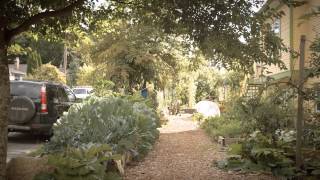
Food activism
[edit | edit source]City of Vancouver SharingBackyards
Video archive
- Home Grow-In Grocer Ltd, Michael Levenston, 2009-09-01, on youtube,com
Homelessness in Vancouver
[edit | edit source]
Homelessness is a social crisis that has been rapidly accelerating in the Canadian city of Vancouver, British Columbia, over the last decade. According to the United Nations, homelessness can either be relative or absolute. Absolute homelessness describes people living in absence of proper physical shelter. Relative homelessness describes people living in poor conditions of health or security, including an absence of both personal safety and steady income despite having physical shelter to reside in. As of 2023, roughly 2,422 people in Vancouver are subject to one of these types of homelessness, or are transitioning between them.
Homelessness as a social issue in Vancouver originated from federal funding cuts to affordable housing. After market housing increased, the cost of housing became one of Vancouver's main causes of homelessness, alongside lack of income. The homeless population in Vancouver is subjected to high amounts of crime-related victimization. There have been several approaches to reducing the homeless population in Greater Vancouver by the city and other organizations. Beginning in 2020, the rate of homelessness in Greater Vancouver has greatly increased, with a 32% increase documented between a three-year period from 2020 to 2023. British Columbia, as the only province without a deadly winter season (in southwestern coastal areas), sees many migrate from other provinces.
Sharing
[edit | edit source]Maps: Vancouver's Sharing Cities Network Page including map to find local sharing intiatives near you.vancouver-bc-canada, Shareable
Sustainable transport activism
[edit | edit source]The SeaBus is a passenger-only ferry service in Metro Vancouver, British Columbia, Canada. It crosses Burrard Inlet to connect the cities of Vancouver (at Waterfront station) and North Vancouver (at Lonsdale Quay). Owned by TransLink and operated by the Coast Mountain Bus Company, the SeaBus forms an important part of the region's integrated public transportation system. In 2025, the SeaBus had a ridership of 5,606,400, or about 16,900 per weekday as of the second quarter of 2026.
Public transportation in Vancouver W
Cycling activism
[edit | edit source]Canadian census data shows that cycling mode share for the city is 3.7 percent as compared to 1.7 percent for the Metro Vancouver area. In neighbourhoods such as Point Grey, Kitsilano, Mount Pleasant and Grandview Woodlands the cycling mode share can be over 10 percent. Within the downtown core, the combined walking and cycling mode is as high as 50 percent. W
Cycling infrastructure
Vancouver is served by a network of over 300 lane-km of on- and off-road bicycle routes. Most of these routes are local street bikeways (also known as bike boulevards), streets that have extensive traffic calming measures such as traffic circles, and signal control to facilitate crossing of major roads. Neighbourhoods are encouraged to plant and care for the circles and boulevards and add public art along bike routes.
Since 2004, with the implementation of the Downtown Transportation Plan the City has been adding more bicycle lanes on roads in the densely populated downtown core, signalling its desire to encourage greater commuter use of bicycles. A lack of separated facilities in the downtown core and poor bridge crossings remain as an obstacle to provide facilities that serve the needs of novice and advanced cyclists. The City of Vancouver is continuing to provide additional racks and other types of bike parking.
The Central Valley Greenway, a 25-kilometre (16 mi) green bicycle corridor, was officially opened on June 27, 2009. This route forms a regional connection linking downtown Vancouver to Burnaby and New Westminster. Within the City of Vancouver, the Central Valley Greenway is almost entirely separated from traffic; counts completed by the City of Vancouver show that almost 2,000 cyclists per day were using this route within one month of the opening.
On May 7, 2009, Vancouver City Council approved a bicycle lane trial on the Burrard Bridge which began on July 13. It saw the southbound motor-vehicle curb lane and the northbound-side sidewalk allocated to bicycles, with the southbound-side sidewalk allocated to pedestrians. The reassigned lane was separated from motor vehicles by a physical barrier. As part of the trial, traffic pattern changes to accommodate feeder bicycle traffic were also completed on Pacific St. next to the North bridgehead over complaints from local merchants that cited lack of consultation and a negative impact on their businesses. Two weeks into the trial, the City of Vancouver released a data report showing daily bicycle travel across the bridge had increased by an average of 30 percent. The same report indicated little change in pedestrian trips, a slight drop in motor vehicle trips, but no change in motor vehicle travel times between 12th Avenue and Georgia Street along Burrard via the bridge.
Proposed cycling infrastructure upgrades have often been met with concerns about impacts to the business community. Three days into the Burrard Bridge Bike Lane trial, a local merchant reported a 46 percent drop in sales compared to the same days the year before. Six weeks into the trial another local merchant reported a 25 percent drop in sales, and a local restaurant reported a 30 percent drop in sales. In July 2011 Stantec was commissioned by the city to survey businesses in areas around recently installed downtown bike lanes in order to prepare a report summarizing impacts to businesses of the bike lanes; 32 percent of business responded to the survey. The study concluded that there was a total loss of $2.4 million in sales for nearby businesses amounting to $480,000 in lost profits a year, which was categorized as "moderate economic impacts." However, in 2017, the upgrades were welcomed by the Downtown Vancouver Business Improvement Association as a "competitive edge" for local employers.
TransLink, the regional transportation authority, permits two bicycles aboard each SkyTrain car at all times except in the peak direction at morning and afternoon rush periods. The Canada Line Skytrain permits one bicycle per car with no limitations on time of day or direction. All buses are equipped with bicycle racks. The Seabus, which connects Vancouver to North Vancouver, allows up to six bicycles per sailing during all hours of operation. W
Bike share
On July 20, 2016, a bicycle sharing system known as Mobi launched in the City of Vancouver. In September 2018, Uber announced plans to launch its dockless electric bicycle sharing system, Jump Bikes in Vancouver. W
Urban sustainability
[edit | edit source]The City of Vancouver is a member of Metro Vancouver, which provides sustainable regional services to the Greater Vancouver area. The city electrical grid is serviced by BC Hydro, which claims 97.8% of the energy it generates is clean owing to the extensive use of hydroelectric power generation. The City of Vancouver is the greenest city in Canada according to an independent ongoing urban ecological footprint study.
The Greenest City action plan (GCAP) is a City of Vancouver urban sustainability initiative. Its primary mission was to ensure Vancouver would become the greenest city in the world by 2020. The GCAP originated based on the 2009 work of the Greenest City Action Team, a committee co-chaired by Vancouver mayor Gregor Robertson. The GCAP was approved by Vancouver city council in July 2011.
In May 2018, the Zero Waste 2040 Strategy was passed The city began work the same year on decreasing the amount of single-use items distributed in the city. It intends to ban these items by 2021 if businesses do not meet reduction targets. As part of the plan, a ban on plastic straws, polystyrene food packaging and free shopping bags was to go into effect in mid-2019.
In January 2022, the city council passed a regulation mandating that businesses charge a $0.25 fee on single-use cups. This decision was criticized because the fees stayed within the business and were not re-invested in city-wide environmental efforts. On March 28, 2023, the council enacted a by-law that repealed all single-use cup fees. W
Vancouverism is an urban planning and architectural philosophy characterized by a large residential population living in the city centre in mixed-use developments, typically narrow, high-rise residential towers atop a wide, medium-height commercial base. It focuses on the reliance of mass public transit, the creation and maintenance of green spaces, and the preservation of view corridors. Vancouverism originates in its namesake city of Vancouver in British Columbia, Canada, and began as a means of addressing the city's expensive housing market while also decreasing the city's car dependency and improving city livability in and around the centre.
Vancouverism consists of rapid and expansive residential and commercial developments, often with direct or close access to mass public transit, typically metro. Generally, the first few floors contain commercial space for business and offices that completely fill the plot, with some single-family townhouses constructed above. A narrow high-rise, or in lower-density areas a mid-rise tower is built above the initial structure, set back from the street; the narrow width allows additional light and air flow between the building to reach more units, and the set-back allows for private spaces such as a pool or green space for residents, and prevents shadows completely blocking the streets.
The philosophy of Vancouverism allows for cities to account for rapidly growing populations by providing housing directly in or near the city centre, as well as helping to provide affordable housing to address high housing costs or a lack of housing. When built around mass public transit, it can allow for cities to further develop such networks, providing higher ridership from residents and workers of the towers.
However, concerns have been raised over the strategy; such sudden and rapid developments, while beneficial for higher income groups, can price out existing residents and contributing to gentrification of a city. Their developments can also suffer from corruption by companies or local officials, possible money-laundering schemes, and lack of transparency and public engagement on such projects. Additionally, these projects can greatly reshape the skyline of an area, with concerns in lower-density residential neighborhoods over the shadows cast by high-rises.
About Vancouver
[edit | edit source]Vancouver is a major city in Western Canada, located in the Lower Mainland region of British Columbia. As the most populous city in the province, the 2021 Canadian census recorded 662,248 people in the city, up from 631,486 in 2016. The Greater Vancouver area had a population of 2.6 million in 2021, making it the third-largest metropolitan area in Canada after Toronto and Montreal. The region, together with the Fraser Valley, makes up the Lower Mainland, which has a total population of over 3 million. Vancouver has the highest population density in Canada, with over 5,700 inhabitants per square kilometre (15,000/sq mi), and the fourth highest in North America (after New York City, San Francisco, and Mexico City).
Vancouver is one of the most ethnically and linguistically diverse cities in Canada: 49.3 percent of its residents are not native English speakers, 47.8 percent are native speakers of neither English nor French, and 54.5 percent of residents belong to visible minority groups. It has been consistently ranked one of the most liveable cities in Canada and in the world. In terms of housing affordability, Vancouver is also one of the most expensive cities in Canada and in the world. Vancouverism is the city's urban planning design philosophy.
Vancouver archive
[edit | edit source]Video archive
- 100in1 Day - Transforming Our Cities, 2014, youtube.com
- Cecily // "Heart and Soul" // Vancouver Cycle Chic Films, 2013, youtube.com
- Talk Green To Us - Tell us how the City of Vancouver can reach its 2020 greenest target goals, 2010, youtube.com
Past events
- Aug 13, 2016, Bike to Shop Day
- November 8, 2015, Great Climate Race, a run/walk to crowfund for local solar energy
- June 6, 2015, 100in1day Vancouver, transform your city
- May 27, 2015, Feeding the 5000 Vancouver
News archive
[edit | edit source]2015-2016
In Vancouver, 50% of trips are by foot, bike, or transit. This video shows how they did it. Dec 9, 2016...vox.com
- Robson Square a tremendous opportunity to celebrate Vancouver's vibrant urbanism, Apr 19, 2016...vancitybuzz.com
- Vancouver moves to protect urban wildlife with new strategy, Feb 2, 2016...globalnews.ca
- Electric scooter sharing service to launch in Vancouver this summer, January 22, 2016...vancitybuzz.com
- New In Town: Lupii Café – Vancouver's First Zero Waste Café, August 10, 2015...ref currently blocked (Mar 24, 2023)
- Green landlords, 150,000 trees and super-efficient plumbers - how Vancouver became a green leader, June 19, 2015...1010
- Half of Vancouver trips being done by walking, cycling, transit: Officials, May 13, 2015...msn.com
- Vancouver City Council Approves $3 Million in New Bike Lanes, June 13, 2013...bcbusiness.ca
| Authors | Phil Green |
|---|---|
| License | CC-BY-SA-3.0 |
| Cite as | Phil Green (2014–2026). "Community action/Vancouver". Appropedia. Retrieved October 17, 2026. |
}}