


Community action/Berlin

The aim of this page is to recognise, celebrate and encourage the self-empowerment of community agency networks (CANs) and community groups' activism for climate, environment and many other sustainability topics across Malling.
News
[edit | edit source] The "Lebensmittepunkte" - or Berlin's Food Hubs - are a perfect and sustainable fit for the idea of the fifteen-minute city, Daily Alternative (Apr 15, 2024)
- Berliners rave against motorway extension threatening cultural venues, bbc.co.uk (Sep 03, 2023)
- Berlin's vote to take properties from big landlords could be a watershed moment, Alexander Vasudevan, Sep 29, 2021...theguardian.com
- Meet the biggest heat pumps in the world, BBC News (Dec 16, 2025)
- Climate Disaster Survivors in the Global South Take Legal Action Against European Carbon Majors, insideclimatenews.org (Nov 03, 2025)
- Hamburg to set 2040 net-zero target after residents vote for stronger climate action, theprogressplaybook.com (Oct 13, 2025)
- Europe’s rivers are running dry, and the knock-on effects are disastrous, Yiannis Baboulias, theguardian.com (Aug 05, 2026)
- How Australia combines modern tech and Indigenous knowledge to fight wildfires, BBC News (Aug 01, 2026)
- May and June heatwaves killed about 2,700 people in England and Wales, data suggests, theguardian.com (Jul 13, 2026) — Extreme heat led to 440 deaths a day during June peak, say scientists, with climate crisis ramping up temperatures
- South Korea's president orders all-out response to heatwave, reuters.com (Aug 06, 2026)
- Young activists in the Maldives confront climate threats to their island nation, seattletimes.com (Aug 06, 2026)
- Philippines steps up solar transition as Iran war hikes energy costs, eenews.net (Aug 06, 2026)
Video
[edit | edit source]



Networks and sustainability initiatives
[edit | edit source]- ufaFabrik, International Center for Culture and Ecology, Berlin
- Berlin alternatives, by alabaeye, Mapping the alternatives in Berlin, 2nd Open Street Map of Berlin
Food activism
[edit | edit source]- Lebensmittelpunkte Network, Berlin, "an open alliance of local projects, neighborhoods, organizations and committed individuals. Our vision: LebensMittelPunkte in every neighborhood, for an ecological and social transformation of our food system in Berlin." added 07:36, 25 April 2024 (UTC)
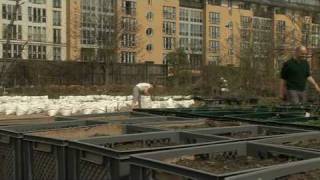
Berlin has a tradition of communal neighborhood gardens (Schraebergaerten) stretching back over 150 years. That tradition lives on in projects like the huge Prinzessinengarten (Princess Garden) in the multicultural Kreuzberg district and the Mauergarten (Wall Garden) in the shadow of the Berlin Wall. This list from Foodtank explores many similar projects...Shareable.
- foodsharing.de (in German) coordinates a network of community food fridges across the country and recruits groups of volunteers to "rescue" food which would otherwise be thrown out from willing shops and producers...Shareable.
- Prinzessinnengärten (Princess gardens, Berlin)
- Wikipedia (German), Prinzessinnengärten
See also: Urban Foraging in Germany
Community resources
[edit | edit source]
- Baumhaus (Treehouse) project space (in German) in the Wedding district is a nonprofit project and event space dedicated to creating a hub for the development of neighborhood sustainable development projects. A repair café, an improvisational orchestra, and a vertical gardening program are just a few of their initiatives.
- Leila Berlin (in German) is a thriving tool library in East Berlin that has spawned several imitators across the country. Their selection goes way beyond household carpentry tools. Need to borrow a bicycle helmet, a drill, or a set of wine glasses? Go see them...Shareable
- Little Wood
- Community Lovers Guide Berlin
Arts, sport and culture
[edit | edit source]- New neighbourhood, Moabit, non-profit association founded in 2013. "Today we are one of the largest voluntary neighborhood initiatives in Berlin. With our large rooms and our daily program, we create a social and artistic platform for exchange, learning and engagement for the neighborhood from all over the world. We don't help, we learn from each other. Our goal is to influence society, to actively shape it, to create new opportunities for non-hierarchical political and social coexistence. Our work is voluntary." added 14:56, 15 July 2021 (UTC)
- Cooperative for Urban Creativity
- Kulturlabor Trial & Error Berlin based non profit, working with crafts, D.I.Y. culture, sustainability, arts and media
See also: Community resources
Reduce, reuse, repair and recycle
[edit | edit source]- BerlinRepair, cherish, maintain, pass on, added 15:50, 30 April 2021 (UTC)
Sharing
[edit | edit source]The bustling German capital is an amazing city to visit for all sorts of reasons, but it has a lot to offer for those who are interested in cooperatives, squats, and other local sharing projects.
Köpi is a well-known squat where free alternative movie nights are organized three times a week. Discover new films and enjoy cheap drinks while meeting people and learning more about the Berlin squat scene...Shareable
See also: Food activism, Community resources, Maps
Open spaces
[edit | edit source]- gruen-berlin.de, Green infrastructure and public open spaces for Berlin. "We create open spaces and green infrastructures for a more liveable, social Berlin that is barrier-free for all people and at the same time meets its ecological responsibility as a metropolis in the 21st century." added 15:05, 15 July 2021 (UTC)
Cycling activism
[edit | edit source]

Cycling is an important part of Berlin's transport system, accounting for 18% of trips made by residents in 2023. The city's Cycling Plan defines a planned cycling network of 2,371 kilometres (1,473 mi), including an 865-kilometre (537 mi) priority network. The plan, which forms part of the framework established by the Berlin Mobility Act, aims to increase the share of trips made by bicycle to at least 23% by 2030. Following amendments to the Mobility Act in July 2026, the target for completing the priority network remained 2030, while the target for the full network was extended to 2035.
There are a number of regional and long-distance bike paths that run through Berlin. These include the Berlin-Copenhagen trail, Berlin-Usedom Cycle Route and the European Cycle Route R1. W
In 1997, Berlin-made cycle rickshaws called velotaxis were created. The tickets are about one half the cost of regular taxis. Velotaxis are three-wheeled vehicles with a "space-age lightweight plastic cab that is open on both sides", a space for a driver, and behind the driver, space for two passengers. They have been invented by Ludger Matuszewski, the founder of "Velotaxi GmbH" company. W
- bikesurf.org, bicycle sharing project
Ethical consumerism
[edit | edit source]- Original Unverpackt, zero waste store...European Green Capital
- Sustainable Berlin, information from visitberlin.de
News archive
[edit | edit source]- 7 Reasons Why Berlin is a Successful Sharing City, Shareable (Oct 06, 2017)
- Berlin's Holzmarkt Shows the Incredible Potential of Urban Villages, Aug 23, 2017...Shareable
- The Urban Common Spaces That Show Us We Belong to Something Larger, May 3, 2017...Shareable
- Berliners finally dump the car for love affair with the bicycle, Apr 26, 2017...irishtimes.com
- In Berlin, a Model for Creative and Affordable Housing, Apr 12, 2017...@yesmagazine
- Coming Soon to Berlin: Bike Superhighways, Mar 6, 2017...citylab.com
- To engage citizens in planning technology must be matched with a participatory culture, Mar, 2017...dailyplanet.climate-kic.org
Berlin pulls funds out of fossil fuel companies, Jun 23, 2016...gofossilfree.org
- Berlin 'borrowing shop' promotes the benefits of sharing, March 17, 2014...theguardian.com
- 30,000 show how fed up they are with industrial food, January 19, 2014...Agricultural and Rural Convention
- Berlin beats London and Washington DC in league table of world's best democratic space, www2.warwick.ac.uk, August 8, 2012.
- Sehr gut: Why cycling in Berlin is a dream. Wide streets, bikes in parks, cycling culture... 10 reasons why the German capital is a marvellous place to cycle, guardian.co.uk, April 22, 2010.
- Reichstag to run solely on renewable power, The Guardian, March 21, 2008.
About Berlin
[edit | edit source]Berlin is the capital and largest city of Germany. With 3.7 million inhabitants, it has the highest population within its city limits of any city in the European Union. The city is also one of the states of Germany, being the third-smallest state in the country by area. Berlin is surrounded by the state of Brandenburg, bordering Brandenburg's capital Potsdam to the southwest. The urban area of Berlin has a population of over 5 million, making it the most populous in Germany. The Berlin-Brandenburg capital region has around 6 million inhabitants and is Germany's second-largest metropolitan region after the Rhine-Ruhr region, as well as the fifth-biggest metropolitan region by GDP in the European Union.
Berlin was built along the banks of the Spree river, which flows into the Havel in the western borough of Spandau. The city includes lakes in the western and southeastern boroughs, the largest of which is Müggelsee. About 1/3 of the city's area is composed of forests, parks and gardens, rivers, canals, and lakes. First documented in the 13th century and at the crossing of two important historic trade routes, Berlin was designated the capital of the Margraviate of Brandenburg (1417–1701), Kingdom of Prussia (1701–1918), German Empire (1871–1918), Weimar Republic (1919–1933), and Nazi Germany (1933–1945). Berlin served as a scientific, artistic, and philosophical hub during the Age of Enlightenment, Neoclassicism, and the German revolutions of 1848–1849. During the Gründerzeit, an industrialization-induced economic boom triggered a rapid population increase in Berlin. Berlin in the 1920s was the third-largest city in the world by population.
- Wikitravel: Berlin, Get around
| Authors | Phil Green |
|---|---|
| License | CC-BY-SA-3.0 |
| Cite as | Philralph (2014–2025). "Community action/Berlin". Appropedia. Retrieved August 12, 2026. |