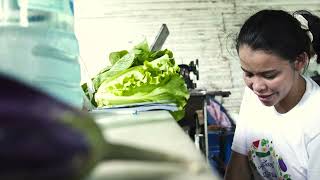
La Canasta Campesina/The Peasant Basket


La Canasta Campesina is a cooperative association made up of women and young farmers dedicated to the production and marketing of organic products such as vegetables, aromatic herbs, fruits, and eggs, in the municipality of Comasagua, department of La Libertad, El Salvador.
It is a very special cooperative, different from traditional cooperatives, because it has a fair and supportive short-circuit marketing system, as well as a production process for vegetables that is carried out under a subscription system for consumers, who are called "basket-growing friends." On the other hand, beyond marketing, consultancies are being carried out, materialized through workshops, with the purpose of sharing ancestral knowledge, and promoting a green conscience.
Mission
- La Canasta Campesina is a cooperative specializing in offering high-quality organic agricultural products through fair and supportive marketing, using a process in which producers and consumers participate, motivated by a sense of social responsibility.
Vision
- We believe that you and your family deserve to have healthy, nutritious and high-quality food on your table. We make this possible thanks to a system that promotes a fair and supportive economy, providing farmers with adequate payments and decent work.
History

The La Canasta Campesina project began on a small scale. People in the community were called upon to learn to be self-sufficient, especially in terms of their food, that is, to achieve family food sovereignty, since crops only grew during the corn and coffee seasons in the municipality of Comasagua. The cooperative was created so that the inhabitants, mostly women, could learn to plant vegetables in small plots and family gardens for their own consumption.
From the beginning, the project was successful because it worked only with the mothers of the community. The women farmers did very well and began to have surpluses of their products. Later, it was these same women who began to organize themselves, forming a union of people, which is a legal entity in the country, to try to market the vegetables they grew in a more orderly manner. Marketing began thanks to one of the largest partners of La Canasta, the French Lyceum, since the association worked with funds from the European Union and mainly from France. Parents and teachers from the French Lyceum were asked if they were interested in buying the surplus products from the basket, they agreed, and that is how the distribution of 37 weekly baskets to the affiliated people began.
Over time, this situation improved, more vegetables began to be planted, more people signed up, and the product began to be distributed to some embassies. Three years ago, La Canasta Campesina opted for other lines of growth within the cooperative, such as giving workshops on agroecology and selling pesticide-free inputs; people began to ask for bocashi, compost, organic fertilizers, etc., to grow their own vegetables. The cooperative grew little by little, and currently 500 baskets are being sold per month.
What is the day-to-day life of the cooperative like?

On Wednesdays, all products are collected from farmers who are members of La Canasta Campesina. At 12 noon, the produce is taken to the La Canasta facilities. At this point, the colleagues in the offices have already cleaned and arranged the baskets for the placement of the vegetables. There are products that have already been previously washed and selected. When the vegetables arrive at the offices, there is a record sheet of all the orders that indicate, for example, if three güisquiles are going to be placed in the small basket, four in the medium one, or five in the large one; the quantity will depend on the orders of that week.
Each basket contains 12 to 14 different products, including the famous love eggs. The product that is a good size is selected and then the packaging is done; starting with the heaviest products and then the smallest ones. The next day, the aromatic herbs are placed, the baskets are tied and the name of the basket-making friend is placed on them. There are many baskets that are special, due to the health conditions of the consumer. What is done in this case is that the products vary and are changed depending on what the affiliate establishes. On Thursday, at eight thirty in the morning, the collection center in Comasagua is left for the different delivery points in Santa Tecla and San Salvador. On Friday, the local sale takes place in the community, and on Saturday, the agricultural market is held.
What makes La Canasta Campesina special?
Their value propositions. Since the cooperative was founded, it has sought to generate an impact within the communities. The second is the productive and ecological part; that is, the organic production of fruits and vegetables; the third is climate action together with care for the environment; and finally, there is the food sovereignty of the people who interact with La Canasta; which are small families that are within the communities, cantons, hamlets, etc.
Another differentiating element of the cooperative is the inclusion of women so that they can play a leadership role in the actions of La Canasta. On the other hand, young people, who are sons and daughters of the farmers, have also been included; they participate in the different activities carried out by the cooperative.
One of the principles of the value proposition offered by La Canasta is marketing, through a fair and supportive short-circuit system; this allows the farmer to produce within her land, grow the products autonomously and then market them directly to the consumer; who is a person who forms an alliance with the cooperative in the short, medium or long term.

What is the success of this cooperative?
The success of La Canasta Campesina lies in the inclusion of women in the project. The cooperative seeks to raise awareness among the population about how women also have all the capabilities and attitudes to do something for themselves. Comasagua is a municipality with deep-rooted machismo, which is why it is important to encourage women's participation in agroecology.
Another value that gives the basket an element of success is the social value. It has been women, mothers, together with young people, who have joined together to form a cooperative.
On the marketing side, the highest value sought is to get a low-income family to become farmers, so that they can earn a higher income and find that sense of belonging to the community. The Canasta Campesina is not a personal profit but a common project that seeks to help the members of the cooperative grow as people. Income is important but it is also intended that being part of the cooperative adds certain family values that are materialized through actions such as: that the children of the farmers go to school, that there is health in the families, that the conditions of their homes improve, that they have all the basic services covered, etc.
How has the work of La Canasta Campesina evolved with access to new digital tools?
The inclusion of technological tools in La Canasta's activities was somewhat complex because most of the farmers did not have much knowledge about it. However, in response to this situation, workshops have been held so that they can learn to use technological tools in their crops.
Initially, the La Canasta Campesina project included technological investment in its work plan so that families would not only produce on small plots but also in Mayan houses or greenhouses. The cooperative began working with 13 Mayan houses, one of which specialized in the manufacture of seedlings, that is, plastic trays where seeds are placed and small plants grow; these seedlings were then moved to closed spaces or open plots. Inside the Mayan houses, atmospheric control systems with sprinklers have evolved, which is a system placed on the roof that pours sifted water on the plants during peak hours of high temperatures so that the plant remains as cool as possible.
On the other hand, marketing applications have been created, the basket makes use of Ecommerce to sell its products online.
Female farmers also have an application for the effective treatment of plant diseases and pathologies.
A system is being worked on to manage all the information held by the cooperative, as this is one of the shortcomings that the cooperative has had over the time it has existed, so that the information collected in a conventional way can be found in a cloud.
In addition, an ecotourism app is planned to be created to locate all the local entrepreneurs in Comasagua and other nearby municipalities to give tourists an option. La Canasta Campesina is venturing into ecotourism, thanks to the eco farm, the plots that are worked and the Comasagua rock; a great attraction in the municipality. They want to put all these elements in the application and have it reach people, soup kitchens, restaurants, etc. With this, it is hoped that tourist visits will increase.
Grassroots Environmental Solutions identified in La Canasta Campesina
- La Canasta Campesina vegetable distribution system.
- Organic agriculture and short-circuit model.
- Green Consciousness Project .
- Eco-farm.