


Rodeostat:FAST

Safety Training Requirements
[edit | edit source]- Dr. Pearce Safety Lab Tour
- Worker Health & Safety Awareness
- WHMIS 2015 - Workplace Hazardous Materials Information System
- Laboratory Safety & Hazardous Waste Management
Rodeostat[1]
[edit | edit source]- TEB7
- IO Rodeo
- Controlled via USB/Serial and a Python library, which allows for continuous data collecting during tests. It can be programmed using the Arduino IDE via the Teensy 3.2 microcontroller
- Current measurement ranges: +/- 1, 10, 100, 1000uA
- Output voltage ranges: +/- 1, 2, 5, 10V
- https://iorodeo.com/products/rodeostat
Operation & Procedure
[edit | edit source]The instrument works in two ways:
1- Web-based application
The web-based application is straightforward to use.
- Download and install Serialport-bridge software from iorodeo.
- After running the Serialport-bridge software, open the web-app software from iorodeo.
- Disable "Block insecure private network requests" in Chrome (via chrome://flags/#block-insecure-private-network-requests) to allow communication between the Serialport-bridge and the web app.
- Restart Chrome after changing the setting.
- Three main pages through navigation bar are available:
- Device Connection:
- Serialport-bridge Host Default Address is localhost: 5000
- Connect to the Serialport-bridge.
- Select the name of USB/Serial Port in your computer
- Activate the "open serial port" switch
- Test & Parameters:
- Select a test.
- Set desired test parameters.
- Data Acquisition:
- Run the selected voltammetric test.
- Plot the resulting test data.
- Option to save data to file or upload to Plotly.
- Device Connection:
2- Python library
For the Python library on Windows, follow these steps:
- Insert the USB cable into your computer.
- Run the code provided in the Github repository
- Before testing the battery, use a dummy cell to calibrate the instrument. Use the calibration code available on Github. The figure displayed after running the code should resemble the example shown in Figure 1.

Fig 1. calibration: cyclic voltammetry with a 50K dummy cell - It is taped on top of the device (Figure 2).
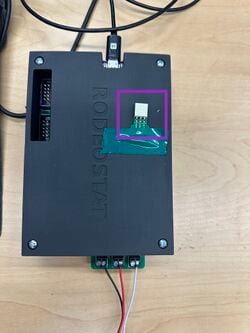
Fig 2. Dummy cell - After calibration, use the battery holder which is a 3D-printed clip to connect the battery to the device. The battery should be placed between two washers, as shown in Figure 3.
- Connect the alligator clip attached to the Rodeostat to the battery. The working electrode alligator clip should be connected to the electrode you are testing (e.g., a 3D-printed anode). The other side of the battery serves as both the counter electrode and working electrode; attach the alligator clip to the wire coming from this side (Figure 3).


Important Note:
The current range of the device is limited to '1 µA', '10 µA', '100 µA', and '1000 µA'. The internal resistance of the device is basically determined by the digitally controlled analog switches used to connect or disconnect the electrodes, and the on-state resistance (Ron) of these switches is quite low. If you don't use an appropriate resistance, the device will become saturated and won’t function properly.
To prevent saturation and keep the current draw within a reasonable range, you need to place a correctly sized resistor in series with the battery cell (Figure 3). To calculate the necessary resistance, use Ohm's law:
V=IR, where V is the voltage between the CTR/REF and WRK electrodes, I is the desired current (limited to the device current range), and R is the resistance that should be used in series with the battery cell.
For example, if the voltage between the CTR/REF and WRK electrodes is 3V and you want to limit the current draw to less than 90 µA, you would need a 33kΩ resistor in series with the battery.

- Once everything is set up, the Rodeostat is ready to run (Figure 4).
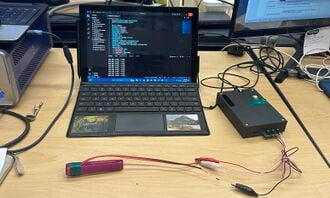
Fig 4. Assembled Rodeostat

References
[edit | edit source]- ↑ von Zuben, T.W., Salles, A.G., Bonacin, J.A. (2024) Low-cost open-source potentiostats: A comprehensive review of DIY solutions and fundamental concepts of electronics and its integration with electrochemistry. Electrochimica Acta, Volume 498, 2024, 144619. https://doi.org/10.1016/j.electacta.2024.144619. Pandiyaraj Kanagavalli, Chrysanthus Andrew, Kannadasan Anand Babu, Mani Jayakumar, Murugan Veerapandian (2023) Label-free genosensing of dengue serotypes with an electrodeposited reduced graphene oxide-tris(bipyridine)ruthenium(II). International Journal of Biological Macromolecules, Volume 253, Part 2. https://www.sciencedirect.com/science/article/pii/S0141813023036437 Jain, T, Tantisuwanno, C, Paul, A, et al. (2023) Accelerated in vitro oxidative degradation testing of polypropylene surgical mesh. J Biomed Mater Res. 2023; 111(12): 2064-2076. doi:10.1002/jbm.b.35308 Yasser GadelHak, Sarah H.M. Hafez, Hamdy F.M. Mohamed, E.E. Abdel-Hady, Rehab Mahmoud (2023) Nanomaterials-modified disposable electrodes and portable electrochemical systems for heavy metals detection in wastewater streams: A review. Microchemical Journal, Volume 193, 2023, 109043. https://www.sciencedirect.com/science/article/pii/S0026265X23006628 Bullen JC, Dworsky LN, Eikelboom M, Carriere M, Alvarez A, Salaün P (2022) Low-cost electrochemical detection of arsenic in the groundwater of Guanajuato state, central Mexico using an open-source potentiostat. PLoS ONE 17(1): e0262124. https://journals.plos.org/plosone/article?id=10.1371/journal.pone.0262124 Fatoni A, Widanarto W, Anggraeni MD, Dwiasi DW (2022) Glucose biosensor based on activated carbon – NiFe2O4 nanoparticles composite modified carbon paste electrode Results in Chemistry, Volume 4, 100433 https://www.sciencedirect.com/science/article/pii/S2211715622001527 Ioannou K, Eleftheriou C, Drouza C, Pafiti KS, Panayi T, Keramidas AD, Zacharia LC, Vlasiou MC (2022) Novel Zinc and Vanadium (V) Hydroquinonate Complexes: Synthesis and Biological Solution Evaluation. Journal of Molecular Structure, Volume 1257, 132582. https://doi.org/10.1016/j.molstruc.2022.132582. Bogoslowski S, Geng F, Gao Z, Rajabzadeh AR, Srinivasan S (2021) Integrated Thinking - A Cross-Disciplinary Project-Based Engineering Education. In: Auer, M.E., Centea, D. (eds) Visions and Concepts for Education 4.0. ICBL 2020. Advances in Intelligent Systems and Computing, vol 1314. Springer, Cham. https://doi.org/10.1007/978-3-030-67209-6_28 Fatoni A, Wijonarko A, Anggraeni MD, Hermawan D, Diastuti H, Zusfahair (2021) Alginate NiFe2O4 Nanoparticles Cryogel for Electrochemical Glucose Biosensor Development. Gels. 2021 Dec 17;7(4):272. https://www.ncbi.nlm.nih.gov/pmc/articles/PMC8701366/ Guillem P, Bustos RH, Garzon V, Munoz A, Juez G (2021) A low-cost electrochemical biosensor platform for C-reactive protein detection. Sensing and Bio-Sensing Research 31 (2021) 100402. https://doi.org/10.1016/j.sbsr.2021.100402 Hardi GW and Rahman SF (2021) Enhancing the sensitivity of dopamine biosensor using PEDOT-PSS modified glassy carbon electrode. AIP Conference Proceedings2344, 020003 (2021); https://doi.org/10.1063/5.0047170 Kandahari E, Smith EJ, Goeltz JC (2021) Beyond the Textbook: Introducing Undergraduates to Practical Electrochemistry. Journal of Chemical Education 98 (10), 3263-3268. https://doi.org/10.1021/acs.jchemed.1c00155 Karlovits, I., Kavčič, U., Trafela, Š., and Žužek Rozman, K. (2021) Comparison of cyclic voltammetry measurements of paper-based screen printed electrodes viaproprietary and open source potentiostats. BioResources 16(2), 3916-3933. https://ojs.cnr.ncsu.edu/index.php/BioRes/article/view/BioRes_16_2_3916_Karlovits_Cyclic_Voltammetry_Measurements Sibug-Torres, S.M.; Go, L.P.; Castillo, V.C.G., Pauco, J.L.R., Enriquez, E.P. (2020). Fully integrated 3D-printed electrochemical cell with a modified inkjet-printed Ag electrode for voltammetric nitrate analysis. Analytica Chimica Acta, Volume 1160, 2021, 338430. https://doi.org/10.1016/j.aca.2021.338430. Kumar, Lokesh S., Indirajith, P., & Tetala, Kishore K.R. (2020). Onion based zinc oxide nanoparticles ability as electrochemical sensor. Indian Journal of Chemistry Section A: Inorganic, Bio-inorganic, Physical, Theoretical and Analytical Chemistry, 59A(8), 1100-1107. https://inis.iaea.org/search/search.aspx?orig_q=RN:51106284 Sibug-Torres, S.M.; Go, L.P.; Enriquez, E.P. (2020). Fabrication of a 3D-Printed Porous Junction for Ag|AgCl|gel-KCl Reference Electrode. Chemosensors 2020, 8, 130. https://doi.org/10.3390/chemosensors8040130. https://www.mdpi.com/922642 Umar, Siti Nur Hanisah & Akhtar, M. Nishat & Elmi, A.B. & Kamaruddin, Noorfazreena & Othman, Abdul. (2020). Development of Heavy Metal Potentiostat for Batik Industry. Applied Sciences. 10. https://www.researchgate.net/publication/348575707_Development_of_Heavy_Metal_Potentiostat_for_Batik_Industry Matthew G. Street, Cristin G. Welle, and Pavel A. Takmakov (2018). Automated reactive accelerated aging for rapid in vitro evaluation of neural implant performance. Review of Scientific Instruments 89, 094301. https://aip.scitation.org/doi/10.1063/1.5024686
| License | CC-BY-SA-4.0 |
|---|---|
| Organizations | FAST |
| Cite as | Maryam Mottaghi (2024). "Rodeostat:FAST". Appropedia. Retrieved October 20, 2026. |