


NREMT Skillset/Airway Patency Assessment

| Subskill of | Penetrating Chest Trauma |
|---|---|
| Acting roles | EMR emergency medical responder EMT emergency medical technician paramedic |
| Pathologies | compromised airway |
| Body systems | respiratory system |
| Body parts | head |
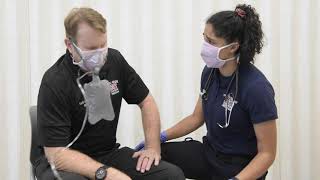

Airway patency may be assessed in several ways by the EMT. Most commonly, adventitious (abnormal) sounds and compliance with ventilatory techniques are used to determine patency of the airway from a BLS standpoint. A quick assessment may performed with the naked ear, but a stethoscope should be utilized to listen to tracheal sounds and lung sounds.
Adventitious sounds:
- Gurgling: Indicates fluid obstruction in the airway. Commonly associated with blood, vomit, or saliva. Control airway with suctioning.
- Stridor: Indicates upper airway constriction. Commonly associated with pediatric respiratory infection. Control may require ALS intervention and medications.
- Snoring: Indicates physical obstruction of the airway. Commonly associated with tongue obstruction or increased pressure due to excess adipose tissue. Control airway with head-tilt chin lift or jaw thrust. NPA and/or OPA insertion may help keep the tongue out of the way in the future.
- Wheezing: Indicates lower airway constriction. Commonly associated with restrictive airway diseases such as COPD and Asthma. If wheezing can be heard without the need for a stethoscope, patient requires rapid ALS intervention.
Compliance describes the ease with which positive pressure ventilations are delivered to the patient via bag valve mask. Poor compliance may indicate dislodgement of an endotracheal tube, spontaneous respiration, poorly positioned or non-patent airway, or potentially pneumothorax.
Self Assessment
[edit | edit source]
Tips and Tricks
[edit | edit source]- When first assessing the patient, their voice can tell a responder a lot about a person's airway patency. A patient loudly complaining of shortness of breath has a patent airway while a patient with a hoarse, quiet voice may be at risk of airway compromise.
References
[edit | edit source]National CPR Association Infant/Pediatric CPR Study Guide
| Authors | GSTC |
|---|---|
| License | CC-BY-SA-4.0 |
| Cite as | GSTC (2020–2026). "NREMT Skillset/Airway Patency Assessment". Appropedia. Retrieved October 17, 2026. |