


Vibration Dampener (MOST Delta: Athena)


| Authors | John J. Laureto |
|---|
This vibrational dampener was designed to reduce the vibrational noise of the MOST Delta - Athena during printing. This is achieved by reducing the motor-end contact area with the table / desk and provides a "spring" like action. Most notable differences will be seen on non-rigid tables / desks.
Design and Printing
[edit | edit source]
Design
[edit | edit source]OpenSCAD was utilized for all modeling operations. The MOST-Athena GitHub file repository is located here. The motor-end assembly was imported into OpenSCAD and the part was designed to accommodate the geometrical constraints of the parts provided to MY4777.
Printing
[edit | edit source]The stiffness of the component is driven by the infill percentage. Adjust as necessary to achieve your desired characteristics.
Print Parameters Utilized:
- Layer Thickness: 0.2mm
- Skin Thickness: 1.0mm
- Top/Bottom Thickness: 0.5mm
- Temperature: 180C
- Speed: 80mm/s (60mm/s outer contour)
- Flow: 100%
- Infill: 50%
Installation
[edit | edit source]The model is designed to snap fit onto the bottom of the motors ends. Print out qty. 3 of the STL and install as shown below.
-
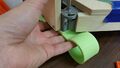 Placement. *Note: You may have to invert the printer to apply enough pressure.
 -
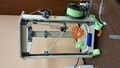 Fully Installed.


Link to Files
[edit | edit source]The file repository is located on Thingiverse thing:1809228
Other Sound Dampening Techniques
[edit | edit source]- The default U,V,W motor acceleration is 4000mm/s. You can uniformly decrease this to any lesser value to quiet the quick movements of the motors / bearings.
- Utilizing a heavy weight grease on the guide rods seems to reduce the vibrations of the quick bearing movements.
See also
[edit | edit source]| License | CC-BY-SA-3.0 |
|---|---|
| Cite as | John J. Laureto (2016–2025). "Vibration Dampener (MOST Delta: Athena)". Appropedia. Retrieved October 19, 2026. |