


TissueDB/Simulators/Peripheral Intravenous Catheterization Trainer

The Peripheral Intravenous Catheterization Trainer, commonly known as the Caboodle Noodle 2.0, is a low-cost task trainer, built from inexpensive and readily available materials, for practicing peripheral intravenous cannulation (PIVC).[1] The trainer uses a pool noodle section as its base, IV extension tubing as a simulated vein, multipurpose sealing wrap as a subcutaneous tissue layer, and tattoo practice skin as the puncture surface. A gravity-fed IVPB bag provides fluid for flashback confirmation when the catheter enters the tubing lumen. The skin layer can be replaced when it wears, and each learner can have a dedicated trainer.
Not to be confused with: The original Caboodle Noodle (NLN HomeGrown Solutions), which is a separate removal-skills trainer for sutures, staples, saline locks, and Stat locks — it does not include IV insertion capability.
| Field | Details |
|---|---|
| Features and Basic Operation | Learners palpate the simulated vein through the skin and wrap, insert an IV catheter into the tubing, confirm entry by fluid flashback, then advance the catheter. The catheter is removed and the site reused; the skin layer is replaced when it wears, and each learner can have a dedicated trainer. |
| Current Development Status | Third-party built and tested; not yet formally validated |
| Estimated Build Time and Cost | ~$20 ~20 minutes (estimated; the source gives no build time) |
| Specialized Tools and Equipment | None (built with ordinary household items — a stapler and a cutting tool, both named in the build steps). |
| Version | Version 1 |
| Development Team Contact Information | Stephanie McKee — NLN SIRC HomeGrown Solutions (National League for Nursing); build and practice videos by Tomas Amadeo (Intuitive Foundation, 2026); test build by Patrick Diamond (Intuitive Foundation, March–April 2026) |
Tissues
| Tissue | Qty | Material | Cost | Notes |
|---|---|---|---|---|
| Blood vessel (superficial vein) | 1 length | IV extension tubing (secondary IV tubing) | $5 | Patent lumen; carries the flashback fluid. |
| Subcutaneous tissue | Enough to cover the whole noodle | Multipurpose sealing wrap (Glad Press'n Seal or equivalent) | $5 | Palpable layer over the simulated vein. |
| Skin (epidermis) | 1 sheet | Tattoo practice skin (tattoo practice pad) | $15 | Puncture surface; consumable. |
| Blood (simulated) | Enough to prime the tubing and bag | Normal saline or sterile water, with optional red food coloring | $5 | Flashback fluid for the simulated vein. |
| Limb | 1 | Pool noodle | The base of the trainer, under the IV tubing that mimics the vein and the tattoo skin. |
Structural Parts
| Part Name | Qty | Material | Cost | Notes |
|---|---|---|---|---|
| IV fluid bag (IVPB) | 1 bag, any size | IVPB bag (any size) | $5 | Gravity-fed fluid reservoir. |
| Staples | 6–10 | Office staples | $1 | Skin retention. |
Consumables
| Consumable | Quantity | Material | Approximate Cost | Notes |
|---|---|---|---|---|
| IV catheter | 1 per attempt | Peripheral IV catheter | $3 | Consumable. |
Build Instructions
Phase 1: Pool Noodle Preparation
[edit source]Step 1: Cut the pool noodle into a section about 30 cm (12 in) long.

Step 2: Inspect the cut surface for straightness and uniformity. Proceed if the cut is reasonably straight and even; if irregular, re-cut.
Phase 2: Vein and Tissue Layer Assembly
[edit source]Step 1: Prime the IV extension tubing with normal saline or sterile water (add a little red food colouring first if you want a visible flashback). Clamp the distal end after priming.

Step 2: Lay the primed tubing along the longitudinal surface of the pool noodle in a straight path.
Step 3: Wrap the tubing and noodle with multipurpose sealing wrap, covering the whole noodle; the wrap is self-adhering. This secures the tubing in position and creates a palpable tissue layer.
Step 4: Position a sheet of tattoo practice skin over the wrapped noodle surface, centered over the tubing.
Step 5: Staple the tattoo skin in place, making sure it covers the IV tubing.

Step 6: Verify the assembly by palpating the trainer surface: the IV tubing should be detectable as a linear, slightly firm structure running through the tissue layers. If the tubing is hard to feel, use less wrap; if its surface feels exposed, add a little more.
Phase 3: Fluid System Assembly
[edit source]Step 1: Connect the primed IV extension tubing to the IVPB bag, which the source says can be any size.
Step 2: Hang the IVPB bag on an IV pole or hook above the trainer so it gravity-feeds the tubing.
Step 3: Unclamp the distal tubing end and verify fluid flows freely through the system. If flow is absent, check for kinks, reprime the bag, or check the adapter connection.
Video resources
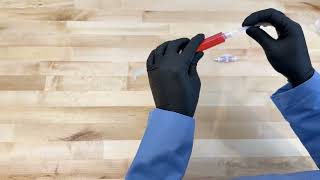
Build walkthrough.

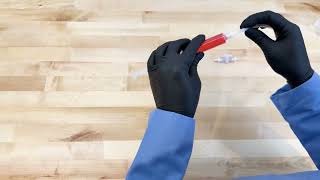
Completed-build demonstration.
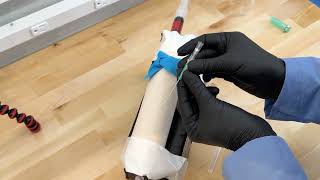
Procedure demonstration.
Phase 4: Final Testing
[edit source]Step 1: Insert an IV catheter through the tattoo skin and sealing wrap into the tubing at a shallow angle.

Step 2: Observe the catheter hub for fluid flashback. Colour change (if food colouring was added) or rapid filling of clear saline confirms successful entry.
Step 3: Advance the catheter off the needle into the tubing using the over-the-needle technique.
Step 4: Flush the catheter with saline to confirm patency and seal integrity. Free flushing indicates successful cannulation. If any test fails: verify the IVPB bag height, check for tubing kinks or air locks, and confirm the tattoo-skin puncture has not sealed around the tubing.
Step 5: Remove the catheter and press on the puncture site; the sealing wrap helps limit leaking, and the trainer can be reused for the next attempt.
References
- ↑ Stephanie McKee. "Caboodle Noodle 2.0." NLN SIRC HomeGrown Solutions (Solution 394). National League for Nursing / INACSL. NLN website (retrieved 27 July 2026). Not indexed in PubMed; primary source linked directly.
Sources consulted for this page but not cited at a specific claim:
- Stephanie McKee. "Caboodle Noodle." NLN SIRC HomeGrown Solutions. National League for Nursing / INACSL. NLN website.
- Arslan S, et al. "Effectiveness of simulation-based peripheral intravenous catheterization training for nursing students and hospital nurses: A systematic review and meta-analysis." Journal of Clinical Nursing. 2022. PMID 34258809. doi:10.1111/jocn.15960.
- de Souza LC, et al. "Effect of rapid cycle deliberate practice in peripheral intravenous catheters insertion training: A simulation experimental study." Nurse Education in Practice. 2023. PMID 37544240. doi:10.1016/j.nepr.2023.103734.
| Alternative names | Caboodle Noodle 2.0 Caboodle Noodle IV Caboodle Noodle IV Simulator NLN HomeGrown Solution (IV Insertion) Pool Noodle IV Trainer DIY IV Insertion Trainer Low-Cost PIVC Trainer Pool Noodle Venipuncture Trainer Caboodle Noodle NLN SIRC IV Trainer IV Cannulation Arm NLN Solution 394 NLN HomeGrown Solution 394 |
|---|
| Authors | Arturo Pelayo |
|---|---|
| License | CC-BY-SA-4.0 |
| Cite as | Arturo Pelayo (2026). "TissueDB/Simulators/Peripheral Intravenous Catheterization Trainer". Appropedia. Retrieved October 14, 2026. |