


NREMT Skillset/SpO2 Measurement Pulse Oximetry

| Subskill of | CPAP (Continuous Positive Airway Pressure) Administration |
|---|---|
| Acting roles | EMR EMT emergency medical responder emergency medical technician paramedic |
| Pathologies | hypoxia |
| Body systems | respiratory system |
| Body parts | hands upper extremities |
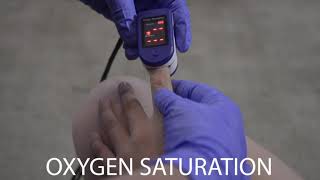

Oxygen Saturation (SpO2)
[edit | edit source]A patient's peripheral blood Oxygen saturation, or SPO2 can be measured via a pulse oximeter which is a noninvasive means of measuring both pulse rate and the arterial oxygen saturation of hemoglobin at the peripheral capillary level. It consists of a portable monitor and a photoelectric sensing probe that clips onto the patient's finger, toe or earlobe. The sensing probe measures the amount of red and infrared light being absorbed as blood flows through the capillary beds allowing a ratio of oxyhemoglobin to deoxyhemoglobin and therefore the peripheral oxygen saturation percentage (SpO2) to be calculated. As the total absorption fluctuates with the pulse, the monitor calculates the time between the peaks of light absorption and displays a pulse rate in beats per minute. A SPO2 reading below 89% could mean there isn't enough oxygen in the blood to meet the body's needs. The following are situations that may alter the reading:
- Nail polish
- Cold fingers
- Poor peripheral circulation at baseline or secondary to shock
- Darkly pigmented skin (in a recent study it was found that hypoxia is missed in 12% of Black patients and approximately 4% of white patients[1])
Alternate sites such as the toes or earlobe may be tried if the fingers are either injured, or suspected of giving an erroneous reading secondary to peripheral perfusion. In darkly pigmented patients, do not overly rely on an apparently normal pulse oximetry reading if the patient's other clinical signs indicate respiratory insufficiency.
References
[edit | edit source]- ↑ December 17, 2020 N Engl J Med 2020; 383:2477-2478 DOI: 10.1056/NEJMc2029240
| Authors | GSTC |
|---|---|
| License | CC-BY-SA-4.0 |
| Cite as | GSTC (2020–2026). "NREMT Skillset/SpO2 Measurement Pulse Oximetry". Appropedia. Retrieved October 18, 2026. |