


CSU Research Competition 2025 Physical and Mathematical Sciences trophy

| Type | Trophy |
|---|---|
| Authors | 47.208.134.128 Derek Gomez Aiden Higgins Miaka LaRose |
| Location | Arcata, California, United States |
| Environment | Classroom |
| Status | Deployed |
| Made | Yes |
| Replicated | No |
| Uses | education, science, felicitations |
ENGR 205 Physical Sciences and Mathematics Trophy created by team MIAD FALL 2024. This project is for Cal Poly Humboldt for the Engineering class 205. It is to create trophies for the CSU research Competition. This is for the users of the trophies to have a larger understanding of their trophies and maintenance.
Background
[edit | edit source]In 1985 the California State University Research Competition was created to bring forth ideas from numerous categories across the state every year. April 2025 marks the 39th year the competition takes place with the location being Cal Poly Humboldt. To celebrate the first ever hosting of the research competition Cal Poly Humboldt became dedicated to creating unique trophies for each category with the involvement of its students from the engineering department.
Problem statement
[edit | edit source]The objective of this project is to design and create two functioning egg of Columbus based trophies for the Physical and Mathematical Sciences category, they are to be presented to the 39th annual CSU research competition winners in this category.
Criteria
[edit | edit source]-Below resides a list of our criteria weighed in order from most important to least important
| Criteria | Description | Weight (1-10) |
|---|---|---|
| Cost | No more then $500 is spent on the product ($75 from each team member and $200 from the client) | 10 |
| Construction | Durability, portability, and safety of the trophie | 9 |
| Aestetics | Is one of the focal points in the room its placed in | 8 |
| Interactability | Easy to use with low maintenance cost | 7 |
| Represent CPH | Represents Cal Poly Humboldt as a school as well as the capabilities of our school | 7 |
| TSA Guidelines | Passes TSA guidelines with no hiccups | 7 |
Prototyping
[edit | edit source]- Prototyping Gallery
-
-
-
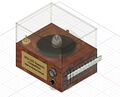 corner view from above showcases rotating surface and objects as well as acrylic shield.
 -
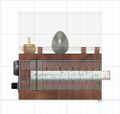 Trophy Side view showcases slide-rule.
 -
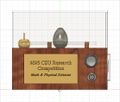 Trophy front view, showcases plaque, switches and overall aesthetics.
 -
 Comparison of stains and finishes on scrap redwood.
 -
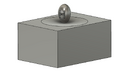
-
 Miaka LaRose Egg of Columbus CAD model
 -
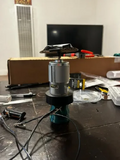 Functionality prototype of spinning magnetic fields.


Final product
[edit | edit source]-
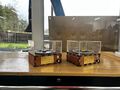 front view of both trophies
 -
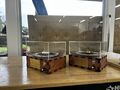 alternate front view of both trophies
 -
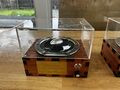 front view of trophy with aluminum egg in dish
 -
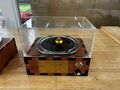 alternate object, gold flip over top
 -
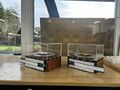 Rear view of both boxes demonstrating the sliding scales on our slide rules
 -
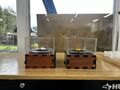 side view of our boxes, the right shows the screws that can be removed to replace batteries the left shows the non removeable box cap.


Construction
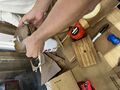
[edit | edit source]Parts of the construction process consisted of laser cutting to find the perfect dimensions for our trophy housing. Instead of using a copper coil design to create magnetic field we decided that we will be using a magnet and motor for similar results and easier design. We also conducted a test on wood conditioners for the best cosmetic appearance. For the housing of the trophy the type of wood we picked to use was redwood to represent Humboldt County and because of its distinct color.
-
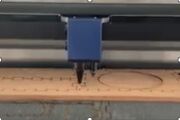 Laser cutting machine cutting box sides for our box
 -
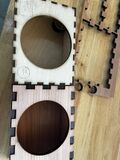 Red wood and prototype boxes side by side.


Video instructions
[edit | edit source]A good way to display a process is by making a video explaining your process. See Template:Video for information on how to add and annotate videos.

Bill of materials
[edit | edit source]Description of costs, donations, the fact that this is just proposed, etc. For a simple cost table, see Help:Table examples#Cost Table and Template:Bill of materials for two nice formats.
| Item | Amount | Cost per unit | Total |
|---|---|---|---|
| Redwood — Get at | 1 | USD 65.00 | USD 65.00 |
| Acrylic Sheets | 2 | USD 8.00 | USD 16.00 |
| Egg of Columbus | 2 | USD 50.00 | USD 100.00 |
| Brass | 2 | USD 8.00 | USD 16.00 |
| 19mm Latching Pushbutton | 2 | USD 10.00 | USD 20.00 |
| LED strips | 1 | USD 10.00 | USD 10.00 |
| Battery Holder | 1 | USD 7.00 | USD 7.00 |
| Magnet Assortment | 1 | USD 6.00 | USD 6.00 |
| Grand total | USD 240EUR 206.40 <br />GBP 175.20 <br />CAD 297.60 <br />MXN 5,004.00 <br />INR 17,964.00 <br /> | ||
Operation
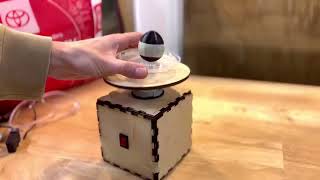
[edit | edit source]The operation of this trophy is designed to be intuitive and affirming for the user. the Trophy contains a push-button switch and a rotary dial switch and a choice of two objects to spin, an aluminum egg and a 'flip-over' spinning top.

Locate the Main On/Off push-button on the front of the trophy and depress it with one finger until it clicks into the ON position.

Locate the rotary dial on the trophy after it has been turned on and slowly increase or decrease the speed until an ideal frequency has been achieved causing the egg to increase velocity steadily, once the egg or spinning top is moving the dial can again be increased to achieve rotation on the vertical axis of either object. The Dial should be increased until the object is rotating at the steadiest rate with the least amount of horizontal movement.
Maintenance
[edit | edit source]Must remove and insert batteries within the machine. Batteries last around 5-10 hours in high drain situations. Overall the user should replace them once a month.
The user should also clean the device buy dusting once a week. Thanks to the acrylic shield it gets dusty less often then other trophies.
Maintenance schedule
[edit | edit source]This is when to maintain what. Please keep the format the same as it populates the kiosk in CCAT.
- No Work necessary
- Weekly
- Dust once a week
- Monthly
- Replace batteries
Conclusion
[edit | edit source]Testing results
[edit | edit source]Describe the testing results.
The test Columbus egg was able to stand up on a plate on its own when held at the right distance from the spinning magnetic plate.
Neodymium magnets were much more effective for producing Eddie currents compared to ceramic magnets.
When testing different motors we learned that the RPM had to be significantly higher to create Eddie currents than the motor we used for our initial prototypes.
The laser cutter could only cut wood up to 3/8ths of an inch thick before excessive passes were needed to cut through it, our final conclusion for cutting speed was 2.6% speed with 100% power and 4 passes to cleanly cut the redwood boards.
Discussion
[edit | edit source]Discuss the testing results.
When holding a plate with a resting plastic egg with magnets inside you are able to lift an egg laying sideways at rest into an upright position. If the egg place is held too far the rotating magnetic disk will not receive enough force to lift. Likewise if the egg plate is held too closely to the rotating magnetic disk it will cause the egg to fly off the plate.
Neodymium magnets were attached to a round fixture plate and spun with a brushless motor at the full speed at low voltage (1.5V) , roughly 500 rpm and the previously mentioned plate was hovered above the fixture plate. The same procedure was done with neodymium magnets. Ceramic magnets had little to no effect on the egg however the neodymium magnets allowed the washer to temporarily enter into a eddie current induced rotation.
Once we were able to test rotation with a smaller higher rpm motor we saw a significantly stronger reaction to the magnets eddie current at a higher speed.
The laser cutter we used to cut out our boxes is a CO2 laser and therefore ideally to be used for thin materials so when approaching a material like our thick redwood board we chose to test first with 3/8ths of an inch plywood to estimate settings and then dial them in as we developed prototypes.
Lessons learned
[edit | edit source]Discuss lessons were learned during this project and what you would do different next time.
During the research and experimenting of the Columbus egg, as a team we discovered that applying the concept sounds more difficult than it was. We learned that the speed of the spinning magnetic plate was not fast enough as well as the magnets need to be more strong. We also learned being able to adjust the speed allowed for a better demonstration of the eddie currents and their effects. Additionally we learned to set goals that were achievable based on our situation and capabilities and we learned to work well together as a team.
If we were to revisit this project we ideally would spend less time brainstorming and spend more time prototyping and building the final product. The more time there is to revisit issues or components the better the final project will be. The trophies were build according to plan the entire way through but some components had less reiterations and could be improved upon.
Next steps
[edit | edit source]Discuss any next steps for the project as it goes on into the future.
The next step is delivering the trophies to the Mathematical and Physical Science CSU student research competitions winners in 2025, there is no further required research or testing needed.
Troubleshooting
[edit | edit source]| Problem | Suggestion |
|---|---|
| Slow or complete
Lack of rotation |
Check that batteries are charged and the rotary switch is turned to a sufficient speed |
| Does not turn on | Verify batteries are charged and correctly installed, and that the power button is depressed |
| Object rotates sparadically | Increase or Decrease Rotational velocity with rotary switch until movement stabalizes |
Team
[edit | edit source]- Ibrahim Alyassiry
- Derek Gomez
- Aiden Higgins
- Miaka LaRose
References
[edit | edit source]
| Authors | Ibrahim Alyassiry, Derek Gomez, Aiden Higgins, Miaka LaRose |
|---|---|
| License | CC-BY-SA-4.0 |
| Organizations | Cal Poly Humboldt |
| Cite as | Ibrahim Alyassiry, Derek Gomez, Aiden Higgins, Miaka LaRose (2024–2026). "CSU Research Competition 2025 Physical and Mathematical Sciences trophy". Appropedia. Retrieved October 22, 2026. |