


TissueDB/Simulators/Patent Ductus Arteriosus Ligation Simulator

The Patent Ductus Arteriosus Ligation Simulator is a low-cost trainer for closing a patent ductus arteriosus (PDA) in an infant by surgical ligation through a left thoracotomy.
| Field | Details |
|---|---|
| Features and Basic Operation | The box gives three levels of sensor feedback: a colour-coded LED that grades the traction applied to the model and peaks red when the force is hazardous; a continuous 0–9 digit display recorded by the phone camera; and a final 0–9 score at the end of the exercise. A companion phone app runs an AI-enabled alarm that watches the distance sensor and can flag a potential emergency, such as a PDA rupture from excessive displacement, with on-screen action options. A phone holder on the lid gives a tall, centred camera view for recording. An open-source module for practising PDA ligation without an instructor present. The trainee dissects the parietal pleura off the aorta, exposes the PDA, and places two 3-0 silk traction stitches then two 2-0 silk ligature ties, judging the force applied from the box's sensor feedback. For general, paediatric and cardiac surgical trainees in low- and middle-income countries.[1] |
| Current Development Status | Published open-source in 2021 by the SELF-Training team (Global Surgical Training Challenge); no face- or transfer-validity study is reported. |
| Estimated Build Time and Cost | - Gel model sets overnight; the box assembles from the kit pieces. No total build time stated in the source. |
| Specialized Tools and Equipment | Custom PDA casting mould supplied in the SELF-Training kit: a two-piece foam outer mould, three connecting green-plastic inserts that form the vessel lumen, and four injection nozzles. For setup: measuring jug with capacity greater than 100 ml, kitchen scale, cooking pot, scalpel or craft knife, tweezers, 100 ml syringe with cap, and 8–10 small rubber bands. |
| Version | Version 1 |
| Development Team Contact Information | SELF-Training team, Global Surgical Training Challenge (2021). The module gives team.selftraining@gmail.com for kit requests and questions; confirm current kit availability with the team. |
Tissues
| Tissue | Qty | Material | Cost | Notes |
|---|---|---|---|---|
| Blood Vessel (PDA and aorta) | 1 | Gelatin-Glycerol Gel | — | Compliant model of the PDA and aorta; the trainee dissects and double-ligates the vessel. |
| Pleura (parietal) | 1 | Gelatin-Glycerol Gel | — | Parietal pleura cast as part of the same model; the trainee dissects it off the aorta to expose the PDA. |
Structural Parts
| Part Name | Qty | Material | Cost | Notes |
|---|---|---|---|---|
| Wooden box components | 8 | Wood | — | Supplied wooden components for the training box; see the assembly instructions. |
| Internal frame | 1 | Wood | — | The internal support that holds the model and the sensors. |
| Phone holder | 1 | Wood | — | Two combs and two arms; holds the phone over the model for a tall, centred camera view; width-adjustable. |
| Electronic sensor assembly | 1 set | Distance sensors, colour-coded LED, 0–9 digit display, reset/initiation and final-score buttons | Under US$25 | Pre-configured in the supplied kit; a do-it-yourself build is also possible. The figure covers buying the electrical components for a do-it-yourself build. |
Consumables
| Consumable | Quantity | Material | Approximate Cost | Notes |
|---|---|---|---|---|
| Glycerol | 40 g per model | Glycerol | — | Base of the gel mixture. |
| Gelatin powder | 15 g per model | Gelatin | — | Sets the gel; mixed with the glycerol and pigment. |
| Red pigment (powdered) | 0.5 g per model | Powdered pigment | — | Colours the model. |
| 9-volt battery | 1 | 9-volt battery | — | Powers the sensor and feedback electronics. |
Build Instructions
Phase 1: Prepare the mould for injection
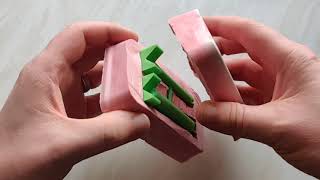
Step 1: Connect the three green plastic inserts to one another (as shown in the video) and place them in the fitted space in the bottom half of the mould.
Step 2: Push the four nozzles into the top half of the mould, making sure the tips pass all the way through.
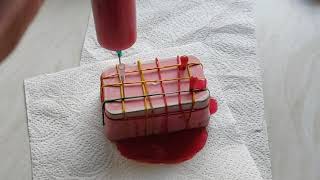
Step 3: Put the top half of the mould in place and seal the halves firmly with rubber bands. Set aside on paper or cloth towels while making the gel.

Phase 2: Make and inject the gel
Step 1: Place the measuring jug on the scale, zero the scale, and add 40 g of glycerol.
Step 2: Zero the scale and add 15 g of gelatin.
Step 3: Zero the scale, add 0.5 g of powdered red pigment, and spread the powders across the surface of the glycerol.
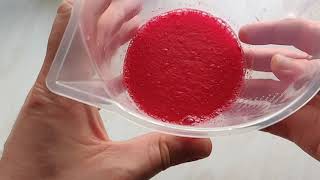
Step 4: Add cold tap water to the 100 ml line of the jug, stir until fully dissolved, and let it sit for 20 minutes to congeal.
Step 5: Transfer the mixture to the cooking pot and stir over low heat (do not boil) for about 10 minutes until it fully liquefies.
Step 6: Remove the syringe plunger and check the cap is secure. Fill the syringe with the hot mixture, replace the plunger, turn it upside down, remove the cap, and push gently until no air remains.
Step 7: Screw the syringe into each of the four nozzles in turn and push the hot gel through until the mould is completely filled. Some leakage at the seam is normal.
Step 8: Refrigerate the filled mould overnight. Excess gel can be ejected into a container and refrigerated for reuse.
Phase 3: Remove the model from the mould
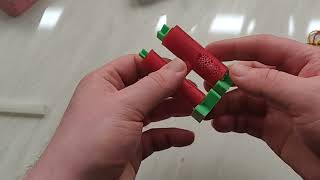
Step 1: Remove the rubber bands and nozzles, peel the excess gel from the outside of the mould (save it for reuse), and carefully separate the two halves.
Step 2: Use a scalpel or craft knife to clear the gel from the V-shaped ends of the plastic inserts.
Step 3: Gently twist and pull out the smaller of the two long inserts, loosening the ends with the knife as needed.
Step 4: Use tweezers to free the central connecting pin from the larger long insert, then twist and pull the insert out.
Step 5: Push the connecting rod into the larger vessel and remove it with tweezers.
Phase 4: Assemble the training box
Step 1: Slot the base into the two side panels with the four holes.
Step 2: Slot the side panel with three holes onto the assembly.
Step 3: Slot the side panel with many holes onto the assembly (this panel carries the electronics).
Step 4: Assemble the internal frame as shown in the diagrams.
Step 5: Insert the internal frame into the main box.
Step 6: Insert the lid into the two slots at the top of the box.
Step 7: Assemble the phone holder by slotting the two combs into the two arms; adjust the width using the different comb slots.
Step 8: Slot the phone holder onto the lid in a central position for a tall, centred camera view.


Phase 5: Companion app listed by the source
Step 1: The source lists the following app links for smartphones or tablets. Confirm current availability with the SELF-Training team before relying on the app:
- Android: https://play.google.com/store/apps/details?id=com.NMIS.OrganlikeARDR
- Apple iOS: https://testflight.apple.com/join/7CdIIjM4
The box arrives with the electronic sensors pre-configured. Builders making additional boxes can assemble the sensors from scratch following the electrical sensor configuration instructions (schematic diagrams and a video walkthrough).
Electronics and Sensor Setup
The simulator box ships with the electronic sensors pre-configured and ready to use. Builders assembling the sensors from scratch should follow the electrical sensor configuration instructions (schematics and video walkthrough); the cost is given under cost, above.
Software Setup
Companion phone app links listed by the source; confirm current availability with the SELF-Training team:
- Android: https://play.google.com/store/apps/details?id=com.NMIS.OrganlikeARDR
- Apple iOS: https://testflight.apple.com/join/7CdIIjM4
The app installs as an augmented-reality app; its AI-enabled alarm watches the distance-sensor signal in real time and can flag a potential emergency — for example, excessive tissue displacement indicating a risk of PDA rupture — with on-screen action options for the trainee.
References
- Source: Cardiac Surgical Skills Training Module — Phase 2: Simulator Setup (Appropedia)
- ↑ Cardiac Surgical Skills Training Module, SELF-Training team / Global Surgical Training Challenge, Appropedia, 2021. Build and operation: Phase 2 (Simulator Setup), Phase 3 (Skills Practice) and Phase 4 (Self-Assessment).
| Alternative names | Cardiac Surgical Skills Trainer Cardiac Surgical Skills Simulator SELF-Training PDA Simulator PDA Ligation Task Trainer |
|---|
| Authors | Arturo Pelayo |
|---|---|
| License | CC-BY-SA-4.0 |
| Cite as | Arturo Pelayo (2026). "TissueDB/Simulators/Patent Ductus Arteriosus Ligation Simulator". Appropedia. Retrieved October 23, 2026. |