


Safe Paediatric Male Circumcision Simulator/Module 1: Knowledge overview

.png)
Anatomy of the male genitalia
[edit | edit source]The male external genitalia include structures of the penis, scrotum, and testes (Fig 1). The dorsal aspect or dorsum refers to the upper plane extending from the penopubic junction to the tip of the penis (Fig 2). The ventral aspect or ventrum refers to the lower plane from the penoscrotal junction to the tip of the penis. (Fig 3).
-
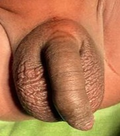 Fig 2. Dorsal Surface
 -
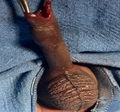 Fig 3. Ventral surface


The Penis
[edit | edit source]The penis is anchored to the pubic bone, it courses outward along the pubic tubercle and emerges
below the pubic symphysis. The penis can be divided into three parts: the proximal root, the shaft/body, and the glans (which includes the prepuce or foreskin). The proximity of the pubic symphysis to the base of the penis is helpful when administering a dorsal penile nerve block or when describing the location of palpable undescended testes.
Corpus
[edit | edit source]The corpus or body of the penis is composed of three cylindrical bodies of erectile tissue (Fig 4). There are 2 corpora cavernosa dorsally which are bound together by a strong fibrous sheath to form one functional unit. Each corpus cavernosum at its base courses laterally to anchor with the respective ischiopubic ramus. The ventral corpus spongiosum encloses most of the urethra and terminates distally in a mushroom-shaped expansion called the glans penis (Fig 5). The Urethra ends as a vertical slit opening at the tip of the glans – urethral meatus (Fig 5).
.png)
The three corpora are bound together from their root to the coronal sulcus by the Buck’s fascia which is a loose mesh of connective tissue which contains a network of small vessels, the deep dorsal vein, the dorsal arteries and the dorsal nerves. The dorsal penile nerve block is most effective if placed just outside Buck’s fascia in the subpubic space, where the penis begins its downward course under the pubic symphysis.
Surrounding the Buck’s fascia is a smooth muscle meshwork that extends from the scrotum called
dartos fascia which continues into the prepuce (Fig 5). Within the dartos fascia lies the superficial dorsal vein which must be ligated in freehand circumcision to avoid haematoma formation (Fig 4).
Coronal Sulcus
[edit | edit source]The groove that delineates the glans from the penile shaft is called the coronal sulcus (Fig 5). The coronal sulcus can be made out through the foreskin and is where the foreskin is excised to in circumcision.
Prepuce
[edit | edit source]The prepuce, foreskin, or hood, is the sheath of skin that normally surrounds and extends distally
beyond the glans tapering down to the preputial ring or meatus (Fig 5). The prepuce has 2 layers; an outer part which is continuous with the penile skin and an inner side which is a mucous membrane (Fig 5). At birth, the mucous membrane surface of the glans is adherent to the mucous membrane of the prepuce which gradually separates between birth and puberty.
The prepuce is tethered along the ventral raphe of the glans by a thin layer of mucous membrane which contains a network of vessels and fibrous bands called the frenulum (Fig 5). If the frenulum is tethered too tightly, it may cause a downward curvature of the glans called chordee. In hypospadias the ventral prepuce and the frenulum are absent while in epispadias the dorsal prepuce is absent. In circumcision the prepuce and part or all of the frenulum are removed: the preputial space is created by blunt dissection, separating the mucous membrane of the prepuce from that of the glans. Attention must be given to avoid leaving part of the inner mucous membrane by dissecting close to the glans and also avoid injury to the frenulum which can cause bleeding.
Engorgement of the corpora (cavernosum and spongiosum) leads to erection which can occur from birth often before urination. Avoid doing a circumcision on an erect penis as it distorts the layout of the penile skin.
Urethra
[edit | edit source]The urethra starts from the bladder and goes through the corpus spongiosum near its base, through the glans and terminates at the tip of the glans as the urethral meatus (Fig 1,5). It is subcutaneous in its course on the penile shaft. Disruption of this pathway during development can result in an improperly fused urethra. During pre-circumcision assessment, the entire course from the scrotum to the meatus must be carefully examined for abnormal openings, translucent appearing tissue, or areas of mucous membrane.
Care must be given during separation of mucosa layers of the glans and prepuce to avoid injury to the urethra and frenulum which could result in a urethrocutaneous fistula.
.png)
.png)
Blood supply
[edit | edit source]The penis is supplied by the dorsal and deep arteries of the penis (Fig 6) both branches of the internal pudendal artery.
The dorsal artery runs on each side of the deep dorsal vein in the groove between the corpora cavernosa. The deep artery runs distally near the center of the corpora cavernosa (Fig 6). Arteries of the bulb of the penis, superficial and deep branches of the external pudendal also supply the penis.
Venous drainage is by (Fig 6);
1. Deep dorsal vein of the penis which drains into the prostatic venous plexus.
- The superficial dorsal vein which drains into the superficial external pudendal vein.
Nerve supply
[edit | edit source]Derived from S2 -S4 spinal cord segments and the spinal ganglia through the pelvic splanchnic nerves and pudendal nerve. Sensory and sympathetic innervation is by the dorsal nerve of the penis, a terminal branch of the pudendal nerve.
Benefits of circumcision
[edit | edit source]- Prevention of urinary tract infections
- Prevention of sexually transmitted diseases - genital herpes simplex virus and human papilloma virus
- Decreased risk of HIV infection – prevents female to male transmission of HIV, reducing the risk of transmission by 60−70%
- Prevention of phimosis, paraphimosis, balanitis and posthitis
- Prevention of penile cancer
Indications
[edit | edit source]- Religious and cultural preferences
- Phimosis and paraphimosis
- Balanitis xerotica obliterans
- Recurrent posthitis
- Recurrent balanitis
- Smegma retention cyst
- Cosmetic reasons
Contraindications
[edit | edit source]The following situations and conditions are contraindications to circumcision:
| CONTRAINDICATIONS TO CIRCUMCISION |
|---|
| Congenital anomalies of the penis |
| Hypospadias |
| Epispadias |
| Chordee (bending of the penis) |
| Buried penis |
| Micropenis |
| Bleeding disorders |
| Haemophilia |
| Easy bleeding from any part of the body |
If any of these conditions is identified during assessment for circumcision, the child should be referred to a specialist paediatric surgeon or paediatric urologist.
Aanalgesia for circumcision
[edit | edit source]Circumcision can be painful. Analgesia is necessary to alleviate pain during and after the procedure. It is recommended even for neonatal male circumcision. Local anaesthesia is adequate for the procedure in the form of dorsal penile nerve block, ring penile block or a combination of both during the procedure, as well as topical anaesthesia. Glucose pacifier helps make the procedure comfortable. Following the procedure oral acetaminophen (paracetamol) is adequate.
Penile Nerve Block
[edit | edit source]Dorsal penile nerve block (DPNB)
[edit | edit source]The most effective method involves injecting plain lidocaine (without epinephrine) at the base of the penis. 1% plain lidocaine (or 0.25% Bupivacaine without adrenalin) is injected with a small gauge (23G) needle after routine cleaning and draping, at the 2 O’clock and 10 O’clock positions.
Before injecting, aspirate to avoid injecting into a vessel which can lead to toxicity.
Penile Ring block
[edit | edit source]This involves injecting plain lidocaine circumferentially at the base of the penis. It requires that the needle is inserted more than dorsal penile nerve block.
The dose of plain lidocaine is 3mg/kg.
1% lidocaine contains 10mg/ml.
The dose of bupivacaine is 2mg/kg.
0.25% bupivacaine contains 2.5mg/ml.
Complications
[edit | edit source]Complications of nerve blocks include:
- Minor bruising.
- Minor bleeding.
- Swelling at the injection site.
Topical analgesia
[edit | edit source]EMLA (eutectic mixture of local anaesthetics, containing 2.5% lidocaine and 2.5% prilocaine) Cream.
It is a water‐based cream containing lidocaine and prilocaine cream applied over the prepuce and penile skin, 60 mins before the procedure. It should be applied with care (avoid excessive application) as it can cause methaemoglobinaemia in neonates.
EMLA and other lidocaine creams can cause skin color changes or local skin irritation.
Studies have shown that DPNB and EMLA do not eliminate circumcision pain but are both more effective than placebo.
Oral Acetaminophen
[edit | edit source]This is used for post circumcision analgesia. It is commonly known as paracetamol and should be given at 15mg/kg per dose, 6-8 hourly by the oral route.
Glucose Pacifier
[edit | edit source]Comfort during the procedure can be provided by sugar (glucose) solutions, pacifiers, or expressed milk on a gloved finger or clean gauze.
Types of circumcision
[edit | edit source]There are various forms of circumcision in neonates/infants and children. These include:
Device. Involves the use of a device. Examples include:
- Plastibell.
- Gomco.
- Mogen clamp.
Free hand. No device is used during the procedure. Examples include:
- Sleeve circumcision.
- Dorsal slit circumcision.
- Guillotine circumcision.
Device Circumcision
[edit | edit source]Plastibell circumcision
[edit | edit source]This involves the excision of the fore skin and leaving a plastic over the glans.
Materials required:
- Plastibel of appropriate size.
- 2 straight haemostat forceps.
- 1 curved haemostat forceps.
- Dissecting scissors.
Technique:
- The infant is positioned on the bed and the assistant restrains him.
- Skin of the penis and groin is cleaned with hypochlorite solution (hibitane, savlon) or appropriate available antiseptic, twice and dried.
- Local anaesthesia is given for analgesia as described above.
- Straight artery (haemostat) forceps are placed at the 3 O’clock and 9 O’clock of the preputial opening to keep it open, then a curved haemostat (forceps) is inserted into the preputial opening with the tip pointing upward and close to the skin between the prepuce and the glans. It is then gradually opened so as to dilate the preputial opening and release the adhesions between the glans and prepuce.
- The curved forceps are removed. The prepuce is then retracted over the glans to ascertain that the prepuce has been completely separated from the glans. If incomplete, it is completed by gently pushing the prepuce away from the glans with moist gauze. Any smegma is cleaned with antiseptic or saline.
- Plastibel of different sizes are placed over the glans to select a size that adequately covers the glans without being tight or too loose.
- The prepuce is returned, and the straight haemostat forceps are reapplied at the preputial opening.
- A straight haemostat forceps is used to crush the dorsal preputial skin at 12 O’clock position. Then a dorsal preputial slit is made using sharp dissecting scissors.
- The selected plastibel size is applied. The provided suture is applied and tied firmly at the plastibel groove.
- Excess preputial skin beyond the Plastibell is excised and the Plastibell handle is gently broken off and detached. This completes the procedure.
- The wound should be inspected all round to ensure that there is no area of bleeding.
- The Plastibel is expected to separate from the glans over a period of 4-14 days.
Gomco circumcision
[edit | edit source]- This involves the use of the Gomco device, similar to the Plastibell circumcision, but the device is completely removed on completion of the circumcision.
- The prepuce is separated from the glans as described in Plastibell circumcision.
- A dorsal preputial slit is made, the prepuce retracted, the bell of the device applied over the glans, and the prepuce is pulled up over the bell.
- The base plate and top plates are applied and screwed firmly.
- The device is left in place for 2 or more minutes, after which the prepuce is excised with a scalpel.
- The clamp is then unscrewed and detached.
- The penis is inspected, and a non-adherent dressing applied.
Mogen clamp circumcision
[edit | edit source]- This involves the use of a device known as the Mogen clamp.
- After complete separation of the glans from the prepuce, the clamp is applied over the prepuce taking care not to include part or the whole glans.
- The clamp is secured, then a scalpel is used to excise the prepuce above the clamp.
- The clamp is removed, the penis is inspected and a non-adherent dressing with Vaseline impregnated gauze (e.g. Sofra-tulle) is applied.
Freehand Circumcision
[edit | edit source]Sleeve circumcision
[edit | edit source]Skin is cleaned and draped.
- Straight haemostat (artery) forceps is placed at the 3 O’clock and 9 O’clock of the preputial opening.
- The preputial opening is dilated with the forceps and completely retracted. Any adhesion between the prepuce and glans are gently separated, and the glans is cleaned with antiseptic solution or saline.
- A circumferential line of incision on the penile shaft skin and inner preputial skin, 0.5cm proximal to the corona are marked with a surgical marker, allowing for sufficient penile skin cover.
- The skin is incised along this marked line with a scalpel. The excess foreskin is then excised by dividing the subcutaneous layer between the inner and outer preputial skin.
- Following excision, haemostasis is secured. The inner and outer preputial skin are then apposed using absorbable sutures (e.g. Vicryl 5/0) in an interrupted fashion.
- Non-adherent dressing is applied with Vaseline impregnated gauze (e.g. Sofra-tulle).
Dorsal slit circumcision
[edit | edit source]- Prepuce is separated from the glans as for Plastibel circumcision.
- A dorsal preputial slit is made. The prepuce is then excised circumferentially on either side of the dorsal preputial slit.
- Haemostasis is secured.
- The inner and outer preputial skin edges are apposed using Vicryl 4/0 or 5/0 suture.
- The penis is cleaned, and non-adherent dressing is applied using Sofra-tulle.
Guillotine method
[edit | edit source]- After separating the glans from the prepuce, the prepuce is clamped over the glans using a straight haemostat (artery) forceps or bone cutter, taking care not to include the glans.
- The clamp (forceps/bone cutter) is held in place for about a minute.
- The prepuce above the clamp is excised, the clamp removed, and the penis is inspected.
- The inner and outer preputial skin edges may be or may not be apposed depending on the surgeon’s preference.
- A non-adherent dressing is applied at the end of the procedure.
Post circumcision (post procedure) care
[edit | edit source]Circumcision is usually a day care procedure, which means that the child will go home same day as the procedure. If you feel that in-patient observation would be required after the procedure, such patient should be referred to a specialist.
Following the procedure, the parent or caregiver should given specific instructions (Table 2).
Analgesia
Following circumcision, adequate analgesia MUST be provided. It’s important to remember that the effect of the local anaesthesia used during the procedure will soon wear off (one hour for lidocaine and 3-4 hours for bupivacaine).
Any analgesia should preferably be provided using the ORAL or RECTAL route.
Options for analgesia include:
- Oral acetaminophen (paracetamol)
- Dosage: 10 - 15mg/kg body weight per dose, 6 – 8 hourly.
- Duration: 3 – 5 days.
Oral non-steroidal anti-inflammatory agent (e.g ibuprofen, diclofenac)
[edit | edit source]Dosage:
- Ibuprofen
- 5-10mg/kg 8-12hrly, not exceeding a maximum of 400mg. Avoid in children less than 3 months of age or less than 5kg weight. Duration: 3 - 4 days.
- Diclofenac
- 0.3-1mg/kg 12hrly, not exceeding a maximum of 75mg.
- Avoid in children less than 1 year.
- Duration: 3-4 days.
Rectal non-steroidal anti-inflammatory agent (e.g. diclofenac) or acetaminophen (paracetamol)
[edit | edit source]Dosage:
- Diclofenac
- 0.3-1mg/kg 12hrly, not exceeding a maximum of 75mg. Avoid in children less than 1 year.
- Duration: 3-4 days.
- Acetaminophen (paracetamol)
- 15 -20mg/kg 12hrly (neonates) or 8hrly (older children).
- Duration: 3-5 days.
Antibiotics are not necessary and should not be given.
| Instructions for Parent or Caregiver | |
| # | Child should feed immediately after the procedure |
| # | Put infant to breast to feed if being breast fed |
| # | Give analgesia as prescribed |
| # | Child can be bathed from the following day |
| # | No need to worry if the dressing falls off |
| # | Expect Plastibel to fall off on its own within 7-10 days
Do not force it off |
| # | If sutures have been used, they will disintegrate and disappear within 14 days as they are absorbable |
| # | Please, bring the child back to the hospital if you notice any of the following:
Bleeding Change in colour of the glans Severe pain despite giving the analgesia as prescribed Plastibel has not fallen off by day 10 |
Complications of circumcision
[edit | edit source]Complications can occur with any method of circumcision. Certain complications are however more commonly encountered with specific methods than others. These complications may range from less severe which are often readily treatable with no long-term effects; to more severe, requiring a referral to a specialist paediatric surgeon/paediatric urologist for re-evaluation and possible re-operation.
Careful, meticulous attention to penile anatomy and the correct use of surgical equipment by trained clinicians can prevent most complications of circumcision. It is also important to be able to identify when complications occur and to know the immediate appropriate measures to take.
Complications may be encountered at any stage during a circumcision procedure. Common complications which can occur include:
Intra-Operative Complications
[edit | edit source]HAEMORRHAGE
This is the most common early complication of circumcision. Rates vary from 2.5 to 10%. It is especially encountered with the use of Plastibell. Haemorrhage can occur in the intraoperative period commonly with newborns who have bleeding diathesis or in the early post-operative period.
- Distressed parents return to the hospital a few hours following a circumcision with complaint of persistent dripping of blood from the surgery site.
- Majority of bleeding occur from the trimmed edges of the skin especially in cases where the suture/tie holding a Plastibel in place has not been firmly secured.
- May also occur from injury to the frenular artery especially with freehand circumcision if this has not been appropriately ligated.
- Additionally, iatrogenic injuries to the surface of the glans during circumcision may bleed.
- Post-circumcision bleeding can result in significant blood loss especially newborns, such that admission and blood transfusion may be required.
- Treatment in the majority may involve simple application of pressure/pressure dressings especially for intra-operative bleeding.
- Sometimes wound review and ligation of the specific bleeding vessel will be required.

What to do if bleeding is not easily controlled by pressure:
- Apply firm pressure dressing.
- Refer the child to a specialist.
HAEMATOMA
- May occur at a needle puncture site if a blood vessel had been traversed during application of anaesthetic blocks for circumcision, but commonly results from bleeding from trimmed skin edges.
- Haematoma occurring from needle puncture of vessels will often resolve spontaneously requiring no further intervention.
- Most haematomas will begin to resolve (reduce in size) after 72 hours and should resolve completely by 7 – 10days. During this period, the patient may be placed on antibiotics to prevent superimposed infections especially when the haematoma is greater than 2cm.
What to do if the haematoma persists or is expanding:
- Refer the child to a specialist.
GLANS LACERATION
- Often occurs while trimming the redundant prepuce.
- May range from a small nick to outright cuts.
- The glans has great tendency to bleed uncontrollably as it’s very vascular and control of bleeding can be difficult.
- Nicks can be handled with pressure to stop bleeding.
- Cuts may require application of a few simple interrupted non-absorbable sutures using Vicryl 4/0 or 5/0.
- What to do in severe lacerations/cust.
- Apply pressure dressing to control bleeding.
- Then refer the child to a specialist.
GLANS/PENILE AMPUTATION
- This is a very serious and severe complication.
- May be partial or complete.
- It is unlikely to occur with Plastibel or sleeve circumcision but rather more common with guillotine circumcision or when the gomco clamp is poorly applied.
- What to do when this complication occurs:
- Apply pressure dressing to control bleeding.
- Then, refer immediately to a specialist.
PENILE SKIN LOSS
- Results from excessive excision of penile skin.
- Can occur with any method of circumcision and is common with Plastibel circumcision:
- when the penile skin is pulled too taut over the Plastibell.
- when the Plastibel migrates proximally.
- Can also occur if lidocaine with adrenaline is used for penile block.
- It is best prevented by:
- clearly marking out how much prepuce to remove before proceeding with circumcision.
- avoiding the use of adrenaline with local anaesthetic for penile block.
- Refer to a specialist if this complication occurs.
Early Post-operative Complications
INFECTIONS
- Are amongst the most common complications of circumcision. May range from mild to severe and life threatening such as necrotizing fasciitis.
- Mild superficial infections are common and can be treated by wound care and wound dressings.
- More severe infections require specialist referral for more intensive care such as systemic antibiotics, debridement and wound cover.
ADHESIONS
- May include minor adhesions which will separate if addressed early.
- Skin bridges may occur when adhesions between the penile skin and the glans become dense.
- Skin bridges are usually short diameter (<0.5cm) but have the propensity to cause penile tethering and painful erection.
- They can usually be surgically separated by division.
- Cicatrix and Phimosis are severe contractures that hold down the whole or part of the penis resulting in buried penis. They may be mistaken for amputated penis at initial presentation until closer evaluation is done.
- Refer to a specialist if this complication occurs.
RETAINED PLASTIBEL
- Occurs when the Plastibel and distal prepuce fail to fall off after a period of more than 10 days following Plastibel circumcision.
- It is oftentimes a simple complication of failure to make the securing knot tight enough on the Plastibel such that the distal prepuce remains vascularized.
- It usually involves only part of the circumference of the prepuce and the residual attachment can usually be incised to detach the Plastibel. This can be performed by the clinician.
- Retained Plastibel can however result in more serious complications such as proximal migration of the Plastibel, loss of penile skin, and glans necrosis. When these occur, immediate specialist referral should be made.
PROXIMAL MIGRATION OF PLASTIBEL RING
- Occurs usually when a Plastibel size that is too small for the glans is used.
- The pressure erodes through proximal penile tissue with considerable oedema such that the ring gets lodged proximally.
- This may result in loss of penile skin.
- When this complication occurs, refer to a specialist.
Late Post-Operative Complications
REDUNDANT PREPUCE
- This gives an impression of incompletely done circumcision.
- It results in dissatisfaction with the cosmetic outcome but can be corrected with a redo circumcision usually by freehand methods.
- Refer to a specialist if this complication occurs.
URETHRO-CUTANEOUS FISTULA
- Often a result of inadvertent ligature of part of the ventral circumference of the urethra while securing a bleeding vessel with a stitch.
- This results in ischemia and loss of the urethra at that area and may also involve the urethra distal to that point.
- Refer to a specialist if this complication occurs.
IMPLANTATION DERMOID CYST
- Occurs when skin epithelium/epidermis becomes entrapped in underlying tissues.
- Often occurs at the junction of apposition of inner and outer preputial layers following circumcision.
- Refer to a specialist if this complication occurs.
FURTHER READING
- Omole F, Smith W, Carter-Wicker K. Newborn Circumcision Techniques. Am Fam Physician. 2020 Jun 1;101(11):680-685.
- Brady-Fryer B, Wiebe N, Lander JA. Pain relief for neonatal circumcision. Cochrane Database Syst Rev. 2004 Oct 18;2004(4):CD004217. doi: 10.1002/14651858.CD004217.pub2.
- World Health Organization & JHPIEGO. (2010). Manual for early infant male circumcision under local anaesthesia. World Health Organization. https://iris.who.int/handle/10665/44478 (Accessed November 16 2024).
- Imran M. Circumcision, meatotomy, and meatoplasty In: Davenport, M., Spitz, L., & Coran, A. Editors. Operative Pediatric Surgery, 7th ed. CRC Press. 2013
- Sidler D, Bode CO, Desai AP. Male circumcision. In: Ameh EA, Bickler SW, Lakhoo K, Nwomeh BC, Poenaru D (Eds). Paediatric Surgery: A Comprehensive Textbook for Africa. Springer, 2021, Pp. 997-1110.
- Talini C, Antunes LA, Carvalho BCN, Schultz KL, Del Valle MHCP, Aranha Junior AA, Cosenza WRT, Amarante ACM, Silveira AED. Circumcision: Postoperative Complications that Required Reoperation. Einstein (Sao Paulo). 2018;16(3): AO4241.
- Ince B, Dadacı M, Altuntaş Z, Bilgen F. Rarely Seen Complications of Circumcision, and their Management. Turk J Urol. 2016 Mar;42(1):12-5.
- Iacob SI, Feinn RS, Sardi L. Systematic Review of Complications Arising from Male Circumcision. BJUI Compass. 2021 Nov 11;3(2):99-123
| Authors | SAFE PAEDIATRIC MALE CIRCUMCISION SIMULATOR |
|---|---|
| License | CC-BY-SA-4.0 |
| Cite as | SAFE PAEDIATRIC MALE CIRCUMCISION SIMULATOR (2025). "Safe Paediatric Male Circumcision Simulator/Module 1: Knowledge overview". Appropedia. Retrieved October 18, 2026. |