


Open Climate/Open Climate Fellowship
We are developing a network of Open Climate practitioners working across all facets of the open and climate movement who can advance climate justice with an open lens.
The inaugural edition of the Open Climate Fellowship, supported by the Wikimedia Alliances Fund, brings together 7 open climate practitioners coming from various disciplinary and cultural backgrounds to engage in exchanges with other peers alongside activists, researchers, emerging leaders and other individuals working at the intersection of the open movement and the climate crisis.
During the 4-month program (February-May 2023) fellows will develop new and existing projects based on their communities and areas of interest through a facilitated peer-learning process, with support and mentorship from the Open Climate team. The cohort will also help shape public-facing programming and contents related to Open Climate’s mission, while learning in the open and contributing to the knowledge commons.
The aim of this program is also to encourage fellows to share the skills and experience gained from their fellowship with the communities and organizations that they are a part of, to ultimately develop a culture that translates the principles of open practices into the climate action movement.
Meet the 2023 Open Climate fellows
[edit | edit source]Our first fellow cohort was selected by the Open Climate team from over 270 applications collected through an open call process launched back in December 2022. They come from various disciplinary backgrounds, cultural contexts and different open communities.
Dr. Sadiat Adetoro Salau
[edit | edit source]📍Minna, Nigeria: Building open resources to increase open access to climate education in Nigeria
🏷️ #OpenAccess, #OpenClimate, #OpenEducationResources Fellowship Focus
Sadiat Adetoro Salau (she/her) is a knowledge mobilization and training specialist with over ten years of experience in the conceptualization and implementation of knowledge management systems. Sadiat is passionate about analyzing, mobilizing, transferring and disseminating evidence-based research knowledge for the public good. She also facilitates the design of sustainable programs on knowledge dissemination.
Climate denial and misinformation is a challenge in Nigeria. These challenges are compounded by Africa’s low carbon footprint, as well as other factors linked to the effects of climate change including insecurity, poverty and government negligence. However, the effects of climate change across geographical regions in the country are becoming increasingly devastating, from the desertification in the north, to the devastating floods in the middle belt and southern areas, to the haze caused by soot in oil producing areas.
During the fellowship, Sadiat will work with course content creators and language specialists to democratize contextual climate education through an easy-to-understand open self-study tutorial. This will first be constructed in English and subsequently in the three major languages in Nigeria. Taking into consideration the ways climate change affects different regions, the online self-study tutorial will be designed to build capacity for anyone with little or no prior formal education or knowledge on climate change. The open tutorial will also be beneficial for participants interested in building their capacity on climate education for the non-formal education sector. At the end of the tutorial, participants should be able to:
- Teach contextual climate change to diverse groups of persons in the non-formal education sector, and
- Select a ‘good enough’ balance of facilitation strategies to dispel misinformation online and offline about climate change (e.g., updating climate change and environmental information on Wikipedia).
PhD Rub(én) Solís
[edit | edit source]📍Berlin, Germany; Coimbra, Portugal; Mérida, Mexico: Opening access to climate science for Yucatecan Mayan communities 🏷️ #OpenScienceInformation, #ClimateJustice, #IndigenousCommunities Fellowship Focus
Bio: Rubén (Rub) Solís (they/them) comes from the Yucatan Peninsula, the Mayan and Caribbean zone of Mexico. They are a Marine Biologist from Universidad Autónoma de Yucatán (UADY) and have a Master’s in Natural Resource and Rural Development from El Colegio de la Frontera Sur (ECOSUR) in San Cristóbal de las Casas, Chiapas. They recently graduated as a PhD in Post-Colonialisms and Global Citizenship at the Center of Social Studies (CES) and Coimbra University, Portugal. Between May 2018 – July 2022, their PhD research was funded by the Foundation for Science and Technology (FCT) of Portugal and the Social European Foundation. They have experience in research projects of different topics, each with a trans-disciplinary and gender approach, including: ecology of marine zones, climate change perceptions within indigenous populations, migration of artisanal fishermen inside Mexico, and health of people from Yucatecan coast. As an indigenous activist, they have had the opportunity to join different emancipatory movements from Mayan populations in southeast-Mexico.
Fellowship Focus: This project has a transdisciplinary and intersectional approach with the goal to share and translate scientific information about climate change with Mayan rural communities from Yucatan Peninsula, Mexico. For that purpose, the project will consist of two phases.
The first phase will involve searching the recent scientific information (last 5 years) about climate change in the region. We will prioritize open access journals and platforms, and mix these with interviews with local climate justice activists to have at least two different perspectives of the same problem.
The second phase will be the translation processes of all that information for indigenous communities. The translation process in this context is complex because it implies finding ways to communicate information in accessible formats and not in occidental languages (Yucatecan Maya in this case). For this process, I will collaborate with Mayan translators and with the support of members of Múuch’ Xíimbal Mayan Assembly to share tools identified during the fellowship.
These informational materials will consist of digitals infographics (about water, soil, rainforest) with a soft language in Spanish and Yucatecan Maya as an informative resource to share with different rural and urban indigenous communities through social media and websites. These infographics can also be printed and shared in deep rural communities where access to Wi-Fi or telephone coverage are limited or unavailable. This project will be a practical and specific way to downscale climate science to local levels and work for the smallest possible policy-makers and communities that are directly impacted by the consequences of climate change in their daily lives. Bio
Nelly Mouawad
[edit | edit source]📍Berlin, Lebanon, US: Wikibase for geospatial and ground-based metadata of carbon emissions 🏷️ #OpenSource, #SearchEngine, #Wikibase, #SatelliteData, #GreenhouseEmissions
Bio: Nelly Mouawad (she/her) is an astrophysicist who has worked on multiple projects in space sciences, including on NASA missions and with Nobel Prize laureates. She is an educator with 10+ years of work experience as a university faculty member. She has contributed to building new education programs in her home country (Lebanon), as well as developing astronomy and bringing it to students. Through her work, promotes equal rights and gender equality. She believes in the power of education and mentoring as a tool for innovation and entrepreneurship. She has studied and worked in Europe, the Middle East and the US, and is interested in working on topics that matter and make a difference in people’s lives. Her main focus is on projects that apply science and technology to create innovative solutions with global impact.
Fellowship Focus: There is an increased interest and demand to monitor and track carbon emissions. There is also a considerable effort and action taken to geospatially measure carbon emissions. More satellites are being launched or designed to support monitoring of greenhouse gas emissions. National and international initiatives are being coordinated to sustain, advance and share satellite observations. At-cost data providers, or SaaS companies using their own commercial satellites, have already realized the importance of having a platform that combines all data sources, and are offering this as a paid service.
Nelly will create a database hosted on Wikibase that includes metadata of available geospatial and ground measurements of carbon emissions. These data will be linked to a geolocation and a time of observation. The database acts like an open source search engine that would provide the user the information on where to find carbon emission data for a certain geolocation. The user could search for a geolocation and choose to confine the search to a certain time. The aim of this project is to help foster collaborations and transparency in the effort to address climate change, which will be a valuable tool for individuals, organizations, and governments working to reduce their carbon footprint.
Nano Castro
[edit | edit source]📍Mendoza, Argentina: Open source technologies to support and strengthen the agroecological transition in Argentina 🏷️ #Agroecology, #SmallholdFarmers, #OpenScienceHardware, #OpenDigitalInfrastructures, #ClimateSmartFarming, #CarbonFarming
Bio: Nano Castro (he/they) is a digital artisan from Mendoza, Argentina working at the interface between open scientific/technological communities and local communities that need to build knowledge about their environments or productive processes. Nano is part of Cooperativa Ayllú, a coop that manages a small farm that produces food and beverages. He has facilitated several workshops about open source scientific tools around the world and is currently engaged in establishing an Open Agroecology Lab to support the agroecological transition in Latin America. He is an active member of the Gathering for Open Science Hardware (GOSH) and its regional chapter reGOSH.
Fellowship Focus: This project started 5 years ago with a dialogue between several territorial organizations to explore how open technologies, and the people working on them, could be part of and support the agroecological transition. This process of mutual translation and understanding led to the idea of integrating people and open tools to systematize, follow and share experiences in order to enable our collaborative learning and the public amplification of agroecology. Nano and colleagues call this emergent infrastructure Open Agroecology Lab. They view this as a bottom-up proposal for the digitalization of agroecological experiences to support and strengthen public valorization and acknowledgement of agroecology (i.e., through participatory guarantee systems) and to resist the current AgTech wave that will only intensify pressure on small farmers and increase their technological dependency to corporations. During this fellowship, Nano will dedicate time to exploring how climate change issues can be addressed by and inscribed into the Open Agroecology Lab infrastructure.
Marjahn “MJ” Finlayson
[edit | edit source]📍Nassau and Eleuthera, Bahamas: Climate Adaptation: Developing “green cities” in The Bahamas through open science and education. 🏷️ #Education, #Development, #ClimateScience, #Weather, #TropicalClimateChange, #ClimateAdaptation, #SIDS
Bio: Marjahn is a climate change scientist, educator, and activist. She got her start in science as a tropical cyclone (hurricane) watcher, trying to figure out how climate change will affect these phenomena since she is a native of a hurricane-prone nation, The Bahamas. She studies severe weather in our changing climate, especially for island nations and communities. She began her earth science career at Wesleyan University, learning about tropical cyclones, paleoclimatology, and climate modeling. In 2020, she earned a Master’s in Research from the University of Leeds in Climate and Atmospheric Science. There she studied storm track movement and statistical analysis under different climate scenarios. Between her undergraduate and graduate studies, she discovered her love for teaching and working with students of all ages. As a former physical scientist at the Cape Eleuthera Institute, Marjahn has introduced atmospheric science and meteorology to South Eleuthera. She has collaborated with local Bahamian and international institutions and scientists to provide accessible documentation and studies on climate change, hurricanes, and weather, as well as mentored many young people in STEM. Based on her work in education and community engagement for climate science and weather, she founded ClimateEdu Bahamas and Fin Forecasts in 2022 and co-founded DAPS ( DAPS (Development. Advancement. Preservation. Sustainability) as conduits to extend her reach in this work. As an activist, Marjahn’s mission is to bring concerns of Small Island Developing States and underserved communities to the center stage of the international climate change talks and to work more toward radical climate justice.
Fellowship Focus: ClimateEdu Bahamas and DAPS (Development, Advancement, Preservation, and Sustainability) were established to provide education and reintroduce sustainability to the Bahamas, especially in rural areas. In this fellowship, Marjahn will combine these projects to create a collective “green city mindset” in small communities all over the country. With the aim of influencing rural community development, increasing climate education and introducing more sustainability, activities will include: creating equitable and accessible open educational resources, introducing DAPS as a club for high school students as a means of community service and virtually supervising inventory through a DAPS technological application. This project will also develop community sustainability by introducing climate education on climate change and adaptation to locals, thereby encouraging more community adaptive work to better prepare for impending climate disasters.
Luis Carrasco
[edit | edit source]📍Santiago, Chile: Integrating open knowledge about terrestrial ecosystems of Chile and their state of conservation on Wikimedia projects. 🏷️ #Ecosystems, #NaturalKnowledge, #AdministrativeDivision, #DecisionMakingInformation, #SouthAmericanEcosystems, #SouthAmericanEnvironment
Bio: Luis Carrasco (he/him) is a Marine Biologist with an academic minor in Natural Resources and Environmental Law, and is pursuing a Master’s in Public Policy from the Pontificia Universidad Católica de Chile. He is interested in public policies that protect and manage the biodiversity and ecosystems of Chile, his native country. He has been editor of Wikipedia in Spanish since 2008 and Director of Wikimedia Chile since 2020. It is during this period of time that he understood the importance of free and open access to all sources of knowledge, for anyone who seeks knowledge. Those who know him know that he is always involved in various projects for citizen participation, free knowledge, the environment, sexual diversity, and youth.
Fellowship Focus: This project -Integrating open knowledge about terrestrial ecosystems of Chile and their state of conservation on Wikimedia projects- will integrate the knowledge about the terrestrial ecosystems of Chile and their state of conservation (according to the IUCN categories) within each of the articles on the Spanish Wikipedia website (and Wikimedia projects) that talk about the communes and regions of Chile. This project plans to achieve this by processing existing information in databases, processed through open-source software (QGIS, RStudio, Inkscape, etc.), and obtaining original text and images based on this pre-existing information, which will then be personalized for each previously mentioned Wikipedia article.
Most of all the information to use comes from the extensive work that professors Federico Luebert and Patricio Pliscoff did for cataloging the “vegetational floors” in Chile (equivalents of the concept of ecosystems). His work has had a great impact on the management of environmental conservation in our country, being officially recognized by the State as the official classification of the natural territory of Chile.
Ben Hur Pintor
[edit | edit source]📍Manila, Philippines: Building capacity for climate action using open geospatial data and tools 🏷️ #OpenGeospatial, #OpenMapping, #OpenData, #OpenKnowledge, #OpenSource
Bio: Ben Hur (he/him) is an advocate of a free and open future. He is based in the Philippines and works at the intersections of the openness, data, technology, and geospatial fields. He has a wealth of experience as an advocate, trainer, and educator on open data, data literacy, and open geospatial. He supports and takes an active role in the open communities in the Philippines both as an individual and through his organizations: BNHR, an open data and open geospatial enterprise he established; and SmartCT, an openness and citizen-centric tech non-profit that he co-founded. With his set of skills and experience working with people in technical, advocacy, and policy sectors, Ben works to inspire others to use data and technology to advance and protect safe, fair, and free societies.
Fellowship Focus: There is a lot of open geospatial data (from large-scale Earth Observation data to community-level data such as those in OpenStreetMap) and open geospatial applications (such as QGIS) that can be used to address climate-related issues. The goal of the project is to help increase awareness about the importance of these open geospatial data and tools and build capacity among relevant stakeholders on how to use these resources effectively for climate action. The project will focus on two components:
- Capacity building: This involves capacity building activities with local communities and relevant stakeholders on how to utilize open geospatial data and applications on the topic of climate change and disaster preparedness. This capacity building phase will utilize a two-step training methodology that combines a training phase and a mentoring phase. This approach allows participants to immediately turn what they learn in the training into a meaningful project through mentoring.
- Awareness raising and creation of open knowledge resources: This involves collaborating with local communities and stakeholders to build an open resource that will include key definitions, tools, information on where to find open data related to climate, and examples of how to use the tools and data in climate-related projects. The projects by the participants of the capacity building activities will form part of this resource.
Overall, the project seeks to empower local communities and stakeholders with knowledge and skills that will allow them to utilize open geospatial data and tools to support climate-related activities. By building capacity and raising awareness about the importance of open geospatial data and tools, it is hoped that more people will be able to take meaningful actions to address climate issues and their associated impacts. Lastly, by building these resources in the open, we hope to encourage and inspire others to contribute as well. For more information, read Ben’s project brief.
Why this fellowship
[edit | edit source]We are facing a critical planetary emergency. How we openly share knowledge for climate action is key to creating relevant local solutions for a global problem. However, there are few coordinated spaces for the open and climate movements to collaborate in knowledge production, sharing, reflection, and action.
Open Climate seeks to create this space of exchange to bring together climate action and movement builders, and to fully connect them to the open movement people, tools and approaches. We seek to identify opportunities for free and open source communities to support climate action and solutions.
Since our first community call in 2020, Open Climate has hosted conversations with people who bring insights about how open practices can strengthen climate action. Over the course of 12 community calls, we identified five issues where the open movement could become a key actor to pursue a sustainable future:
- Our information environment is polluted by companies and governments who deny or delay climate action. This can be countered by a robust knowledge commons.
- Openness can help address the environmental impact of digital infrastructures.
- Downscale climate science to local levels and work for the “smallest possible policy-maker.”
- Freeing access to climate information can be done by growing the socio-technical capacity of community spaces.
- The open movement is a cultural movement in principle, and it can offer value to other movements by operating intersectionally.
Building on the insights from this journey, the Open Climate Fellowship aims to create a space for transdisciplinary collaboration, peer learning and community building. We are developing a network of Open Climate practitioners working across all facets of the open and climate movement who can advance climate justice with an open lens.
Acknowledging the lack of similar opportunities, in particular for practitioners in the regions that are most affected, throughout this fellowship program, Open Climate offers a part-time paid professional development opportunity that provides a platform for learning, creative exchanges, and access to mentors and collaborators.
More Information
[edit | edit source]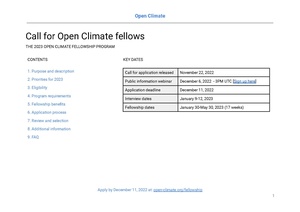
For more information about the Open Climate Fellowship, and to learn more about the application process, read the Call for Fellows Guidelines (now closed).
| License | CC-BY-SA-4.0 |
|---|---|
| Cite as | "Open Climate/Fellowship". Appropedia. 2025. Retrieved October 21, 2026. |