


CSU Research Competition 2025 Engineering and Computer Science trophy

| Authors | Petern08 Kazzington Quinn Simard Carl05 |
|---|---|
| Location | Arcata, United States |
| Status | Deployed |
| Made | Yes |
| Replicated | No |
| Uses | education, science |
The Engineering and Computer Science trophy, built for the CSU Research Competition in November 2024 in accordance with Lonny Grafman's ENGR 205 class. Its design honors the complexity and intellectual rigor of the fields of Engineering and Computer Science, while most of all inspiring innovation.
Background
[edit | edit source]This year will be the first time in the history of the CSU Student Research Competition that Cal Poly Humboldt will be the hosting University. At the same time, this will be the first semester our engineering program will have access to its new Makerspace. More than that, the university is currently putting a lot of effort into expanding our Engineering department in general and is even in the process of building an entire new building for the department.
The Student Research Competition is a competition between students from all the universities in the CSU system. Interestingly, students are not necessarily judged by people in their field of study, but rather by a panel of judges taken from all fields of study represented in this competition.
Problem statement
[edit | edit source]The objective is to create a trophy for the 2025 CSU Student Research Competition in the Engineering and Computer Science category. This award will represent the craftsmanship and creativity of the Cal Poly Humboldt Engineering program and its Makerspace.
Criteria
[edit | edit source]The criteria and constraints section identifies a list of variables in which the engineering and computer science trophy will be judged. The table below details the constraints and weights (1-10 highest), associated with each criterion.
| Criteria | Description | Weight (1-10) |
|---|---|---|
| Aesthetics | Must look like a finished product that is aesthetically pleasing | 10 |
| Category | Major elements must allude to Engineering/Computer Science | 10 |
| Appropriateness | Must not look vulgar | 9 |
| Dimensions | Less than 10 lbs, Should fit within a 1’x1’x1’ box. | 8 |
| Safety | Cannot have elements that have the potential to create harm | 6 |
| Longevity | Should be able to sit on a desk for years without degrading | 5 |
| Ease of use | Must be usable without a manual under normal operating condition | 4 |
| Cost | Ideally costs will not exceed $200 so that we will not have to spend our own money | 2 |
Prototyping
[edit | edit source]The following section discusses the prototyping process and the most impactful prototype results.
Atlas
[edit | edit source]The Atlas was created using a cylindrical shape for the base of the trophy. The figure is a 3D printed atlas which is holding up a gear. We learned that the cylindrical shaped base takes up a lot of space and a rectangular base looks more visually appealing. We also learned that the gear attached to the base would be more structurally sound than the atlas holding it up.
Thinker Gear
[edit | edit source]The Thinker Gear was created out of cardboard and focused on finding a visually appealing shape for the base. The final shape we came up with was a truncated square pyramid. We switched the figure from the atlas to the thinker because the client felt the thinker represented the problem solving aspect of computer science and engineering. We learned that the gear attached to the base increases the structural integrity of the overall trophy and also looks more visually appealing.
TruncBase
[edit | edit source]The TruncBase recreated the truncated square pyramid out of ⅜ inch wood. To make the corners line up together we learned how to use compound angles on the miter saw and table saw. We miscalculated the angle of the inner cuts facing each other to be 45 degrees so there is a slight gap between each piece. We learned that it should be around 42.5 degrees instead. We also learned that to make the top and bottom edges level we needed to set the table saw to 19 degrees.
- Prototype Photos
-
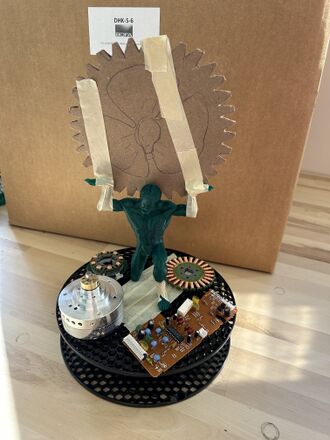 Atlas- Cylindrical trophy base with atlas holding up gear
 -
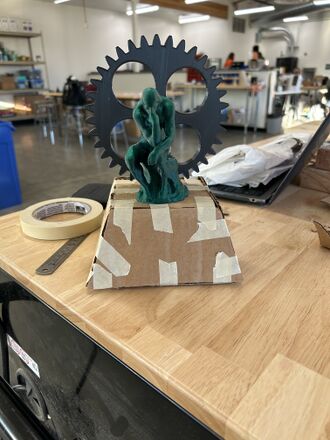 Thinker Gear- Truncated square base constructed out of cardboard with thinker figure and gear attached to base
 -
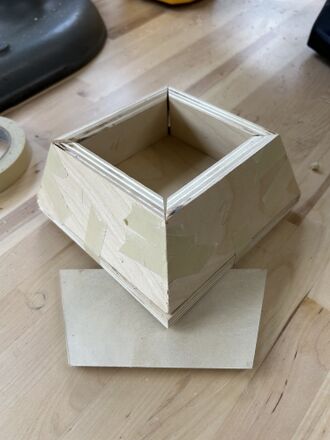 TruncBase- Truncated square pyramid base constructed of ⅜ inch wood


Final Design
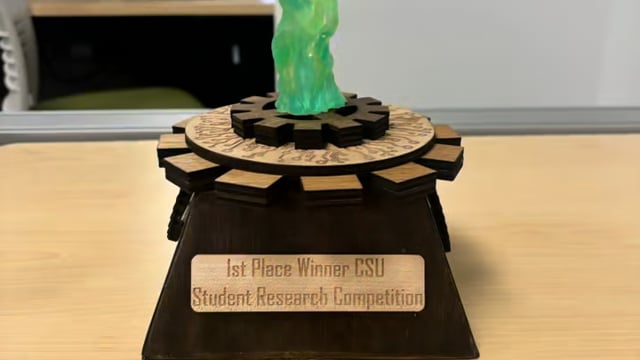
[edit | edit source]The Engineering/Computer Science Trophy features a trapezoidal base embellished with mini gears on all three sides. Sitting flush on top of the base is an arrangement of gears and a circuit board array. Positioned above this is another gear assortment, designed to serve as a platform for the thinker model.
Construction
[edit | edit source]The trapezoid shaped base was used as the final design for both the undergraduate & graduate trophy. However, the undergraduate trophy was made from birchwood and the graduate trophy was constructed out of bubinga wood. In addition, they were laser engraved, with the name of the competition "1st Place Winner CSU Student Research Competition". Their dimensions go as follows: the base of the model measures at 6” wide and 3” high, while the top of the base is 4" .
The Circuit Board was made out of birchwood. Its complex array was laser engraved and then stained with a clear coat. Its dimensions were 3” inches in both height and width.
There are 5 gears in total that are all made out of birchwood. The two gears positioned on top of the base were stained with a hybrid Dark Walnut & Moroccan Red stain. While the 3 mini gears which are on the exterior do not feature any type of stain. The primary gear atop the base has dimensions of 6” in both height and width with a thickness of ⅜”. The second gear slightly above it is 3” in both height and width, with a thickness of ¼”. The mini gears measure out to 1.7” in both height and width, with a thickness of 1/18”.
The Thinker Model was created through the use of 3D printing technology. Once printed, it was then cast out of epoxy resin. The final product measures out to be 2.7" in both height and width.
Video
[edit | edit source]Below is an visual overview of the Thinker of Tomorrow trophy which outlines the process of it's creation.

Bill of materials
[edit | edit source]This section covers the total cost of the overall project.
| Item | Amount | Cost per unit | Total |
|---|---|---|---|
| Deep Pour & Casting Epoxy Resin Kit — Get at [1] | 1 | USD 31.99 | USD 31.99 |
| Multi ply Wood — Get at [2] | 1 | USD 18.48 | USD 18.48 |
| Modeling Clay — Get at [3] | 1 | USD 19.86 | USD 19.86 |
| 104 pc Circuit Boards. — Get at [4] | 1 | USD 16.15 | USD 16.15 |
| Moroccan Red Stain — Get at [5] | 1 | USD 9.00 | USD 9.00 |
| Poly Gloss Stain — Get at [6] | 1 | USD 17.10 | USD 17.10 |
| Speed Tape — Get at [7] | 1 | USD 15.50 | USD 15.50 |
| Bubinga Wood — Get at [8] | 1 | USD 20.83 | USD 20.83 |
| Grand total | USD 148.91EUR 128.06 <br />GBP 108.70 <br />CAD 184.65 <br />MXN 3,104.77 <br />INR 11,145.91 <br /> | ||
Operation
[edit | edit source]Maintenance
[edit | edit source]The Trophy is constructed of wood and has no electrical features so minimal maintenance is required. Bearing this in mind dusting monthly is sufficient, and it is strongly recommended to store the trophy in a dry environment away from any water that might affect its longevity.
Maintenance schedule
[edit | edit source]- Monthly
- Dusting
Conclusion
[edit | edit source]Testing results
[edit | edit source]After multiple phases in the Final Design, the trophy meets the required criteria and our teams goals.
Discussion
[edit | edit source]With the overall flow of the project, conflicts of ideas and visions were very apparent in our prototyping phase. With the overall look and timing also coming into play during this phase, the conflict of choosing which figure would make the trophy look more refined was one of our major problems. Going back to the TruncBase, problems such as the angles of the Truncated square pyramid base arised after a 45-degree angle cut left the base off-centered which in turn created gaps between each corner.
Conflicts of visions of the trophy were bound to happen especially with this being a group project. By using the Delphi Method the entire group was able to come to a consensus in choosing the final design for the trophy.Having picked the TruncBase as our final prototype we still were met with complications in the final design. The most challenging part was figuring out the angles and cuts that were meant to be made to properly make a truncated square pyramid base. The whole group had the impression that the cuts were 45-degree angular cuts but in actuality the cuts were instead supposed to be cut at 42.5 degrees. With the right cuts of the base, the top and bottom edges were easily calculated using a table saw at 19 degrees. After, the team was able to get around those hurdles we were easily able to refine our final design.
Lessons learned
[edit | edit source]Lessons learned throughout this whole project were many. However, aspects like better communication, and taking more calculated risks might have just completely turned the trajectory of our entire project.
Next steps
[edit | edit source]Future steps for our project are all shown in our final design for our trophy.
Troubleshooting
[edit | edit source]All these design elements maintain their integrity and appearance well under standard conditions. Dust the trophy as needed and keep it away from water and humid conditions and it will last for years to come. Of all the design elements, the thinker's itself could possibly snag on clothing, et cetera causing the trophy to be knocked and potentially break. Place this in a location where the gear is unlikely to contact moving objects and be knocked over.
Team
[edit | edit source]Team Pirates Engr 205 Fall 24:
References
[edit | edit source]
| Authors | Petern08, Kazzington, Quinn Simard, Carl05 |
|---|---|
| License | CC-BY-SA-4.0 |
| Organizations | Cal Poly Humboldt |
| Cite as | Petern08, Kazzington, Quinn Simard, Carl05 (2024–2026). "CSU Research Competition 2025 Engineering and Computer Science trophy". Appropedia. Retrieved October 21, 2026. |