


CASA Student Farm rain structure

| Authors | Oath Duncan Daniel Richards Isabelle Carroll Ruben Janssen |
|---|---|
| Location | Arcata, United States |
| Status | Deployed |
| Years | 2026 |
| Made | Yes |
| Replicated | No |
| Uses | education, science |

Constructed in April 2026, the CASA Student Farm rain structure, known as Water-Den, offers individuals on the farm protection from both sun and rain. It fufills the farm's need for a weather protected third space on the farm. The structure itself resembles a dug-out style structure with a slanted roof, three walls, and an open front. Alternative to other dug-outs, the Water-Den has half walls of canvas and recycled pallet boards for air flow. Inside, farm workers and students have space to work, learn, and store needed materials on the farm. Guests will also have the space to socialize and admire student artwork.
Background
[edit | edit source]Located in the Arcata Bottoms, the Cal Poly Humboldt student farm is in the process of becoming a full-fledged part of the curriculum by Fall 2026. It will function as a place-based learning space for those entering the new Bachelor of Arts, CASA(Critical Agriculture Studies and Agroecology). Dr. Cithya Ammerman, a Native American Studies Professor, requested assistance from Team Noodle of the ENGR205 class in constructing a gathering space for students, faculty, and other visitors to the CPH student farm. This gathering space would provide weather protection, bolster community connections, and support CASA students and staff. To achieve this, a dug-out style structure, Water-Den, was constructed on the student farm.
Literature Review
[edit | edit source]Introduction
[edit | edit source]The Literature Review provides base knowledge of terminology utilized within the report. It discusses the client information, examples of purpose, different design elements, and types of materials
Client information
[edit | edit source]The client that requested the rain structure is Dr. Cinthya Ammerman Munoz. She works as an assistant professor for the Native American Studies at Cal Poly Humboldt. Her main research focus pertains to Indigenous connections within the Americas as well as Indigenous land defense movements.[LitR 1].
Dr. Ammerman is one of the many people at Cal Poly Humboldt working to build up the university’s Critical Agriculture Studies and Agroecology program, known as CASA. This program provides students with practical skills in agroecological methods through hands-on farming experiences, exploring such topics as food systems, environmental justice, and cultural resilience. They will also study how history and power dynamics have shaped modern understandings of agriculture[LitR 2]. For this reason, CASA students need a place where they can learn without worry of weather limitations.
Located in the Arcata Bottoms, the forming student farm experiences the same climate those in Arcata proper feel throughout the year. Arcata, and the rest of Humboldt county, fosters the optimal climate for the growth of vegetation with fair weather all year round and regular hydration in the form of misting and general humidity. However, there are points where this regular hydration turns almost excessive during winter seasons, sometimes bleeding into spring. From November to April, Arcata receives more than a hundred inches of rain throughout each of these months with December and January being double that amount[1]. With so much rain persisting for over half of the year, the land is left saturated, causing some areas to be flooded and others too muddy to even cross. Such terrain is a challenge for many reasons ranging from transporting building materials to shifts in the terrain from mud. Therefore, the rain structure would need a sturdy foundation to combat the effects of all the rain. With more than one hundred, two hundred in some cases, there needs to be multiple days of rain and days with class sessions are among that number.[LitR 3] On top of that, strong gusts of wind coming off the bay pass through Arcata Bottoms and the student farm by extension. The rain structure must provide coverage for visitors during these extended periods of poor weather, allowing for a safe and reasonably comfortable experience no matter the climate.
Uses and Examples of Rain and Shade Structures
[edit | edit source]The rain and shade structure will serve as a gathering space, a weather protection area and a space for any other uses the farm could use it for. One of the main goals for this project is to use it as a gathering space. For it to count as a gathering space it needs to be relatively large and it needs to be able to house at least a class from the CASA program and accommodate their needs in terms of shelter from the weather.
Gathering Spaces
[edit | edit source]There are a multitude of things that this structure could be used for, many of those things fall into a broad category that uses the structure as a gathering space. As mentioned in How farms impact community connection and growth, “Farms can serve as gathering places that build social capital” this means that gathering spaces in farms are necessary for community growth and farm introduction. These things include but are not limited to a place for an intro to the farm for form visitors, a place for farm workers to gather and rest and a place for CASA students to gather and regroup after their work on the farm. These things that the structure will be used for also conjure some other questions like how big must the structure be, how many people must it hold, or its capacity, and how much space is needed to thoroughly introduce the farm.[LitR 4]
Structure Sizing and Capacity
[edit | edit source]According to Dr. Ammerman this structure will have to protect about 15-20 people from the Humboldt weather. From a rough measurement just with my feet to hold about 20 people this structure needs to be around 9 feet by 9 feet by 7 feet. This structure will also be used as a place for CASA students to work on their gardening skills because there will be small gardens made and tended by CASA students all around the structure.
Farm Introductions
[edit | edit source]As mentioned in Gathering Spaces, the structure will be primarily used as an introduction place to the farm. It will introduce the farm's history, its mission, its uses, its plan for the future and any other information that would be helpful when giving an introduction. This introduction will be used to get visitors acquainted with the farm and it might even help sway people who are interested in donating or supporting the farm.[LitR 5]
Pallet Art Exhibit
[edit | edit source]Along with the student gardens that will be around the structure, there will also be pallet art exhibited with the student gardens. This pallet art will be made by a local artist and Cal Poly Humboldt alumni Sierra.
Design Choices
[edit | edit source]Roof Shape
[edit | edit source]A large part of designing a shelter for rain and shade is the shape and form that it takes. There are many options when it comes to choosing a shape that will be sufficient for intense rain and wind. Some of the options that stand out from the rest is a cone shaped roof, a diagonal roof, and a pyramid roof. Every structure that was researched, that was built for rain, had one of these three roofs. Of these roof varieties, the slanted shape, where the roof goes all the way to the ground, offered optimal coverage, less materials, and capacity for future purpose.[LitR 6] For instance, this sort of structure is good for lighter rain or rain going the direction of the slant. However, it struggles with heavier rain going the opposite way. For this reason, it's important to have the structure facing the bay, where much of the wind comes from.
Walls
[edit | edit source]As the number of walls increase, the structure's capacity for weather protection also increase; However, the same can be said for needed materials and material costs. To acheive optimal coverage for less expense, one must evaluate what exact is going in the space. Students, faulty, farm workers, and other guests to the farm will be using the rain structure as a third space. Artwork made by students will also be located in the space. These facts alone mean that the structure should have four walls for complete weather coverage. However, it falls to consider how the space will be mainly used for greeting or storage. The people aren't staying in the space for extended periods of time. This allows for a reduction in the number of walls. Three walls provide enough coverage for things within the structure while using less materials than four.
[Half-half walls]
Materials
[edit | edit source]The rain/shade structure will be made with a combination of materials, in order to best fit the needs of the client. No one material will best suit the requirements of every building aspect, so it is up to the Engineers to design which materials will best suit each job. Building materials will be rated on the following: Density, Hygroscopicity (the ability to hold water), Temperature size variation, and Structural Rigidity[LitR 7]. In the interest of this tightly budgeted project, cost will also be factored into the rating.
Types of Materials
[edit | edit source]There are two main categories of materials in Construction, Natural and Manmade. Timber, stone, and straw are considered natural building materials as they retain much of their original properties after limited processing. Manmade materials, like glass, steel, ceramics, and plastics require extensive processing from their raw ingredients in order to become viable building materials.
Foundation
[edit | edit source]There are many types of foundations, however for the purpose of this project, The Slab and Pier foundations make the most sense. Both are made with simple concrete, though their method of anchoring is different. Concrete has a high compression strength, and is used for nearly every type of foundation available. It is highly dense, which is good as it is used to hold structures down to the earth. Concrete is also highly absorbent, allowing rain to fall on its surface and migrate downward to absorb into the earth below. It is also a cost effective option, as an 80 lb bag of Quikrete comes in at around $9 at nearby Ace Hardware. A slab foundation is exactly what it sounds like; a large slab of concrete, which would include bolt-anchors to attach the structure onto. Though this would provide a nice floor to the Rain Structure, it also adds a high cost, due to the massive amount needed, as well as investing in lots of drying/curing time. Pier-post hole foundations, on the other hand, anchor the main structure posts into the ground without the need to pour a full slab foundation. One simply digs a 2-3 foot deep hole, places the beam, and pours concrete around it. Of course, this leads to an unfinished floor in the Rain Structure, but achieves the main goal at a much more affordable price.
Roofing
[edit | edit source]There are several roofing options available, ranging from but not limited to Asphalt Shingle, Wooden Shakes, Metal Corrugated, Clay tiles, and Other Corrugated materials.[LitR 8] Asphalt Shingle roofing is an inexpensive option, coming in at around $1.50/square foot, though it may cause problems with the grit coming off into a possible rainwater catchment system. Wooden Shake Roofing is a higher cost per square foot, at $2/ square foot, and requires a steeper minimum roofing pitch. Wooden Shake roofing would work well for a potential rainwater catchment system, but would also require a large amount of labor to install. Metal corrugated roofing is incredibly water tight,making it a great option for rainwater catchment, though at a high cost of $4/square foot, it is unlikely the project will use it. In addition, the metal roofing will be extremely loud in the rain, and as this is a gathering space, that wouldn’t be the most refined option. PVC/Polycarbonate corrugated roofing comes in at $0.75-$2 per square foot, making it a cost effective option, as well as being a good option for rainwater harvesting.
Other Building Materials
[edit | edit source]Aside from the foundation and roofing, the main structure also has to be taken into consideration when comparing building materials. The project is limited to wood due to the expense and weight of metal structure, but there are many variances in wood that need to be considered. Untreated timber, though more affordable, is prone to rotting within a few years under high moisture conditions such as the Humboldt County climate. Pressure treated lumber is more likely to survive the high moisture content of the farm, and other structures on the farm have implemented it as well. As for joining the wood, there are many joint options available. All joints will be reinforced with either nails or screws, as well as in some cases wood glue.
Problem statement
[edit | edit source]The objective of this project is to provide a space for those at the student farm--students, faculty, and visitors alike--to be protected from harsh weather, and to give them a welcoming space for learning and community.
Criteria
[edit | edit source]Criteria, in relation to the Rain Structure, refers to measuring the extent at which a criterion is considered in design. Ranked based on Weight(1-10), criterion are measured by importance since multiple could be in conflict with one another.
| Criteria | Description | Weight(1-10) |
|---|---|---|
| Cost Effective Materials | When purchasing materials, the team makes sure it's worth the listed price. For instance, it's the willingness to purchase pressure treated lumber over cheaper, regular lumber since the latter would rot in the rain of Arcata Bottoms and cost more in the long run. It also means buying the cheaper pressure treated wood when faced with two different brands, recognizing that there's no point in spending more money if something cheaper does the same job. | 7 |
| Longevity | Refers to overall factors that impact the structure's lifespan. Longevity prioritizes attributes that ensure the structure remains standing for as long as it needs to, forgoing things like cost and aesthetic. This is because, in the long run, these attributes are amplified by longevity. | 10 |
| Functionality | As a way to ensure that people can get the most out of the space, functionality measures how much available space is there within the structure, what storage looks like, and how will different people use the space. It takes into account students, faculty, farm workers, and guests to the farm. It also considers future plans. | 8 |
| Infrastructure for Future Rain Catchment | One of the future plans listed with Functionality. Arcata Bottoms gets very little water to the area during summer months, which can cause a lot of problems for the plants. If the rain structure can be used to support the farm as more than just a shelter, then it's a valuable trait to consider. | 6 |
| Structural Integrity | No one wants to get into a shelter that looks like it will collapse with a single gust of wind. Structural Integrity guards the safety of those at the farm. It also supports the rest of the criterion. | 10 |
Prototyping
[edit | edit source]- Prototype Gallery
-
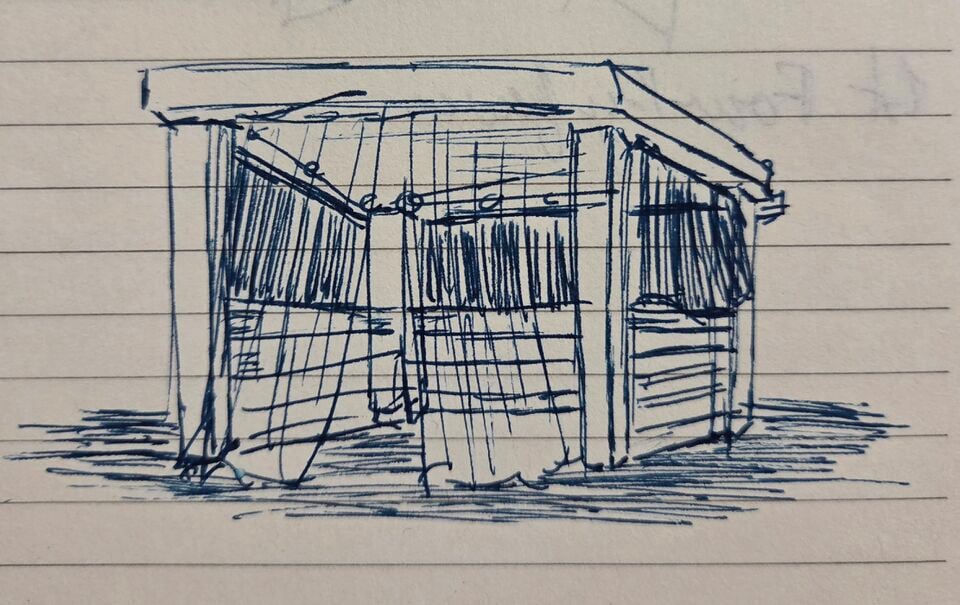 Sketch of an early concept for the Water-Den, March 2026
 -
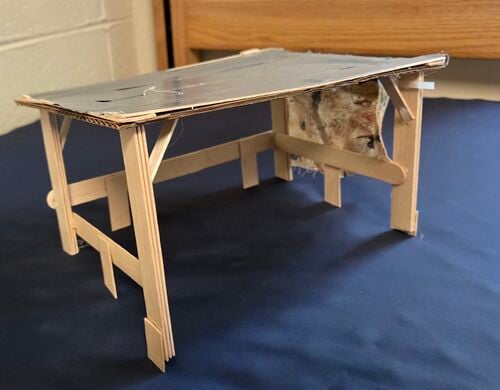 First physical model of Water-Den, way to test the roof slant


Final product
[edit | edit source]The finish product, known as Water-den, takes on a dug-out design with a slanted roof and half walls of recycled canvas and pallet boards. It withstands heavy winds, pelting rains, and radiating sunlight. This provides students and staff with a safe, covered space to work and learn.
The structure itself can hold 10 to 15 people at a time, allowing for classes to be held within the space. This amount of available space also allows farm staff to storage supplies closer to the farm. Hooks within the structure help keep materials off the ground. Shelving along the walls provides even more storage as well as a place for students to place drinks and food as needed.
Because of the upper canvas walls, the structure can easily accommodate to different weather conditions. For instance, portions can be unclipped to allow for air circulation within the structure. This is important for the few sunny days in the Arcata Bottoms. Similarly, the canvas walls can be clipped into place to provide increased protections against wind and rain at the farm. The canvas can also be completely removed and set aside to avoid putting strain on the structure during the harsh winds to come to the farm. Our team implemented this characteristic after learning about the previous structure's battles with the wind
Construction
[edit | edit source]Prepare the Area
[edit | edit source]- Measure out an area of 12ft by 8ft, marking each corner
- Clear the area within and around the measured space
- Dig holes in each corner to a depth of 2 ft, ending with a total of four that line up those around it
Constructing the structure
[edit | edit source]- Place each 4x4x10 pressure-treated post into back two holes
- Set both in concrete, utilizing teammates to keep each post level
- Repeat with 4x4x12 in the front two holes, lining these posts up with the back two
- Measure out roof with respect to the slant of the roof
- Remove excess wood from the post based on the measurement
- Attach stringers
- Attach rafters, utilizing supports
- Screw fiberglass roof into place
- Dig shallow trench between both 12ft-to-10ft distances and 10ft-to-10ft distances
- Prepare pallet walls by removing excess nails from pallet boards
- Place pallets along the trenches, filling them to fit
- Measure and cut railing according to the distance
- Nail each railing on top of the pallet boards, being mindful of exposed nails
- Nail in joist hanger to keep these in place
- The opening, space between both 12ft posts, should be without pallet boards
- Add 3 hooks each into both short sides
- Screw eye bolts into the frame
Constructing the Canvas Walls
[edit | edit source]- Measure out three pieces of canvas: one piece of 12ft by 5ft, two pieces of 8ft by 5ft on one end and 7ft on the other, creating a slope
- Cut out each piece, leaving an additional 3in for hemming
- Fold edge over twice to create a 1.5in hem around the canvas pieces
- Sew hem into place, going over to ensure security
- Grommet both long sides, 8ft and 12ft, with six grommets on each length
- Attach one carabiner for each grommet
- Attach carabiner to eye hook
-
 Early construction of Water-Den, framework of structure
 -
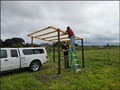 Teammates working together to attach the fiberglass roof
 -
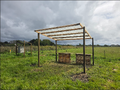 Rain structure with long side attached


How to Add the Canvas Walls
[edit | edit source]-
 Step by Step guide for adding the canvas walls to the structure.

Bill of materials
[edit | edit source]Description of costs, donations, the fact that this is just proposed, etc. For a simple cost table, see Help:Table examples#Cost Table and Template:Bill of materials for two nice formats.
| Item | Amount | Cost per unit | Total |
|---|---|---|---|
| Quick-crete — Get at Pierson's in Arcata, Ca 80lbs per bag, cost per bag | 4 | USD 9.99 | USD 39.96 |
| Pressure Treated 4x4x12 — Get at Mill yard, GRN FIR | 2 | USD 23.92 | USD 47.84 |
| Doug Fir 2x4x12 — Get at Pierson's | 6 | USD 8.00 | USD 48.00 |
| Doug Fir 2x4x8 — Get at Pierson's | 5 | USD 4.00 | USD 20.00 |
| Grommet eyelets — Get at https://www.amazon.com/Glarks-Gun-Black-Thickened-Grommet-Eyelets/dp/B09Y56NLXS?refinements=p_36%3A-1000 Gun-black, 20pcs per unit, 25mm/1" | 2 | USD 8.99 | USD 17.98 |
| Roof Panels — Get at Pierson's Fiberglass, 10ft | 6 | USD 35.00 | USD 210.00 |
| Eye-bolts(Pierson's) — Get at Pierson's intended to be a total of 16 eye-bolts, Pierson's ran out | 8 | USD 1.89 | USD 15.12 |
| Eye-Bolts(Home Depot) — Get at Home depot See previous for explanation | 8 | USD 1.47 | USD 11.76 |
| Carabiner(Pierson's) — Get at Pierson's Intended to be 19 in total, Pierson's ran out | 14 | USD 0.99 | USD 13.86 |
| Carabiner(Home Depot) — Get at Home Depot See previous for explanation | 5 | USD 1.97 | USD 9.85 |
| Roof Supports — Get at Pierson's | 14 | USD 1.39 | USD 19.46 |
| Shelving 1x8 — Get at Pierson's | 1 | USD 16.92 | USD 16.92 |
| Hooks — Get at Ace Hardware | 6 | USD 2.59 | USD 15.54 |
| Screws — Get at Mill yard Comes in bulk | 1 | USD 10.99 | USD 10.99 |
| Pressure Treated 4x4x10 — Get at Pierson's Doug Fir | 2 | USD 25.05 | USD 50.10 |
| Grand total | USD 547.38EUR 470.75 <br />GBP 399.59 <br />CAD 678.75 <br />MXN 11,412.87 <br />INR 40,971.39 <br /> | ||
Grading criteria for costs:
- Formatting (should look good, see Help:Table examples#Cost Table formatting) +20
- Thoroughness and up-to-dateness of budget (should display necessary components, including donations, have an introduction, etc) +40
- Mathematical accuracy +30
- Extra (sortable, etc) +10
Operation
[edit | edit source]This is how to operate. It should have a brief introduction. You might want to show images or videos with step-by-step instructions when needed.
With help from a second person, open the canvas wall that needs to be attached
Starting at both ends, attach the end carabiners to the end eye hooks. Work your way inward to attach all the carabiners properly
Once the top is attached, connect the bottom carabiners to the bottom eye hooks
Maintenance
[edit | edit source]Water-Den, as a structure, requires very little maintenance over an extended period of time. Within a month to a year of noticed disrepair, farm staff could check and repair the canvas walls of the structure. Every 5 years, it's best to replace the canvas used on the walls to ensure structural integrity. The wood should also be restained or oiled at this point in time. Both tasks will be preformed by farm staff.
Maintenance schedule
[edit | edit source]- Daily
- Pick up trash
- Monthly - Yearly
- Repair canvas as needed
- Every 5 years
- Stain/oil wood
- Replace canvas
Conclusion
[edit | edit source]Lessons learned
[edit | edit source]During this experience, our team learned how much work goes into engineering products for the public. We had to do more than just build to a prompt as we had in the past. It taught us how communication, research, and presentation played into our tasks as engineers. If a product doesn't satisfy the needs of a client, then it should be constructed for them. We also learned how much documentation is required to create a product.
If our team could do this project over, then we would take more time with the design and researching the best building style to apply to the structure. This would increase its longevity and fulfill our requirements more. We would also request more time. Due to the lack of time to build our structure, our team had to forgo some design elements that would have made the structure better at tackling the rain.
Next steps
[edit | edit source]Currently, there are plans for a grad student artist to come in and decorate the structure. This will provide a more welcoming feel to the structure. It will also fit the structure into the surrounding area.
In the future, our team discussed adding a rain catchment system to the roof of our structure with the lead of the farm. They brought up concerns for a lack of water in the area during the summer and believe that a catchment system attached to the roof would help solve this issue.
Team
[edit | edit source]Introduce team and semester in the following format: User:OathAbiding913, User:, User:, User:
- User:OathAbiding913
- User:Daniel.Richards
- User:Isabelle Carroll
- User:Ruben Janssen
References
[edit | edit source]- ↑ Climate Data. 2021. “Data and Graphs for Weather & Climate in Arcata” Arcata Climate(data). Accessed February 19, 2026. https://en.climate-data.org/north-america/united-states-of-america/california/arcata-15733/
| License | CC-BY-SA-4.0 |
|---|---|
| Organizations | Cal Poly Humboldt |
| Cite as | Qualla Jo Ketchum, Oath Duncan (2026). "CASA Student Farm rain structure". Appropedia. Retrieved October 9, 2026. |
Cite error: <ref> tags exist for a group named "LitR", but no corresponding <references group="LitR"/> tag was found