


CASA Student Farm primary accessible pathway

| Authors | Dean Bruhl Cruz Rezin Hutt Maxwell Lomeli |
|---|---|
| Location | Arcata, United States |
| Status | Deployed |
| Made | Yes |
| Replicated | No |
| Uses | education, science |

The primary accessible pathway for the Cal Poly Humboldt CASA Student Farm was created in spring of 2026 by the Phantom Pain engineering 205 group. This group consisted of freshmen Dean Bruhl, Rezin Hutt, Maxwell Lomeli, and Cruz Ramirez. The project was started to create a pathway so that people with mobility issues can access the farm.
Background
[edit | edit source]The project that we have been given is to design, create, and implement a accessible primary path for the CASA program at Cal Poly Humboldt during the spring semester of 2026. The purpose of the pathway that our team will be creating is to allow for equal access to different portions of the student farm for all students in the CASA program.
Literature Review
[edit | edit source]Introduction
[edit | edit source]The literature review analyzes several sources researched in order to gain a better understanding of various fundamentals for this project. The following subsections help to outline the aspects considered, methodology, and special insights that show our approach to this project. Organizing our literature properly helps to clearly trace how each of the topics contributes to the project's foundation and how the continuing research helps to shape decisions and change options throughout the development of the design and analysis phases of this project.
Farm Location
[edit | edit source]The Critical Agriculture Studies & Agroecology (CASA) student farm is located a few miles away from the Cal Poly Humboldt campus. The farm is located in Arcata, California, near the Arcata Bottoms, just south of Arcata's downtown. The CASA student farm is located on Foster Road. The university started working with the land around June 2025. It is a twenty-six-acre plot with currently two acres being used by the student farm, with the hope to soon expand to six acres, along with the other acreage being improved upon. (Dr. R Byrd, personal communications, 2/17/26)
CASA Student Farm Purpose
[edit | edit source]The Critical Agriculture Studies & Agroecology (CASA) farm functions as an essential applied learning environment within the emerging CASA program, which helps to provide students with a rigorous setting in which to examine the social, ecological, and political dimensions of food systems. As Dr. Byrd said, it's combining critical theory & various primary subjects with agriculture. The farm serves as a somewhat living laboratory where theoretical concepts can be tested and refined through students' and faculty's hands-on experience. As the CASA farm improves, it advances the program's mission to prepare students to critically analyze and transform food systems toward more equitable and sustainable futures (Humboldt State University, Critical Agriculture Studies & Agroecology BA (2/23/2026).
Sustainable Walkway Designs
[edit | edit source]The design of a walkway is one of the most important decisions in the creation of our walkway. We need to prioritize accessibility, while also keeping in mind sustainability, durability, and adaptability (Keil 137). Many designs cover the issue of runoff and permeability, as water cannot infiltrate into the soil easily and will instead runoff to the side and damage the soils surrounding it (Zandvoort et al. 565 ). Designs that purposefully incorporate holes that allow the water to reach the soil faster solve this problem, but come at the cost of accessibility as they can be hard for crutch and cane users to navigate without getting wedged or becoming tripping hazards (Junita et al. 120). Many accessible designs also require more permanent features, but that impedes the adaptability goals.
Materials
[edit | edit source]Materials make up the foundation of any project and are a key focus point to determining longevity, accessibility, and removability of a walkway. Potential materials are brick, concrete, wood, sand, packed earth, cloth, gravel, and stone. Options like brick, concrete, and wood offer the most accessibility but the least removability; while sand and gravel suffer from the opposite problem (Green). Packed earth has the potential to be both accessible and removable with the drawback of being muddy. Cloth can also be accessible and removable but offers little longevity. (White 83-84). All options have the potential to be long term solutions if implemented properly with the sole exception of cloth (Green and White). The drawbacks of each individual material means that they must be utilized in tandem with each other.
Permeability
[edit | edit source]An important factor of the material to consider is its permeability, especially in a place like Humboldt with massive amounts of rainfall. Permeability plays a big role in human comfort with a path (Noviandini 5). This is exemplified in a garden where improper drainage may affect surrounding crops. Materials such as sand and gravel offer high permeability but little accessibility (White 52). This means that if implemented, they will likely have to be used as fillers or a foundation to provide drainage.
Accessibility
[edit | edit source]The accessibility of the walkway in this project is an important consideration. Under some of the regulations, it is stated that a “path of travel” includes sidewalks, streets, and parking areas, as a path that is unobstructed and that is continuous (“Americans with Disabilities Act Title III Regulations”). In addition, any alteration that is made for accessibility must be beneficial to those who would need an accessible route.
Problem statement
[edit | edit source]The objective of this project is to design, create, and implement accessible walkways and paths for the garden. Our final design will allow for all students and faculty to be able to traverse around the garden. The paths will allow people in wheelchairs and people using mobility devices to access the garden, as before our design is implemented, there are no pathways.
Criteria
[edit | edit source]Criteria we have to consider are accessibility, ease of implementation, removability, durability, and costs. To define these further our path must be ADA compliant, it must be feasible to construct within the time we are given for the project, it must be able to be removed per client request, it must not require upkeep, it must be able to last after use with heavy farm equipment, and it must be able to be constructed with the limited budget.
| Criteria | Description | Weight (1-10) |
|---|---|---|
| Accessibility | The main reason for this path is that wheelchair and other mobility impaired people must be able to use our path. | 10 |
| Cost | We must make a path that is not too expensive to create, and potentially expand should the design work well. | 6 |
| Ease of Implementation | The path should be easy to create and not require heavy work. | 7 |
| Durability | The path must hold up in the weather and as people use it. | 8 |
| Removability | The path must be able to be moved, or removed should changing layouts of the farm need that. | 8 |
Prototyping
[edit | edit source]Our prototyping worked with our first design of using stone tiles to create a durable pathway. Our first design used stone tiles but, we soon realized would be far out of our budget and to many work hours to fit in the semester. After that we began brainstorming and moving towards various alternatives such as poured concrete, packed earth, or a raised wooden path. After a discussion with Professor Grafman we discovered what we would end up using for the final design of the project, pulverized rocks called trail mix.
- Sample gallery
-
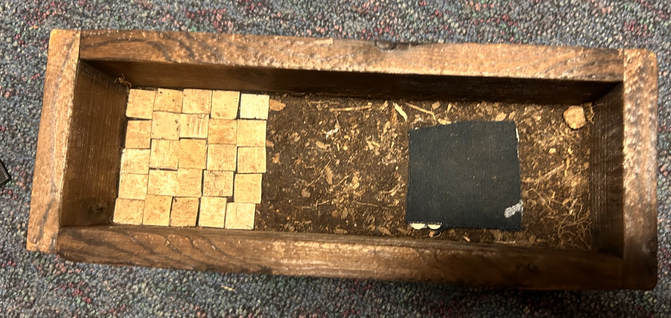 Our first prototype was to test how our current design would work. We used wood to simulate the tiles.
 -
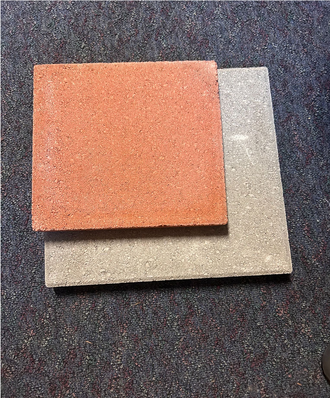 The first tile idea used 12 inch by 12 inch tiles, or 16 inch by 16 inch tiles.


Final product
[edit | edit source]Our final project was using trail mix. We first dug a 6 inch deep hole, then tamped the dirt until it was even. After that, we staked a weed mat and added the trail mix and tamped again. After it was tamped flat, we sprayed water over the path to finish it.
Construction
[edit | edit source]For the 205 engineering project, we were unable to complete more than digging the initial hole. It was very effort consuming, and we had to halt construction due to the soil contamination.
- Sample gallery
-
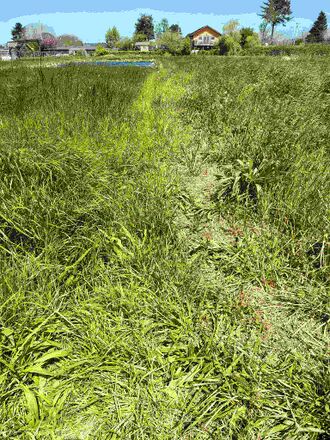 Before we started construction, the pathway looked like this
 -
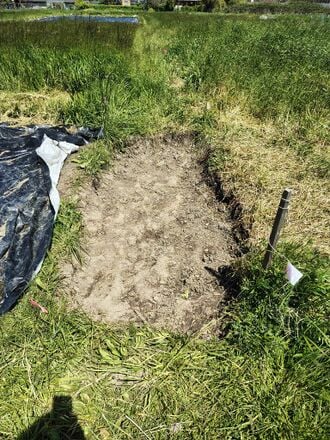 After our first day of digging, we had a 4 foot by 10 foot by 6 inch hole
 -
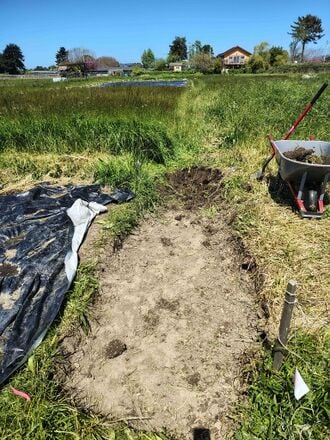 Our group attempted to do work on our own, but much more work was done when we worked as a group
 -
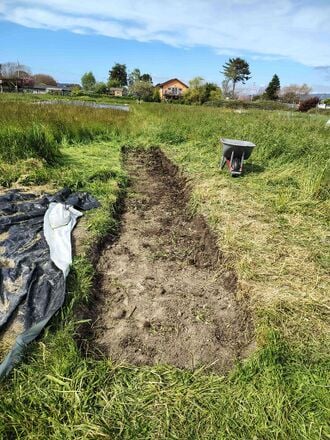 After our third day of digging, we had a 4 foot by 30 foot by 6 inch hole
 -
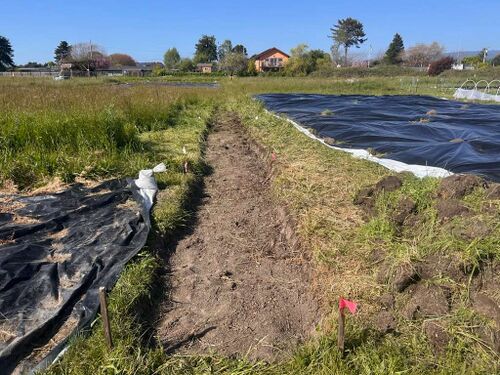 After our fourth day of digging, we had a 4 foot by 50 foot by 6 inch hole


Video
[edit | edit source]Bill of materials
[edit | edit source]| Item | Amount | Cost per unit | Total |
|---|---|---|---|
| Weed Barrier 4ft x 50 ft | 5 | USD 22.99 | USD 114.95 |
| Trail Mix One Yard (10ft x 10ft x .25ft) | 20 | USD 80.00 | USD 1,600.00 |
| Delivery Fee (Over 9 Yards) | 1 | USD 170.00 | USD 170.00 |
| Landscape Staples/Stakes | 1 | USD 10.00 | USD 10.00 |
| Grand total | USD 1894.95EUR 1,629.66 <br />GBP 1,383.31 <br />CAD 2,349.74 <br />MXN 39,509.71 <br />INR 141,837.01 <br /> | ||
Operation
[edit | edit source]The construction process for an ADA-compliant pathway made from Trailmix, a crushed rock mixture consisting of stones ¼ inch and smaller. This pathway excels in outdoor settings that require high permeability, such as very rainy areas or in gardens where improper drainage can be detrimental. The tools required are a shovel, a tamping bar, a wheelbarrow, and a hose. The materials required are a weed barrier, trail mix, and gardening stakes. Use a weed barrier the length of your path with a minimum 4-foot width to maintain ADA compliance. To determine the amount of trail mix required, you first must determine the volume of your path. Do this by multiplying the square footage of your path by .5 to account for the mandatory depth of six inches required to construct a trail mix path. When purchasing trail mix, it will be sold in yards; one yard is equivalent to 25 cubic feet of volume. Our path was 250 feet in length and four feet in width, so we purchased 20 yards of trail mix (25x4x.5=500ft cubed). Lastly, you will need two stakes for every 10 feet of path to hold the weed barrier in place, plus an additional 2 to start. To begin construction, dig out the area of your path to a depth of six inches. Once dug out, use the tamping bar to level and compact the earth. This will provide a stable foundation that will prevent the trail mix from shifting over time. After, fill the path to half its depth with trail mix and tamp again to settle the rocks. Fill the rest of the path with trail mix tamp once more and use a hose to water the path. This completes the construction of the path. The path will have some upkeep depending on the amount of use and wind in the area. Be sure to check the path yearly and replace trail mix as needed when doing this tamp the path again as well.
Maintenance
[edit | edit source]Basic maintenance
This type of pathway will need minimal maintenance but will require some maintenance. That being re-tamping the trail mix based on the best judgement of those caring from this pathway. Our recommendation for how often to re-tamp the pathway is once a year based on the traffic this pathway will get.
Weed control
This pathway's primary way of weed control is a weed mats that will attempt to prevent weeds from growing through the pathway. But in the case that weeds grow through the pathways remove the weeds through either pulling the weed or any other method of removing weeds.
Gravel replacement
Through regular use of this pathway and/or through the weather of Aracta it is possible to that there will be some loss of the gravel, in this event the best steps to take are to use more gravel to fill or level the area with loss and tamp the section down to match the rest of the pathway.
Maintenance schedule
[edit | edit source]- Yearly
- Check to make sure the path is flat and level
- If the path is not flat or level, add more trail mix, level, and then water the path.
Conclusion
[edit | edit source]Testing results
[edit | edit source]We found through testing that the only feasible design for our constraints was trailmix. It handled well with daily use typical to what use on the farm would be like.
Lessons learned
[edit | edit source]We learned that you need to plan ahead for possible setbacks and to not get too invested in an idea before you know for sure if it is going to work or not.
Next steps
[edit | edit source]If our pathways use on the farm works as well as our client hoped for, there might be a future of extending the pathway to connect more of the farm.
Troubleshooting
[edit | edit source]| Problem | Suggestion |
|---|---|
| Path is sinking | Add more trailmix on top to level path |
| Hole in path | Add more trailmix to fill the hole |
Team
[edit | edit source]- Dean Bruhl
- Undergraduate in Environmental Resource Engineering
- Rezin Hutt
- Undergraduate in Environmental Resource Engineering
- Maxwell Lomeli
- Undergraduate in Mechanical Engineering
- Cruz Ramirez
- Undergraduate in Mechanical Engineering
References
[edit | edit source]
| License | CC-BY-SA-4.0 |
|---|---|
| Organizations | Cal Poly Humboldt |
| Cite as | Qualla Jo Ketchum, Cruz, Dean Bruhl (2026). "CASA Student Farm primary accessible pathway". Appropedia. Retrieved October 14, 2026. |