


Swetman Makerspace wood mill surface

| Authors | Madeline Herring Jack Farajian Ozlo Mitchell Rosalyn Luong |
|---|---|
| Location | Arcata, California, United States |
| Environment | SWETMAN Makerspace at Cal Poly Humboldt |
| Status | Deployed |
| Made | Yes |
| Replicated | No |
| Uses | education, science |

For the Spring Semester 2025, Engineering 205 final project, the MaJOR team was assigned to create a temporary level surface for the wood saw. After multiple years of arguing, Cal Poly Humboldt finally purchased a wood saw, however due to construction, they had to find a temporary placement for it. The MaJOR team was commissioned by the SWETMAN Makerspace to create a temporary structure that could be easily removed in two years and provide a level surface for the wood saw.
Background
[edit | edit source]The level surface or the sawmill project is intended to be placed as a temporary build in the SWETMAN backyard. The sawmill will allow for students and faculty to have a greater access to wood materials, which can be used for future projects by both the staff and students who use the SWETMAN makerspace. The surface is meant to be in place for approximately 2 or 3 years, until it is relocated to another building. The main client of this project is Matt, who runs the makerspace area, and the expert for this project was Collin. This project took place over the Spring semester of 2025.
Problem statement
[edit | edit source]The objective of our project is to create a level surface to hold the wood saw level and stable, allowing for full operation of the saw safely and efficiently. The structure is designed to evenly distribute the weight of the wood saw, preventing it from sinking into the loose dirt in the backyard, or otherwise becoming unstable or uneven.
Criteria
[edit | edit source]The criteria were decided by team MaJOR as well as the client. The table below shows the criteria decided with a description of each criterion and the weight of it. The most important criteria were safety, cost effectiveness, ease of use, and outdoor resistance. These were the main criteria that team MaJOR took into consideration when deciding on the design.
| Criteria | Description | Weight (1-10) |
|---|---|---|
| Stability | The build must be secure and not tip over or sway | 7 |
| Moveable | The build is meant to be relocated in 2-3 years | 5 |
| Cost Effective | The budget of this project is $200, although we can tap into our own funds. | 9 |
| Outdoor Resistant | The platform will be outside year round, including 114 days of rain per year | 8 |
| Ease of Use | How will logs be loaded on to the mill, and how user friendly will the build be? | 8 |
| Weight Capacity | The mill must be able to carry the weight of the sawmill, as well as the weight of the logs. | 7 |
| Aesthetics | How aesthetically appealing will the sawmill look? | 3 |
| Safety | Safety of students and staff as they use the sawmill | 10 |
Prototyping
[edit | edit source]While making our first prototype, we hoped to learn more about the general dimensions of our build and how it would best fit into the SWETMAN backyard. To make this prototype, we first drew the layout of the backyard of SWETMAN. We then created the gravel pad and sleepers, which was the build we were set on at the time. We did not attach the gravel pad to the cardboard so that we could figure out the best way to orient the sawmill within the dimensions of the SWETMAN backyard, which we decided would be at the side closest to the paved path, on the West side of the yard. This is how the build is laid in figure 1, which shows the final orientation we chose for the sawmill.
For our second prototype, we hoped to learn more about our cost since we were told that we would be getting free wood. We also wanted to finalize some of our design since we were not sure about how much gravel and concrete we needed. While creating our second prototype, we learned that our original plan with the gravel was too expensive. We first ran the numbers to calculate how much money we needed to create our gravel pad. After realizing that it would completely decimate our budget we talked to our expert and decided to switch to concrete footings instead of spending money to buy gravel. We are going to buy concrete and pour it ourselves to create 8 footings for the structure. Our second prototype can be seen in figure 2.
- Prototype Images
-
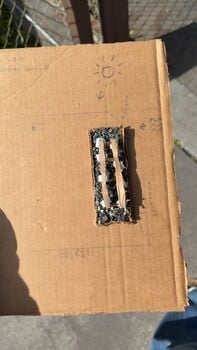 Prototype 1(Left) & Prototype 2(Right)
 -


Final product
[edit | edit source]While the original decision was to create a sleepers and shims method in combination with a gravel pad, upon a closer look at cost analysis, it was decided to avoid using gravel. Instead, the new solution became to dig out a level area for the sawmill build to set, without using gravel. Also, instead of sleepers and shims, group MaJOR decided to rest the sleepers on bracings that will be set into concrete footings. The final product has eight of these footings, four for each side of the sawmill, and each of the footings is laid 8 inches deep in the dirt. The final product is placed in the SWETMAN backyard, until it will be relocated in a couple of years.
Construction
[edit | edit source]Material list
- At Least 34.5ft of 4x4s (2:13’6” & 4: 22.5”)
- 16.5ft2 of 1in Plywood
- 4 4x4 Post Bases
- 320 lb Concrete Mix
- 16 1/4in Lag Screws
- 16 8 in Screws
- 4 gallons of Wood Sealer
Tool List
- Shovels
- Rakes
- Jig Saw
- Hammer
- Concrete Mixer
- String for Leveling
- Level
- Miter Saw
- Paint Brush
- Drill
Instructions
- Dig out the top level of grass out of the backyard of SWETMAN Makerspace using shovels.
- Remove any obstructions such as leftover wood or planter boxes with shovels, pickaxes, and axes.
- Use stakes and string to level and measure out the dimensions of the mill and where we will need to dig out holes for the footers
- Use the measurements to dig out evenly spaced 9in by 9in holes in the ground.
- Use jigsaws to cut up plywood into 16 9in by 9in squares and 16 8in by 8in squares
- Assemble the cut wood into boxes to mold the concrete in using nails or a nail gun
- Plant the molds into the ground and secure them by forming the dirt around them
- Mix concrete in a large concrete mixer by combining bags of premixed concrete and water and stirring with a concrete mixer drill bit
- Pour the concrete into the forms and level them off
- Using the strings as a reference, sink an aluminum reinforcement into each concrete footing lined up with each other to allow a beam to sit flush in a line.
- Take the lumber and cut it to size making two 13’6” beams and coat them in 2-3 layers of weather resistant coating
- Lay the lumber in the aluminum reinforcements and then drill ¼ in Lag bolts into the reinforcements securing the beams in place
- Cut 4 22.5” sections of beam and coat them in 2-3 layers of weather resistant coating
- Lay the 22.5” beams as cross section between the two 13’6” and use 2 8” lag bolts on each side to lock them in place
Bill of materials
[edit | edit source]Below is the bill of materials for this project. Any materials that cost $0.00 were either donated or given to team MaJOR for free by the school.
| Item | Amount | Cost per unit | Total |
|---|---|---|---|
| 13'6" 4x4s | 2 | USD 0.00 | USD 0.00 |
| 22.5" 4x4s | 4 | USD 0.00 | USD 0.00 |
| 16.5 sq. ft Plywood | 1 | USD 0.00 | USD 0.00 |
| 4x4 Post Bases | 8 | USD 12.37 | USD 98.96 |
| 80lb Concrete Bags | 4 | USD 9.59 | USD 38.36 |
| 1/4in x 6in Lag Screws | 16 | USD 0.00 | USD 0.00 |
| 8in Screws | 16 | USD 0.00 | USD 0.00 |
| 1 Gallon Wood Sealer | 4 | USD 19.98 | USD 79.92 |
| Grand total | USD 217.24EUR 186.83 <br />GBP 158.59 <br />CAD 269.38 <br />MXN 4,529.45 <br />INR 16,260.41 <br /> | ||
Operation
[edit | edit source]Due to this being a structure for holding a sawmill, there is nothing to operate on. Just assemble the sawmill onto the structure. The MaJOR team was not responsible for this task.
Maintenance
[edit | edit source]Due to this being a temporary structure, there is no maintenance. If needed, personnel can recoat the wood with water resistant coating. There will be maintenance needed on the sawmill itself, but setting up the sawmill was not part of this project.
Maintenance schedule
[edit | edit source]Personnel can recoat water resistant coating if needed and do general maintenance on the sawmill.
Conclusion
[edit | edit source]Testing results
[edit | edit source]Not completed yet, no testing results
Discussion
[edit | edit source]Discuss the testing results.
Lessons learned
[edit | edit source]During this project, team MaJOR learned about the importance of being flexible. This is because the intended plan for this project was changed several times along the way. Also, there were setbacks in terms of timeline, such as rain, which pushed back the team's time to lay concrete for the build.
Next time, team MaJOR would see if there was a way to collect more free materials for the build. This time, thanks to a faculty member at the SWETMAN makerspace, the lumber which was used for the project was entirely free. Therefore, it would be largely useful to reach out to other resources for the possibility of having more free materials, since the team was slightly overbudget during this project.
Next steps
[edit | edit source]The next steps for this project would be to implement a ramp. The ramp would be used to help load logs onto the platform. The SWETMAN makerspace also has an engine hoist, which could be used in assistance with the ramp. Team MaJOR did not include a ramp, as this was not part of our original problem, and the group was already over budget.
Team
[edit | edit source]Introduce team and semester in the following format:
- Jack Farajian
- Ozlo Mitchell
- Rosalyn Luong
- Madeline Herring
References
[edit | edit source]
| Authors | Madeline Herring and Jack Farajian, Ozlo Mitchell, Rosalyn Huong |
|---|---|
| License | CC-BY-SA-4.0 |
| Organizations | Cal Poly Humboldt |
| Cite as | Madeline Herring and Jack Farajian, Ozlo Mitchell, Rosalyn Huong (2025–2026). "Swetman Makerspace wood mill surface". Appropedia. Retrieved October 21, 2026. |