


StartUp Humboldt grand trophy 2026

| Authors | Dawson Pennington Logan Perry Leo Burks Lazarus |
|---|---|
| Location | Arcata, United States |
| Status | Deployed |
| Made | Yes |
| Replicated | No |
| Uses | education, science |

The StartUp Humboldt Grand Prize Trophy is a wooden icosahedron (20 sided shape) encasing a round terrarium with living plants. It was constructed in Fall 2025 by Leo Burks, Lazarus Onyango, Dawson Pennington, and Logan Perry, during the Cal Poly Humboldt class ENGR 205 (Intro to Design).
Background
[edit | edit source]This product is the Grand Prize trophy for the StartUp Humboldt startup competition, taking place at the small business development center in Arcata, CA. StartUp Humboldt is seeking this trophy to make the award better and more meaningful than a standard trophy.
Problem statement
[edit | edit source]The objective of this project is to create an inspiring and unique trophy that will be presented to the grand prize winner of the first StartUp Humboldt competition.
Criteria
[edit | edit source]The criteria considered when designing the StartUp Humboldt trophy
| Criteria | Description | Weight (1-10) |
|---|---|---|
| Holdable | Must weigh less than 10 pounds and be smaller than a 30 cm in length | 9 |
| Modern | Must reflect the ideals of modern infrastructure and industry. This includes clean lines, bright lights, and straight edges | 8 |
| Rustic | Must posses design inspired by nature and older architecture | 9 |
| Humboldt | Must showcase aspects of the Humboldt spirit (greenery, redwoods, etc.) | 7 |
| Cost | The total cost must be below $250 | 6 |
Prototyping
[edit | edit source]Here are prototype photos taken during the design process
- Prototype Photos
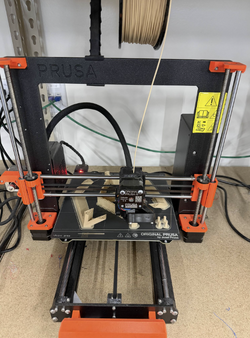
The trophy being printed with 3D wood filament 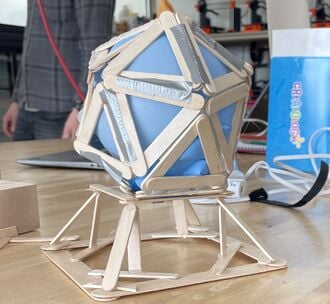
The initial StartUp Humboldt trophy prototype


Final product
[edit | edit source]The trophy features a wooden icosahedron encasing a hand blown glass terrarium with a diameter of 6 inches. The terrarium holds plants that are native to the Humboldt area. It is fully contained and self-sufficient and only needs to be watered if the terrarium appears as dry as it has its own contained water cycle with micro organisms to sustain the plant's CO2 intake and indirect sunlight to sustain photosynthesis. The whole trophy rests upon a wooden base with StartUp Humboldt's logo inscribed on it.
Construction
[edit | edit source]The construction of this trophy starts with 3D printing the icosahedron shape using Woodfill PLA filament. The shape must be large enough to hold the glass terrarium inside and needs to have a way to open up to place the terrarium inside or tend to it, if needed. For the base, two wooden blocks are needed: one for the top step and one for the bottom step. The bottom step dimensions will match the width of the outer points on the icosahedron, the top step will be smaller than the bottom step but large enough to hold the icosahedron. For the top step to hold the icosahedron, cut the shape of a pentagon into the top step so that the icosahedron slots into the base and is held in place. Once the base and icosahedron are constructed, they can be sanded down until smooth and a stain of choice can be applied. For this project a darker stain was used at the request of the client.
Bill of materials
[edit | edit source]| Item | Amount | Cost per unit | Total |
|---|---|---|---|
| Preserved Reindeer Moss | 2 | USD 14.85 | USD 29.70 |
| Horticultural Charcoal | 2 | USD 9.99 | USD 19.98 |
| Monstera Potting Soil | 2 | USD 16.89 | USD 33.78 |
| Succulent Gravel Pebbles | 2 | USD 16.99 | USD 33.98 |
| Woodfill 3D Filament | 1 | USD 55.99 | USD 55.99 |
| Cork Stoppers | 1 | USD 9.99 | USD 9.99 |
| Grand total | USD 183.42EUR 157.74 <br />GBP 133.90 <br />CAD 227.44 <br />MXN 3,824.31 <br />INR 13,728.99 <br /> | ||
Maintenance
[edit | edit source]Most trophy's do not require any maintenance, however because there is a living component within the trophy, some may be needed.
- Weekly
- Monitor the plants inside the terrarium to check for the plants health
In case it is needed:
- Replace or water plants as necessary
Conclusion
[edit | edit source]Testing results
[edit | edit source]The terrarium trophy was tested for both structural stability and plant sustainability. The PLA frame successfully supported the glass bowl without flexing or deformation, and the dowel joints held securely during handling.
Discussion
[edit | edit source]Plant growth tests over a two week period showed healthy results. Humidity and moisture levels inside the glass remained consistent, and minimal watering was needed through the cork opening.
Lessons learned
[edit | edit source]Throughout this project, our team learned the importance of precise measurement and tolerances when combining 3D-printed and handmade glass components.
Next steps
[edit | edit source]The next step is completing the finishing touches on the Terrarium Trophy. This includes staining the wooden base to highlight the natural grain, laser engraving the “StartUp Humboldt” logo for a professional look, and applying a protective clear coat to preserve the materials. Once these steps are finished, the trophy will be fully assembled, polished, and ready for display.
Troubleshooting
[edit | edit source]| Issue | Possible cause | Solution |
| Condensation buildup inside terrarium | Overwatering or tight seal | Remove cork for 1–2 hours to vent moisture |
| Frame feels loose at joints | dowels misaligned | add a thin layer of glue |
Team
[edit | edit source]- Leo Burks
- Lazarus Onyango
- Dawson Pennington
- Logan Perry
References
[edit | edit source]
| Authors | Leo Burks, Lazarus, Dawson Pennington, Logan Perry |
|---|---|
| License | CC-BY-SA-4.0 |
| Organizations | Cal Poly Humboldt |
| Cite as | Leo Burks, Lazarus, Dawson Pennington, Logan Perry (2025–2026). "StartUp Humboldt grand trophy 2026". Appropedia. Retrieved October 12, 2026. |