


StartUp Humboldt audience takeaways

| Authors | Kieren Cumming Damian Kuntz Alexander Miyoshi Enrique Ramirez |
|---|---|
| Location | Arcata, United States |
| Status | Deployed |
| Made | Yes |
| Replicated | No |
| Uses | education, science |

Introduction
[edit | edit source]Team Master Link was tasked with the problem to be able to design and manufacture over 100 items created for an event takeaway. After brainstorming with the client, we landed on making pens for the event. The goal of creating these pens is to make a unique design representing Humboldt County and Startup Humboldt through aesthetics and sustainability. While also developing a way to design a manufacturing process to be able to mass-produce these pens in an efficient fashion by the deadline. The design process for this project began September 15th, and through researching, brainstorming, and prototyping, our first pen was created in the first week of December, 2025. Motivations that have helped drive us to accomplish this project includes providing support to the goals of Startup Humboldt, which is to support local businesses and entrepreneurs. Other motivations include wanting to accomplish a challenge of designing a product and a manufacturing routine to be able to produce multiple of our products. The intended users for our pens are for anybody who attends the Startup Humboldt Competition in 2026, as these pens will be handed out as memorabilia for the event, which has a function.
Background
[edit | edit source]Startup Humboldt is an organization that helps guide local entrepreneurs in creating their own business in Humboldt County. They are hosting a competition that will award $200,000 to contestants who show promising concepts and ideas for businesses that will create jobs in Humboldt County. Through the course ENGR 205 Introduction to Design at Cal Poly Humboldt, they tasked our group to make a minimum of 100 takeaways to be given out at the award ceremony in April 2026.
Problem statement
[edit | edit source]The objective of this project will be to design a small, easily reproduced item to give away, as well as an easy, relatively quick way to produce these items with minimal training or experience using machinery and other processes.
Criteria
[edit | edit source]The criteria list below is an outline of what our client wanted the takeaways to have.
| Criteria | Description | Weight (1-10) |
|---|---|---|
| Cost | Must make 100 pens. With each pen costing less than $2. To be below the $200 budget | 7 |
| Sustainable | Must use as much sustainable material as possible. Each takeaway must be made up of at-least 85% of sustainable material. | 8 |
| Aesthetics | It must be more pleasant than a sticker. It had to represent Humboldt and the competition. | 8 |
| Usability | Has to be used daily | 9 |
| Quantity | Must make at-least 100 pens, preferably more. To | 6 |
Prototyping
[edit | edit source]
The purpose of the first prototype provided below was to have a physical embodiment of what the final product should look like. Usability was slightly tested in the sense that we drilled holes that proved wood can support an ink cartridge wood, however the problem we formulated from this prototype is that drill bits are not generally long enough to provide an insert long enough for an ink cartridge.
We also made the pens in different shapes and of varying body diameters. The goal was to make a variety of pens of varying shapes and sizes to present to the client. This way, we can get a better feel for how she wanted the pen to look. The client liked, starting from the left, the 4th pen. Which more closely relates to the size of a traditional pen.

After finding out which pen the client liked from the first batch of prototypes, we decided to 3D print 3 pens that had different profile shapes. The goal was to provide the client with pens of different numbers of sides, so the client can test which one they like the most. After testing and feeling each pen shape, the client said the 6-sided pen feels the most familiar and comfortable since it has the same number of sides as a standard pencil.

Moving into production, we started experimenting with cutting the pen shells out of wood on CNC machines. A lot of time was spent optimizing the processes in order to reduce the time to cut each part to as little time as possible. As test cuts were made, adjustments to the CNC program were made to correct for errors in the result. Improved fixturing and part holding were also used and improved to attain a higher level of reliability and consistency in cuts.


Final product
[edit | edit source]The final product of the pen provides a unique wooden design with a comfortable area to grip.
Construction
[edit | edit source]The final solution for producing over one hundred takeaways is to manufacture CNC machine-cut wooden pens.

The CNC cuts the body of the pens out of wood, which are separated into 4 sections. Having multiples of one section of the pen being cut out on a slab of wood, at one time. Starting with the outside and then flipping the slab to cut out the inside of the pen. Then repeating this process for each section. This is done to easily cut out and place the ink cartridge into the pen.

Once the body of the pen is finished cutting, the top right of the pen is placed into a laser engraver and “ Startup Humboldt 2026” is laser-engraved into the wood.

The two top halves are then glued together, as well as the two lower halves together. Making sure that the top and the bottom half aren't glued together. This allows for the pen to freely twist and allows for the ink cartridge to be extruded in and out of the pen. After gluing, all that's left is to lightly sand and add wood stain.

Video instructions
[edit | edit source]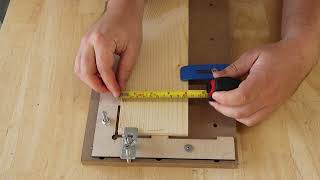

Bill of materials
[edit | edit source]The replication of producing the pens can vary based on how many pens are being produced. The more pens produced will lower the overall cost given that the materials can be bought for cheaper in bulk. The bill of materials chart below represents the cost of buying enough materials for manufacturing 100 pens.
| Item | Amount | Cost per unit | Total |
|---|---|---|---|
| Pen ink cartridge | 100 | USD 0.29 | USD 29.00 |
| Wood | 100 | USD 0.50 | USD 50.00 |
| Wood Glue | 1 | USD 5.50 | USD 5.50 |
| Grand total | USD 84.5EUR 72.67 <br />GBP 61.69 <br />CAD 104.78 <br />MXN 1,761.83 <br />INR 6,324.83 <br /> | ||
Operation
[edit | edit source]This is how to operate. It should have a brief introduction. You might want to show images or videos with step-by-step instructions when needed.
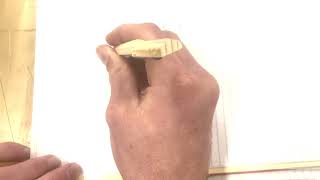
Hold it in your hand in any way you feel most comfortable. Typically, people find it most comfortable and efficient to hold the pen in between their thumb and index finger,

Twist the lower half of the pen and the upper half of the pen in opposite directions. Causing the tip to come out. The arrow in the attached image shows where to grab and twist the pen in order to extract or retract the pen's ballpoint.
Once this is achieved, the pen is used by pressing the tip against a piece of paper and sliding it across the paper, causing the ink to spill out and stain the paper.
Once the pen is done being used, it should be closed to preserve the ink and not let it dry out. To close it, you simply grab the lower half with one hand and grab the upper half with the other hand and twist it in opposite directions. This will retract the tip inside the pen.
Maintenance
[edit | edit source]The maintenance of an individual pen is very minimal and inexpensive. The only two maintenance needed is to retract the ballpoint tip after every use in order to preserve the ink. As well as, replacing the ink cartridge when the ink runs out. Which, depending on how often the pen is used, can range from 6 months to 2 years.
Maintenance schedule
[edit | edit source]This is when to maintain what. Please keep the format the same as it populates the kiosk in CCAT.
- Daily
- Retract ballpoint pen
- Store in a safe location
- Weekly
- Use pen to prevent ink cartridge from drying
- Monthly
- replace ink cartridge, if needed.
- Store in a place away from liquids
- Yearly
- replace ink cartridge, if needed.
- Every 2 years
- Check ink cartridge level, and replace if necessary
- Sand down wood if beginning to split. Apply a thin layer of polyacrylic.
Conclusion
[edit | edit source]Testing results
[edit | edit source]Discussion
[edit | edit source]Testing results
[edit | edit source]| Criteria: | Aesthetics | Form Factor | Quantity | Sustainability |
| Design | - Wooden Shell
- Laser cut |
- Dimensions | - Over 100 products | - Locally sourced wood
- Wood from local companies |
| Notes | - Testing shows that different grains of wood can alter the aesthetic of the laser cut
- Because of the small dimensions of the pen, laser cutting a small design can make it difficult to discern |
- The form factor of the final pen fits well inside a hand and is comfortable | - The quantity of 100 wood-shelled pens proved difficult to design and produce within the time constraint of 14 weeks due to the lengthy manufacturing process | - The use of sustainable wood and recycled pen parts allows this project to have qualities of sustainability |
Lessons learned
[edit | edit source]A large portion of this project takes part under the manufacturing process. If a time constraint is significant, leave an adequate amount of time for the CNC Machine to cut the wooden pen shells.
Troubleshooting
[edit | edit source]| Problem | Suggestion |
|---|---|
| Doesn't write | Replace the ink cartridge |
| Ballpoint tip doesn't come out | Check for any blockages between the two pen sections |
Team
[edit | edit source]Team Masterlink Fall 2025 Cal Poly Humboldt ENGR 205 Introduction to Design
- Kieren Cumming
- Damian Kuntz
- Alexander Miyoshi
- Enrique Ramirez
| License | CC-BY-SA-4.0 |
|---|---|
| Organizations | Cal Poly Humboldt |
| Cite as | Lonny, Enrique, EndoTsumiyoshi, KierenDavid (2025–2026). "StartUp Humboldt audience takeaways". Appropedia. Retrieved September 25, 2026. |