


SeaBin Project/SeaBin Project


Seabin is an innovative floating garbage bin that sucks up waste and debris from the ocean, such as plastic, bags, bottles, cans, among other pollutants discarded in large water sources. An invention by Andrew Turton and Pete Ceglinski
Description
The Seabin project consists of a floating garbage bin that is placed either in the sea, ports, beaches and other large sources of water, which helps collect the waste that is thrown into them on a daily basis. This project was created with the objective of keeping the ocean free of waste that could affect the future well-being of our planet. The Seabin reduces pollution, all this idea thanks to two Australians who were sailing and noticed the amount of garbage floating in the sea, this made them question why there was no system like those on land to facilitate the cleaning of these areas.

A Seabin is made with:
- From 70% to 100% recycled plastic
- Bags made of natural fibers
- Stainless steel handles
- 110/220 volt electric water pumps
- Marine grade alloy brackets
It is installed manually, has a sustainable design, and is specially made to withstand maritime conditions.
Problem
Marine pollution is one of the main problems of the modern world. Most of the ocean's pollutants are due to products derived from humanity, from heavy metals to everyday products such as plastic bags, bottles and cans. The goal of the Seabin project is to solve or, rather, reduce the high levels of pollution in the ocean by collecting small plastic waste, metals, even small amounts of fuel, among other pollutants.
Innovation proposal
The impact that the Seabin has on the ocean is reflected in both our health, that of humans and that of animals, because the ocean is our source of life, since it generates one in three breaths of oxygen, it is logical that it must be kept clean. The Seabin project is part of the solution to end the plastics in the ocean. Each Seabin can collect between one kilo and up to one and a half kilos of waste per day, which over a period of one year represents around half a tonne of plastic.
The challenge now is to achieve larger-scale, cheaper and more sustainable production of Seabin (reducing the carbon footprint it produces), and to find an alternative to the electric motor that is more environmentally friendly and accessible to a greater number of people concerned about the health of our oceans.

Bibliographic review
Literature review for this project can be found at SeaBin Project/Bibliography review .
Value proposition
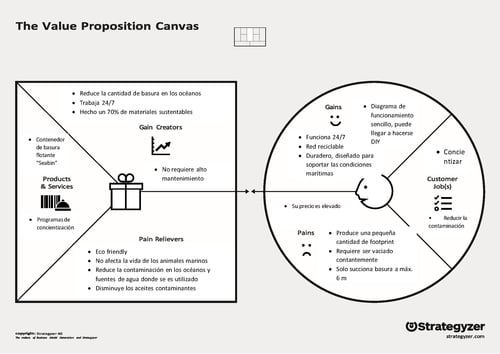
It is important to mention that in addition to directly helping to reduce ocean pollution, it has had a great impact on people through its information programs in schools and technology media, making them reflect and become aware of how their actions can affect the environment. In this way, we will be able to perceive the changes, resulting in a decrease in society's neglect of something as important as the sea and, in general, water sources.
Business model canvas
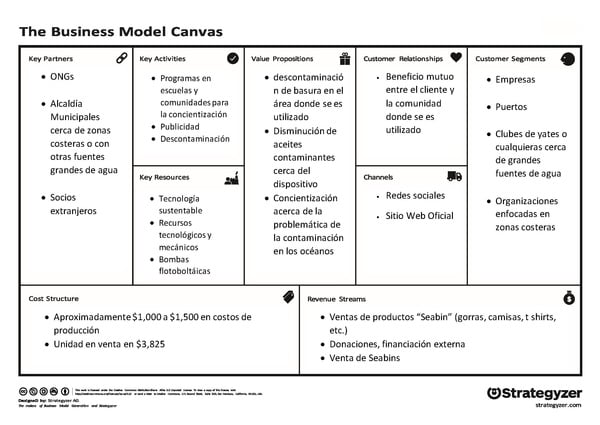
The Seabin project is not presented, nor is it the solution to pollution. Even so, it is an artifact that is undoubtedly a step in the right direction, with the purpose of creating an impact, even if it is small, in the communities where it is used and in which it can be used. Seabin consists of a floating garbage bin which is placed on the surface of the water that sucks up the garbage that passes near it, from two to six meters away, it can hold up to one and a half kilos of waste, of course it has to be emptied daily so that it better fulfills its purpose, but this does not mean that it stops working, it is always in operation. It is used in large water sources where large quantities of waste are dumped, such as beaches, ports, lakes, among others.
Budget
| Item | Amount | Cost per unit | Total |
|---|---|---|---|
| Pre-feasibility study — The study includes... (person hours) | 2 | USD 200.00 | USD 400.00 |
| Manufacturing — Cost of manufacturing a Seabin | 1 | USD 1,800.00 | USD 1,800.00 |
| Installation and Transport | 1 | USD 100.00 | USD 100.00 |
| Grand total | USD 2300EUR 1,978.00 <br />GBP 1,679.00 <br />CAD 2,852.00 <br />MXN 47,955.00 <br />INR 172,155.00 <br /> | ||
The cost of purchasing a Seabin is USD 3,825
Conclusions and recommendations
- Yes, we believe that the Seabin project is quite innovative, as it is a new and simpler way to reduce the amount of trash found in large water sources, which we ourselves pollute. It is a project that sought to convert something as common as a garbage dump and give it a complete turn and recreate it so that it contributes to the decontamination of the sea.
- Seabin is actually already available for purchase from its main page, so any individual can purchase and use it. However, the target audience is ports, yacht clubs, organizations and companies that seek to reduce pollution in the ocean and nearby water sources, which benefits people on a daily basis.
- This project, now complete, has already shown impact in the areas and communities where it has been used.
- There is a need to work more closely with NGOs and organisations or companies in coastal areas.
- The fact that a product is made from sustainable materials does not mean that it is better than the rest or that it pollutes less. Also, the manufacturing process of these materials must be taken into account in order to determine whether a final product is sustainable or environmentally friendly.
Final presentation
