Jump to content

Low-Cost Power Monitoring for Medical Devices

From Appropedia
Prototype Final Build

This project focuses on the design and development of a low-cost, portable power monitoring system for medical devices operating in low-resource environments. The system measures voltage, current, and power consumption in real time, enabling improved reliability, maintenance planning, and performance tracking for critical equipment. The design emphasizes affordability, durability, and ease of use, making it suitable for deployment in rural healthcare settings where access to advanced monitoring infrastructure is limited.

Motivation

[edit | edit source]

Medical devices in low-resource environments are often exposed to unstable power conditions, including voltage fluctuations and outages. These issues can lead to undetected failures and reduced reliability. This project aims to address this challenge by providing a simple and accessible monitoring system capable of logging electrical data and identifying anomalies in device operation.

System Architecture

[edit | edit source]

The system consists of sensing, processing, and visualization components integrated through a microcontroller-based platform.

Power is supplied from a wall outlet and routed through sensors that measure voltage and current. These signals are processed using a Raspberry Pi system with an ADC module and displayed locally while also being logged for further analysis.

Hardware Design

[edit | edit source]

The hardware system includes:

  • Raspberry Pi Zero / Zero W (main controller)
  • Hall Effect Current Sensor (ACS712)
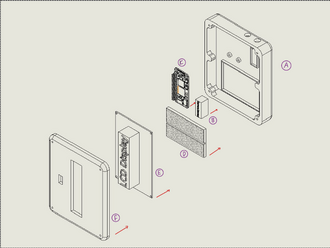
  • Exploded View of 3D Model
    Voltage Sensor Module (ZMPT101B)
  • MCP3008 ADC (analog-to-digital conversion)
  • LCD / OLED Display (real-time monitoring)
  • RTC Module (DS3231 for time tracking)
  • MicroSD Card (data storage)
  • Power supply (5V, 2.5A)
  • Enclosure with M3x16 fasteners for easy maintenance

The device is designed to be durable, with no moving parts, and is enclosed in a protective case to withstand real-world environments.

Software and Data System

[edit | edit source]

The system uses Python for data acquisition and processing on the Raspberry Pi. Sensor readings from the voltage and current sensors are collected, converted into usable measurements, and displayed in real time on the device.

The software focuses on reliable measurement and basic data handling, allowing users to monitor voltage, current, and power consumption directly. Data can be logged locally for later analysis, depending on system configuration.

Technologies used include:

  • Python (data acquisition and processing)
  • Basic data logging and visualization tools
  • On-device display for real-time monitoring

The system provides real-time feedback through the display and supports simple data tracking to help identify trends and potential issues in device performance.


Performance

[edit | edit source]

The system operates within the following design constraints:

  • Voltage range: 12V–48V
  • Current range: up to 10A
  • Power consumption: <5W
  • Measurement accuracy: within ±10%

These specifications demonstrate the feasibility of low-cost monitoring while maintaining acceptable accuracy for practical use.

Fabrication and Assembly (In Theory)

[edit | edit source]

The device is designed for ease of fabrication and maintenance:

  • Enclosure constructed from durable plastic or metal
  • Minimal assembly using four M3x16 fasteners
  • Standard PCB manufacturing process for circuit design
  • Simple wiring and modular components for easy repair

This ensures accessibility in environments with limited tools and technical resources.

Testing and Validation

[edit | edit source]

The system was tested under controlled conditions to validate performance:

  • Power-on testing with standard voltage inputs
  • Comparison of sensor readings with calibrated measurement tools
  • Simulation of power fluctuations to verify logging and display
  • Verification of system durability and stability

Testing confirmed reliable operation within the intended performance range.

Deployment Considerations

[edit | edit source]

The system is designed for real-world deployment with considerations including:

  • Waterproof and heat-resistant enclosure
  • Battery backup or UPS for uninterrupted operation
  • Low power consumption for continuous monitoring
  • Ease of maintenance and repair

Future Work

[edit | edit source]

Future improvements include:

  • Automated alert systems (SMS/email notifications)
  • Integration of machine learning for anomaly detection
  • Expansion to IoT-based monitoring networks across multiple facilities
  • Improved calibration and sensor accuracy
Page data
SDG
Authors
License CC-BY-SA-4.0
Language English (en)
Related 0 subpages, 1 pages link here
Views 2 page views (analytics)
Created April 8, 2026 by HaddenC
Last edit June 1, 2026 by Felipe Schenone
Cookies help us deliver our services. By using our services, you agree to our use of cookies.