


Field Ready Readiness Levels
Product development encompasses a number of concerns that are not always easily captured in saying that something is “ready.” Four separate readiness scales are listed for each item in this story along with a consideration of risk. The five categories are explained below along with the readiness scales on the following pages to provide users of this story with a clear understanding of how the system works.
Field readiness level:
- This measures the degree in which an item is suitable for life-saving situations. It is a key quality that sets items apart in humanitarian contexts.
Maker readiness level:
- This is an indication of the relative ease in making the item as it relates to the complication and skill involved.
User readiness level:
- This is a measure of the end-users acceptability of the item considering issues such as whether it is already commonly used if the item is in an existing catalog and when there are established standards for its use.
Technology readiness level:
- This is an indication of the development process that the item is in (e.g., whether it is at a conceptual stage or available for replication and widespread use). Risk level: This is a measure of severity and likelihood of the risk involved for the maker and end-user of the item. The mitigation and control measures are documented by Field Ready in separate risk assessments for each item it makes.
These categories and measures are captured in the small tables with each entry of this story.
What makes a product ‘field ready’?
[edit | edit source]
Five criteria determine the level of an items field readiness.
Essential:
- Needed in a humanitarian, recovery, or development context. The item is vital and there would be issues if it is not available.
Quality & Safety Checked:
- All items are assessed for risk and reasonable standards (e.g. US FDA) should be met.
Easy to use:
- It should be intuitively designed and exactly fit for purpose. Usable with as little training as possible, and ideally, locally repairable.
Robust:
- Optimized to function in a field context, with design features such as strength, shock resistance and ability to survive moisture or dust.
Replicable:
- For widespread use, it should be affordable, adaptable to different contexts, well documented, and with no intellectual property restrictions.
How is ‘maker readiness’ measured?
[edit | edit source]This category indicates the level of complication in ‘making’ (i.e. manufacturing or fabricating) a particular item. It captures a sense of the degree of knowledge, skill, technical input, and sophistication of tools and equipment needed to reproduce the item. All levels are relative.
1 - Expert
- Expert knowledge backed with extensive experience
- Highly specialized and sophisticated equipment needed
- Knowledge of replication requires advanced skills
2 - Very Hard
- High degree of training or prior knowledge required
- Tools or equipment needed may be a high level of sophistication
- Knowledge of replication requires advanced skills
3 - Hard
- An increased amount of training or prior knowledge required
- Tools or equipment may be needed or required
- Knowledge on replication is passed on simply
4 - Normal
- Some training may be needed to successfully make the items
- Tools may be required but may be basic or readily available
- Knowledge on replication is passed on simply
5 - Easy
- Very little to no training or prior knowledge required
- Few if any tools or equipment needed
- Knowledge on replication is passed on simply
What makes a product ‘user ready’?
[edit | edit source]Five criteria determine the level of an item’s user readiness
Commonly used or needed:
- Needed in a humanitarian, recovery, or development context. The item is vital and there would be issues if it is not available.
Meets or exceeds standards and/or user demands:
- All items are assessed for risk and reasonable standards (e.g. US FDA) should be met.
In existing catalogs:
- It should be intuitively designed and exactly fit for purpose. Usable with as little training as possible, and ideally, repairable locally.
Suitable replacements alright:
- When appropriate, the design and/or process is acceptable to the end users.
Desirable:
- For widespread use, it should be affordable, adaptable to different contexts, well documented, and with no intellectual property restrictions.
What indicates ‘technology readiness’?
[edit | edit source]Technology readiness is a measure referring to the stage of an items maturity. Our Technology readiness considerations are based on a scale of 1-5 and take into consideration safety concerns. Please refer to the scale on each item.
1 - Basic
- Research Basic idea is noted and recognized, beginning application of research and development. The invention is still speculative.
2 - Proof of Concept
- Active research and development are initiated. This includes analytical studies and laboratory studies to physically validate analytical predictions of separate elements of the technology.
3 - Working Prototype
- Concept designs come to fruition through basic components that are tested first in a lab setting, then in a controlled environment. The next iteration tests the entire system in a simulated environment.
4 - Tested but more work needed
- At this level, the prototype is tested in an operational environment, in or near where it will be used (alpha and beta testing).
5 - Proven Tech
- The prototype is proven through successful operations, it is available for intended users.
How is the degree of ‘risk’ measured?
[edit | edit source]A number of questions are used to assess risk for both those used in making the item and, especially, the end user:
What are the hazards involved?
- Consider all hazards that exist, regardless of severity, likelihood or existing controls. For example, anything that is used in the preparation or transport of food or drink carries a hazardous substances risk, as it could ultimately be ingested and be toxic or cause infection.
What are the vulnerabilities?
- How the hazard may have an outcome if there is an accident or negligent use, and what will the result may be. Examples include but are not limited to burns, cuts, falls or anything that may cause harm, including death.
What are the severity and likelihood?
- Consider the impact and frequency the hazard may take place.
What are the control and mitigation measures?
- What can be done to lessen or prevent the hazard. Controls that eliminate hazards are preferable to measures that create a barrier, such as safety guards or personal protection equipment.
Additional considerations?
- Is there anything else that should be considered particularly from the end-users perspective such as risks that emerge through ‘wear and tear’ and any other unintended consequences. Is the risk of not providing the item outweigh any other risks?
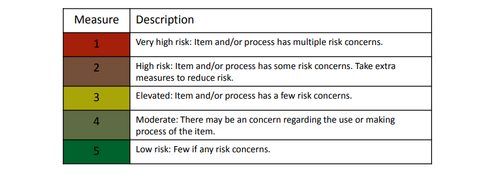
Risk Readiness Levels by Field Ready

Based on these questions, it’s possible to determine a Likert-type scale with a rating from 1 to 5 as follows:
Important Note
[edit | edit source]Field Ready does not undertake work that is very high risk. The organization undertakes a documented risk assessment for all items it considers making and carefully follows a detailed procedure to ensure the safety for those concerned. Further, the organization does not make or distribute items that are medically invasive or have other noted risk concerns.
| License | CC-BY-SA-4.0 |
|---|---|
| Cite as | Charles Vincent Barrete (2026). "Field Ready Readiness Levels". Appropedia. Retrieved October 17, 2026. |