


Cosmos in the Stacks bees

| Authors | Gabriel Morales Arianna Ramos Anita Schicchi Liam Strusinski |
|---|---|
| Location | Arcata, United States |
| Status | Deployed |
| Made | Yes |
| Replicated | No |
| Uses | education, science |
The bee stacks display area project was done by 4 engineering students at Cal Poly Humboldt in the Spring semester of 2026. The Cal Poly Humboldt library required more visitors to interact and visit the third floor section of the library and more specifically the bee book section. The students goal was to create a space that would invite visitors of the library of all ages to interact with this section of the library. In order to do this the students were tasked with educating visitors about bees as well as creating a comfortable space to study and learn within. The display containing resin is operated by a switch underneath with activates LEDs which light up the resin displays. Below thee displays are informational wood engravings about each of the resins. There is also a desk with privacy dividers on each as well as magnetic bee figurines which lead visitors to the bee stacks.
Background
[edit | edit source]The bee display and study area was intended to help bring more attention to the bee section of the Cal Poly Humboldt library which are known as stacks. The library's objective was to create more interaction among visitors of all ages within the lesser visited areas of the library stacks such as the bee section. The display and study, was developed by the The Hive Five of Cal Poly Humboldt's Engr. 205 class and was completed May 10th.
Problem statement
[edit | edit source]The objective of this project is to create an educational study environment and display that educates users and brings attention to the importance of bees in the local environment.
Criteria
[edit | edit source]The criteria table shows a list of criteria the team decided along with our client. The criteria is ranked from 1 to 10 with 10 being the most important criterion and 1 being the least.
| Criteria | Description | Weight (1-10) |
|---|---|---|
| Sound | Less than or equal to 50 decibels | 10 |
| Durability | Won't need repair for at least 10 years | 10 |
| cost | Less than or equal to 250$ | 8 |
| Maintainability | Requires no extra maintenance other than cleaning. | 7 |
| Educational Value | the ability to educated people of all ages about bees | 6 |
| Portability | Movable by 3 people or less | 5 |
| Public interaciton | At least 2 people per day | 5 |
| Time of interaction | greater than or equal to 5 minutes | 4 |
Prototyping
[edit | edit source]Here are some prototypes made during the design process.
-
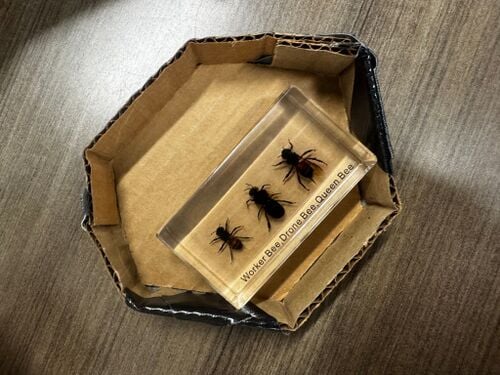 This is a prototype of how we will display the resin displays, what's not included is the light portion. This prototype is for desired purposes. Learned that we may need to adjust for different resin display sizes.
 -
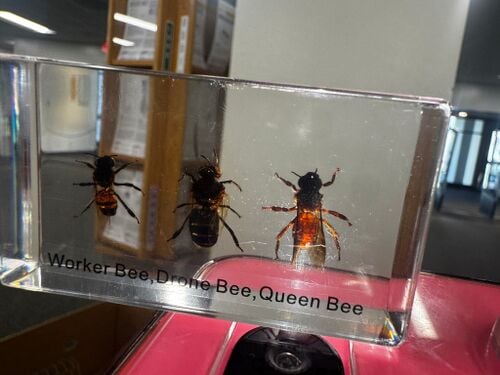 This is a function prototype. This shows us how light passes through the resin displays from below. This is one of the ways to incorporate the resin displays, having them light up within the hexagons.
 -
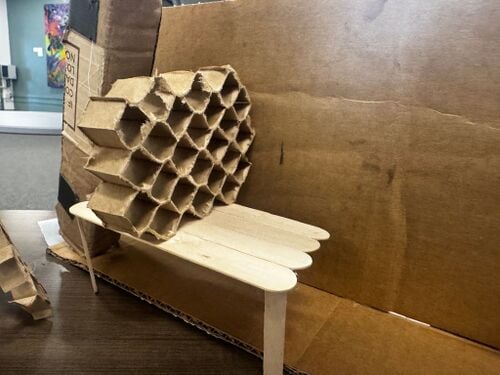 This is an example of one of the possibilities for a table in the study area. This option includes a divider on the table made with hexagons to represent the honeycomb.


Final product
[edit | edit source]The final product is shown below, it consists of three hexagonal maple wood frames with inlayed plexiglass. They each contain LEDs which are connected between each and activated by a switch on the far most left one. Each display has a plywood backing which holds the resin displays which are epoxied onto small plexiglass sheets and then onto the plywood backing.
The following image displays the final desk product which contains a maple plywood cover which was sanded and finished. It then has brackets which hold a hexagonal patterned divider on three surfaces of the desk creating a private study space.
Construction Process
[edit | edit source]Display
[edit | edit source]1 Measure and cut frame pieces
[edit | edit source]For the display case it needs 6 identical pieces cut out in order to assemble a frame. These pieces must have the correct angles in order to fit together and create a hexagon.2
2 Route frame pieces
[edit | edit source]The next step will be creating space for the plexiglass and LEDs to fit into the display. In order to do this use a router to create an inlay the width of the plexiglass and then a separate inlay the width of the LED strips.
3 Connect pieces
[edit | edit source]In order to connect the pieces the plexiglass must first be measured and fitted within the frame and then wood glue should be used and once tried screws angled to connect each piece. Following this plywood should be cut out to match the dimensions of the frame.
4 Staining
[edit | edit source]Stain plywood backboard as well as all frame and then add finished clear coating.
5 LED fitting
[edit | edit source]The LED should have to exit holes for the wiring to exit and these should be drilled in desired positions depending on the orientation of multiple displays. Following this the LED strip should be put tightly into the frame and glued if necessary.
6 Assemble
[edit | edit source]Assemble display by nailing plywood backboard to frame and then drill in picture hangers into the back in order to complete the display.
Desk
[edit | edit source]1 Add plywood to top
[edit | edit source]Start by adding plywood piece of maple to the top of the desk and rough cut to the shape. Then use a flush trim router to exactly match the dimensions of the desk.
2 Sand and stain
[edit | edit source]Sand down edges and imperfections on the desk and then add a stain to the entire area. Then add a clear coat finish to protect the wood.
3 Panels
[edit | edit source]To create the dividing panels laser cut out the hexagonal patter onto 3 pieces of plywood. Once done sand imperfections and stain. Then add a clear coat finish.
4 Assemble
[edit | edit source]In order to assemble the final product use hinges to attach the three individual panels together.
Video instructions
[edit | edit source]Bill of materials
[edit | edit source]Description of costs and total project cost.
| Item | Amount | Cost per unit | Total |
|---|---|---|---|
| LED Strip — Get at the thing store | 3 | USD 22.99 | USD 68.97 |
| Maple Plywood — 3' x 2', yellow | 1 | USD 150.00 | USD 150.00 |
| Breadboard Kit | 1 | USD 8.99 | USD 8.99 |
| Electronics Kit | 1 | USD 8.99 | USD 8.99 |
| Maple Wood (2' x 8') | 1 | USD 19.99 | USD 19.99 |
| Grand total | USD 256.94EUR 220.97 <br />GBP 187.57 <br />CAD 318.61 <br />MXN 5,357.20 <br />INR 19,231.96 <br /> | ||
Conclusion
[edit | edit source]Testing results
[edit | edit source]For testing results the durability was as expected the wood was sturdy as well as the plexiglass. The display and desk both met the portability requirement of only needing 3 people at most to be transported. Aesthetically the product met all standards and the LED lights created a very visually pleasing effect on the final product.
Discussion
[edit | edit source]The testing results showed that the Bee Display Area met most of the requirements.
Lessons learned
[edit | edit source]If The Hive Five was give the opportunity to do the Bee Display Area project again there would be changes such as each display be given its own button for the LED system as well as using different methods such as brackets in order to hold the Resin in place inside of the display cases.
Next steps
[edit | edit source]Discuss any next steps for the project as it goes on into the future.
Troubleshooting
[edit | edit source]| Problem | Suggestion |
|---|---|
| LEDs do not turn on | Remove backing and check wire connection and replace if neccesary |
| Does not turn on | Make sure it is plugged in |
Team
[edit | edit source]The Hive Five from Cal Poly Humboldt's Engineering 205: Intro to Design, Spring Semester '26
- Gabriel Morales
- Arianna Ramos
- Anita Schicchi
- Liam Strusinski
References
[edit | edit source]
| License | CC-BY-SA-4.0 |
|---|---|
| Organizations | Cal Poly Humboldt |
| Cite as | Lonny Grafman, Liam Strusinski (2026). "Cosmos in the Stacks bees". Appropedia. Retrieved October 19, 2026. |