


Cal Poly Humboldt SoE coasters 2025

| Authors | Saul Gurrola Riley Haggerty Alec Magiera Rowan Pecson |
|---|---|
| Location | Arcata, United States |
| Status | Deployed |
| Made | Yes |
| Replicated | No |
| Uses | education, science |

The Cal Poly Humboldt School of Engineering coaster mass production project is a project given to Squirrel Works; a team enrolled in ENGR 205 during the Spring 2025 semester. The project's goal was to create a process to manufacture a mass number of coasters that would be handed out by the Engineering Department at tabling events or as gifts for speakers, faculty, etc.
Background
[edit | edit source]- The major engineering project for team Squirrel Works this semester was to design and set up a method to manufacture coasters for the California Polytechnic School of Engineering.
- They decided upon this project because they thought it would be a great way to work as a team to reach a goal together and to work under the engineering department itself.
- The goal was to create a coaster that people will love to use with an attractive logo relating to the department.
- Another factor must be to ensure that they can produce a good quantity of high-quality products within a reasonable time frame.
Problem statement
[edit | edit source]The objective of this project was to design a coaster and a process to mass produce them for the Engineering Department for Cal Poly Humboldt, so that they could be used as handouts for the department.
Criteria
[edit | edit source]The teams list of criteria was created during client meetings. A combination of the team's best judgement along with client given requirements were used to create this list.
| Criteria | Description | Weight (1-10) |
|---|---|---|
| Minimal Waste | It was a preference that there'd be as minimal waste as possible and that they'd make the most out of all material. | 5 |
| Production Quantity | The team was encouraged to create a process that makes as many as possible. It was explicitly stated that the minimum accepted production quantity would be 20 coasters per 2 human hours. | 6 |
| Easy to Acquire Material | For convenience the material had to found decently locally and always be in stock to meet the ongoing demand of this production process. | 8 |
| Cost | A precedent was set that the cost to make a singular coaster could not exceed $1.50. The coasters needed to be a cheap option. | 9 |
| Aesthetic Appeal | The goal of these handouts was that they'd be representative of the School of Engineering. Appearance was the highest priority. | 10 |
Prototyping
[edit | edit source]The first prototype was cut out of a piece of cardboard, in order to view the design that would be used.

The next prototype was made using scrap wood in the makerspace, which had lines through it, similar to the cardboard, due to the visible streaks in the wood itself. Running the laser cutter a second time on the same area was also tested, to see if that would improve how the design came out.
-
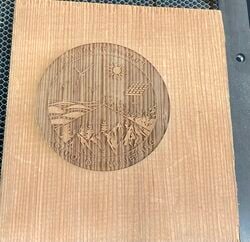 A prototype made from scrap wood, to test how the laser cutter engraved wood.
 -
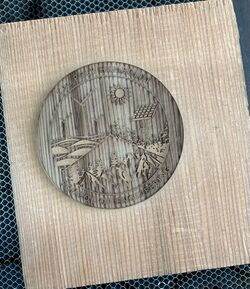 The same area on the scrap wood as the previous coaster, after having the laser cutter make the design in the same spot a second time.


The next prototype was made using a thinner piece of scrap wood, in order to test how the laser cutter would actually cut through the wood, instead of just engraving the design.

After this, two squares were cut out, one from each piece of wood that had been bought, in order to test the various stains that were available and to see how they would look with the different woods.


Once it was decided what stains should be tested, two coasters were cut out from each type of wood, so that one each could be left without stain, and one could have the stains to test on it, testing how the design looked both with and without them.


Prototyping Costs
[edit | edit source]The Cal Poly Humboldt School of Engineering provided $250 for the development of the final product. The group spent $50.92 of this budget, and all was used on materials for prototyping as listed below:
| Item | Amount | Cost per unit | Total |
|---|---|---|---|
| 4' x 4' x 1/4" Sapele Wood Sheet — Get at Almquist Lumber | 1 | USD 44.18 | USD 44.18 |
| 2' x 4' x 1/4" Birch Wood Sheet — Also available at Almquist Lumber | 1 | USD 6.74 | USD 6.74 |
| Grand total | USD 50.92EUR 43.79 <br />GBP 37.17 <br />CAD 63.14 <br />MXN 1,061.68 <br />INR 3,811.36 <br /> | ||
Final product
[edit | edit source]The final process that was created uses the Universal Laser System R9000 Laser Cutter and quarter inch sapele wood sheets to make 4' diameter coasters with the Cal Poly Humboldt School of Engineering logo on them. The process involves an employee coating the coaster in polyurethane for waterproofing. This process creates coasters for under $1, as wood for each coaster costs $0.35, polyurethane costs $0.05, and labor costs $0.50. Here is a pdf of the sheet of coasters by SquirrelWorks for the Cal Poly Humboldt School of Engineering - Media:SquirrelWorks SoE Coasters 2025.pdf.
- Final Product Gallery
-
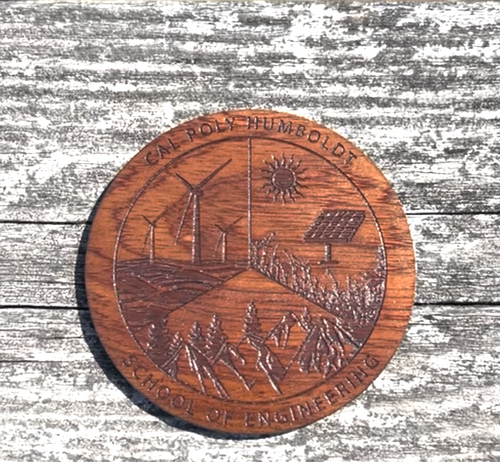 Coaster produced by the process
 -
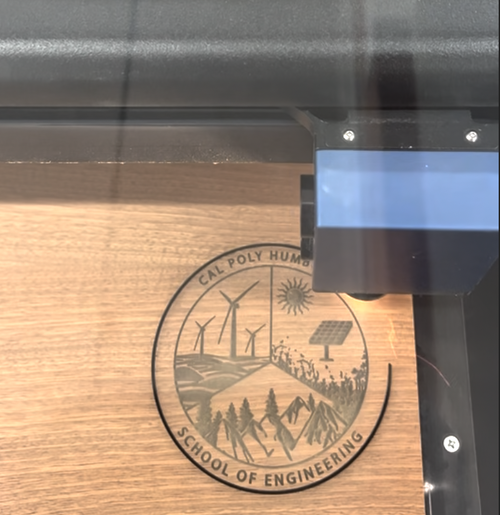 Coaster being cut by ULS R9000 laser cutter


Operation
[edit | edit source]In order to produce coasters in the future there is a procedure to follow.

Place the 2x4 sapele board into the Universal laser System. Run the coaster file on the laser cutter.

Remove the coasters from the laser cutter. Gently sand down the edges until the charcoal is removed.

Coat the sides and top of the coaster with polyurethane. Let dry for 3 hours before moving and the coat will be complete after 24 hours.
Maintenance
[edit | edit source]Maintenace for this process revolves primary on the laser's needs, as it is the main tool used in the production. The laser's following maintenance was taken from the ULTRA R Series Laser Systems User Guide. There is also general maintenance for other supplies used. Larger laser maintenance should be performed by Makerspace faculty while the smaller maintenance can be performed by the employee working on the production. Said employee would also be the one to handle material maintenance.
Maintenance schedule
[edit | edit source]- As Needed
- Restock needed material
- Stir Polyurethane before applying
- Clean Bed of Laser
- Wipe down the inside of the main enclosure with soap solution (use alcohol for difficult to remove debris)
- Vacuum the inside of the main enclosure
- Vacuum the Multifunction Material Support Structure
- Vacuum the Multifunction Material Support Structure debris drawer
- Clean the top door windows inside & out with window cleaner only
- Daily
- Check the mirrors on the left side of the X arm for debris and clean as necessary
- Check the carriage windows for debris and clean as necessary
- Check the inside of the carriage for debris and clean carriage optical surfaces as necessary
- Clean the optics ONLY if dirty (excessive cleaning can prematurely wear out the coatings on the optics)
- Monthly
- Clean rear laser cover cooling fan filters
- Check for X Axis for belt wear
- Check the Y Axis for belt wear
- Replace belts as necessary
- Semi-Annually
- Clean the Z-Axis lead screws with white lithium grease as necessary
- Remove and clean the inside of the exhaust plenum
- Regularly inspect and clean your exhaust ducting to the laser system (consult with HVAC professional)
- Annually
- Open the X axis rail cover and clean the X axis carriage wheels and the V grooves that the wheels ride in
- Inspect the X axis wheels for wear and replace as necessary
- Clean left Y axis linear bearing rail
- Remove the X axis motor cover on the right side of the X rail and clean the right Y axis rail and wheels
- Inspect the Y axis wheels on the right side of the X rial and replace as necessary
Conclusion
[edit | edit source]Testing results
[edit | edit source]After testing various stains and coats listed above the unstained sapele was selected as the best product.
Discussion
[edit | edit source]Certain stains such as Ebony and Redwood would be inconsistent in results unless thoroughly mixed beforehand. The White and Black stains either smothered or blurred anything underneath the coats. Red Mahogany came out too dark. Golden Oak and unstained wood came out with the cleanest looking and most appealing look. Testing both the sapele and birch wood samples showed that they both took stains reasonably well and still showed some texture through the coat although the sapele had a noticeably smoother finish than the birch samples.
Lessons learned
[edit | edit source]This project had difficult hurdles to jump, namely with deciding on the best prototype to produce as the final product. These hurdles were leapt through easily enough but definitely left room for improvement. Teamwork is crucial in getting a project off the ground and making time for the whole team leads to efficient use of time and resources.
Next steps
[edit | edit source]As this project continues its use in the future it will produce plenty of coasters for cost efficient resources and minimal labor to produce coasters for the Cal Poly Humboldt School of Engineering to do with as they see fit. Currently they are being considered for meetings, prizes, and gifts.
Troubleshooting
[edit | edit source]| Problem | Suggestion |
|---|---|
| Laser doesn't cut | Make sure it is set to auto find the z-axis. |
| Design isn't engraved/exterior isn't cut | Make sure the missing process isn't set to be skipped, if that fails re-download and set up the design |
Team
[edit | edit source]Squirrel Works 2025 includes the following members:
- Saul Gurrola
- Riley Haggerty
- Alec Magiera
- Rowan Pecson
References
[edit | edit source]
| Authors | Rowan Pecson, Saul Gurrola, Riley Haggerty, Alec Magiera |
|---|---|
| License | CC-BY-SA-4.0 |
| Organizations | Cal Poly Humboldt |
| Cite as | Rowan Pecson, Saul Gurrola, Riley Haggerty, Alec Magiera (2025–2026). "Cal Poly Humboldt SoE coasters 2025". Appropedia. Retrieved October 11, 2026. |