


CSU Research Competition 2025 Health, Nutrition, and Clinical Sciences trophy

| Authors | Jake Nguyen TangledMango Daniel Rodriguez Samuel Holtman |
|---|---|
| Location | Arcata, California, United States |
| Status | Deployed |
| Made | Yes |
| Replicated | No |
| Uses | education, science |
The "Caring Hands Trophy" is a trophy manufactured by Team Egg in Fall 2024 at Cal Poly Humboldt. The trophy is designed to be received by the 1st-place winner of the 39th annual CSU Student Research competition.
Background
[edit | edit source]Team Egg, consisting of Samuel Holtman, Jonathan Luu, Jake Nguyen, and Daniel Rodriguez, partnered with Cal Poly Humboldt’s Office of Research and Sponsored Programs, which is hosting the 39th California State University Annual Student Research Competition. Top research projects across all CSU campuses meet at Cal Poly Humboldt to present their projects. The projects are classified based on their field of research, including Engineering, Health Sciences, Arts, and seven other categories. Each category is split into the undergraduate and graduate competition. Team Egg is responsible for the Health, Nutrition, and Clinical Sciences category. The campus hosting the ceremony is responsible for the awards given out to the winners of the competition. In previous years, the winners would receive a simple certificate. This will be Cal Poly Humboldt’s first time hosting the competition, so the Office of Research and Sponsored Programs felt a need to give a good impression by giving a truly unique reward.
Problem statement
[edit | edit source]The objective of the project is to build a unique and memorable trophy for the 1st-place winners of the 39th annual CSU Student Research competition in the category of Health, Nutrition, and Clinical Sciences.
Criteria
[edit | edit source]The criteria proposed to Team Egg by the client were:
- Aesthetically Pleasing: The product must look impressive on stage and in the home of the recipient.
- Symbolism: The product must represent the category of Health, Nutrition, and Clinical Sciences.
- Safety: The product must not present any significant safety hazards. "Do no harm."
- Durability: The product must be able to withstand reasonable use and transportation, and ideally last a lifetime.
- Interactivity: The product should have interactive components and not just be an inert object. The interactive components should be straightforward and easy to understand.
- Cost: The product must not exceed the set budget of $500.
| Criteria | Description | Weight (1-10) |
|---|---|---|
| Aesthetically Pleasing | 10 | |
| Symbolism | 10 | |
| Safety | 9 | |
| Durability | 7 | |
| Interactivity | 4 | |
| Cost | 2 |
Prototyping
[edit | edit source]Initial Prototype
[edit | edit source]The initial prototype was made using cardboard, glue, pins, and markers. The prototype was based on the "Beats per Minute" alternative solution. The purpose of the prototype was to judge the aesthetic of the design, as well as to determine if the trophy’s size would meet the readability requirements for a clock. The clutter from the clock hands, the slot, the heart design, the hour numbers, as well as the lack of depth caused by the 2D design, led to the removal of the Beats per Minute design and the genesis of the Caring Hands design.
-
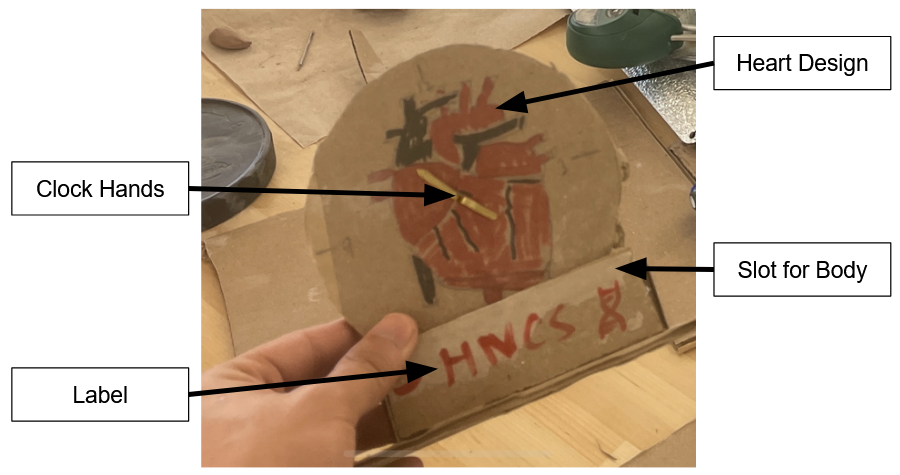 Cardboard prototype of clock heart design

Clay Prototyping
[edit | edit source]Another prototype was made using clay. The purpose of this prototype was to see if the “Caring Hands” design could be hand modeled and be aesthetically pleasing. If this method was used in the final design, a clay sculpture would be made which could then be molded and cast in metal or resin for increased durability and reproducibility. A wire frame was made first by outlining a hand with wire. Clay was then added to the frame from the base up, starting at the wrist, constructing the hand, and then creating the fingers one by one. The prototype achieved its goal of being aesthetically pleasing, but the clay also cracked as it dried due to the wire supports and the different thicknesses of clay involved which caused it to dry and shrink at different rates. One hand also took 3 hours of work to create. A model made of synthetic modelling material (paper clay was considered) could be possible instead because earthen clay was difficult to work with and had many stages at which it could fail.
- Clay Hand Prototype
-
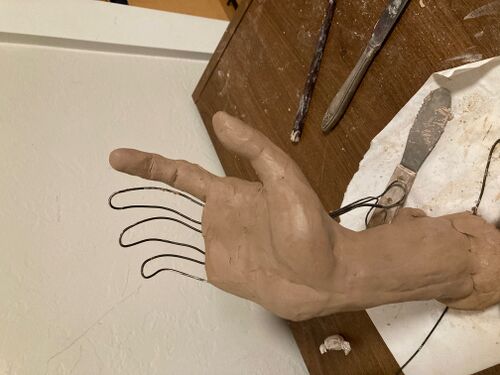 Partially completed clay model, with wire frame still visible
 -
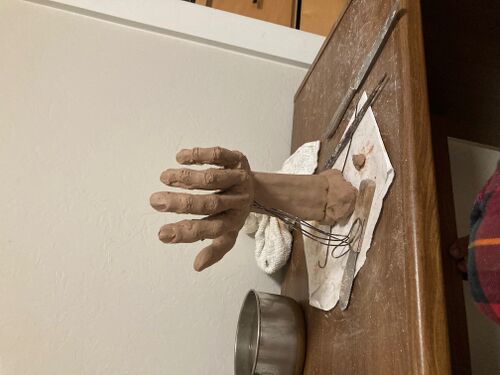 Completed clay prototype


3D Printing Prototypes
[edit | edit source]Multiple 3D printed prototypes were created in the design process. The purpose of these prototypes was to test the viability of PLA as a final material, to test the aesthetic appeal of the models, to test the ability of the translucent PLA to show light, and to troubleshoot fitting the hand model and the heart model together.
- 3D Printing Prototypes
-
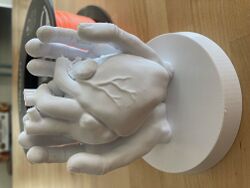 The initial 3D printed prototype which tested the viability of the material and modeling method.
 -
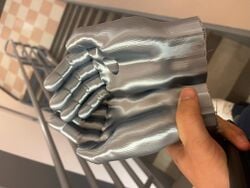 An updated model of the hands, printed to test the aesthetic appeal of the model.
 -
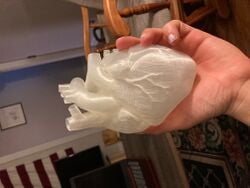 A scale model of a human heart printed to test the aesthetic appeal and the translucence of translucent PLA material.
 -
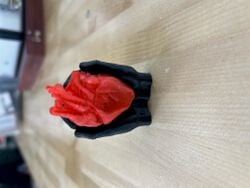 A miniature model of the heart and the hands, printed separately. The purpose of this prototype was to troubleshoot how the hands and heart would slot together.


Wooden Base Prototype
[edit | edit source]A wooden base was constructed from cedar(?) wood using a handmade jig on a table saw, a router table, and laser engraver.
- Base Construction
-
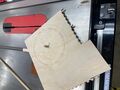 An early test of the circle cutting jig using a piece of plwood
 -
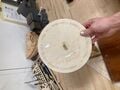 The first test of the cutting method, which became the top on which following pieces were placed
 -
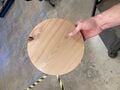 A circle cut out of thicker wood using the completed jig
 -
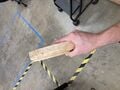 The prototype base cut with a decorative edge using a router table
 -
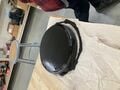 The prototype base being stained to appear more like the proposed final material, walnut wood.


Final product
[edit | edit source]-
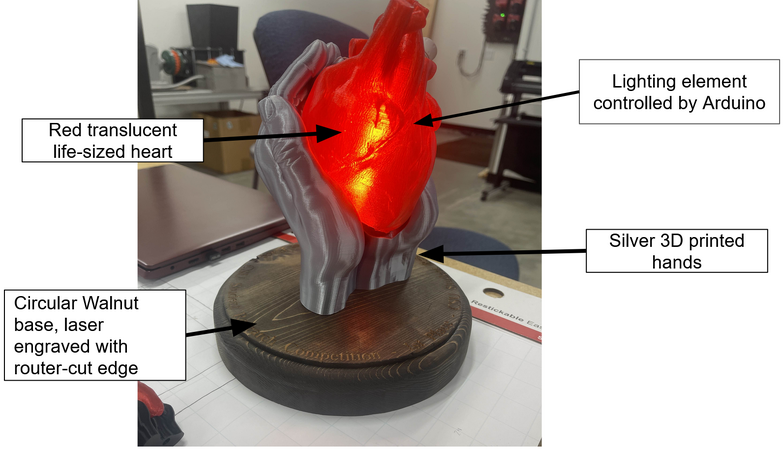 Caring Hands design final product

The imagery of a pair of hands gently cupping a heart symbolizes the trust put in medical professionals for the health and well being of the public, as well as the care and connection between them. The complete trophy is 9" wide, 9" deep, and x" tall.
-
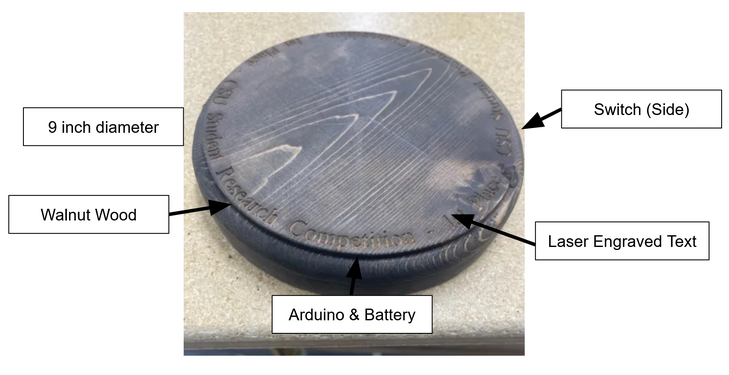 base before assembly

The trophy base is 9" in diameter and 1.5" in height. It is laser engraved with the text "1st Place - CSU Student Research Competition" twice for a full ring of text. The base is also routed with a 3/8" roundover.
-
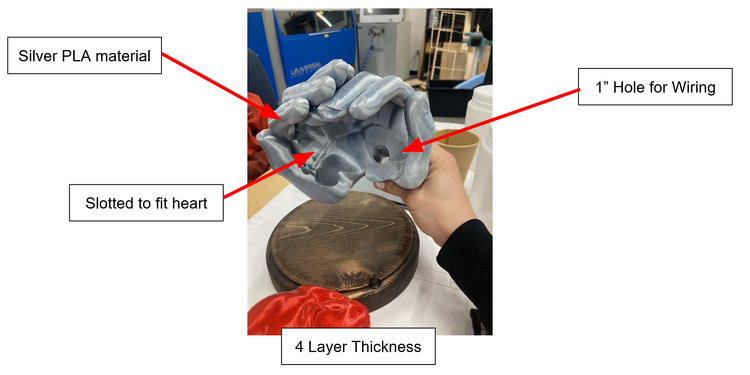 hands before assembly

The hands are 6" by 4.5" by 7.4" and are 3D printed from a silver PLA filament
-
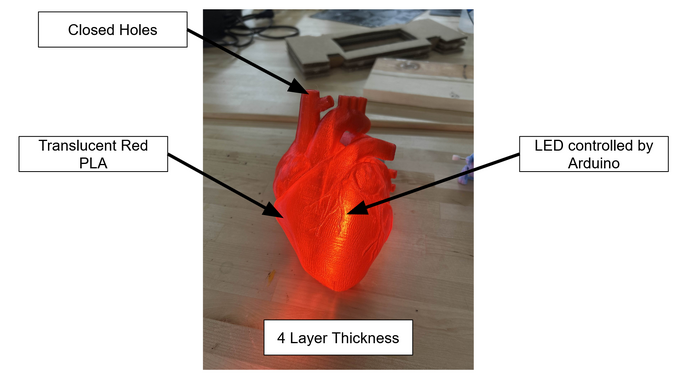 heart before assembly

The heart is 4.2" by 3" by 6.4" and is 3D printed from a translucent red PLA filament.
Construction
[edit | edit source]Heart & Hands
[edit | edit source]The sculptural component of the trophy, consisting of the heart and hands, were 3D printed using a Prusa MK3S 3D Printer.
The model for the heart was sourced from x, the model for the hands was sourced from x and both were modified, rigged, and posed as needed in blender. The models were scaled with the base in Fusion 360 and sliced in PrusaSlicer for 3D printing.
-
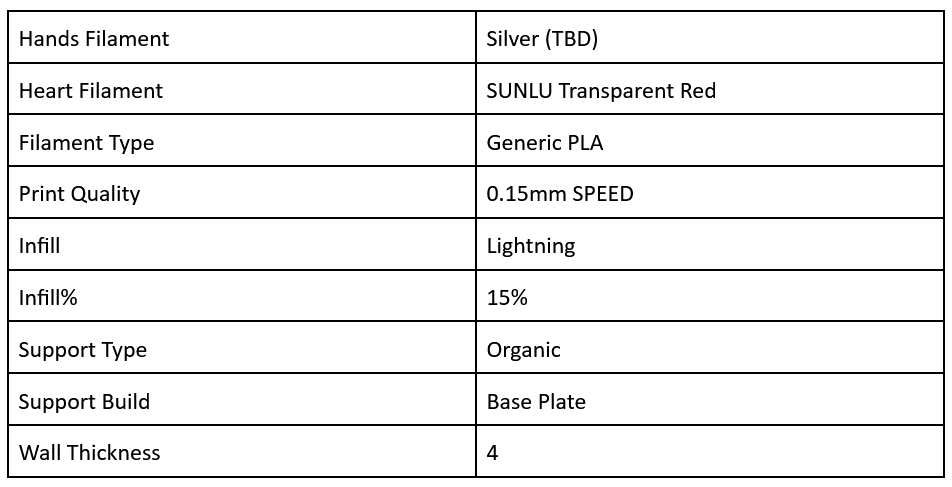 3D Print Specifications

Base
[edit | edit source]A Walnut slab was cut into two 10 inch squares using a table saw. These squares were then placed on a jig which allowed for a circle to be cut on the table saw. The sides of these circles were then sanded smooth using an edge belt sander. A decorative edge was then cut into the top side of the circles using a router table (NAME bit used). Painter's tape was then placed over the perimeter of the top face of these circles, and the text "WHAT'S THE TEXT" was then laser engraved in the edge of the face. The tape allowed for the text to be cleanly painted with silver paint. Spaces for the electronic components was then carved into the bottom of the circle using a drill press and a chisel. A shallow outline of the base of the hands was then cut into the top side. The base was then coated with a water based polyurethane finish.
- Wooden Base Construction
-
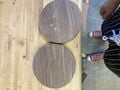 Two simple circles cut on the table saw
 -
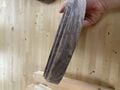 A decorative edge cut on the circles with a router table
 -
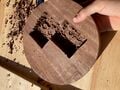 The chiseling process
 -
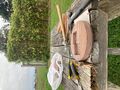 The tools involved in chiseling


Arduino
[edit | edit source]The Arduino Uno R3 is a printed circuit board (PCB) that uses a microcontroller to run electrical circuits. The microcontroller is a small computer that uses programmed code as instructions on how to run an electrical circuit. The programmed code is written on the Arduino IDE and is “injected” into the board through a USB cable. The Arduino retains the program, even when power to the board is lost. The board itself contains input and output pins, as well as special pins for voltage intake, voltage output, and ground.
The Arduino is connected to a 3.6V triple output LED through a 44-ohm resistor and is programmed to run code that pulses at the rate of a human heart. At highest brightness, the LED experiences 25mA of current, far lower than the 700-mA rating of the LED. Four AA lithium primary batteries, totaling 6V, are housed in a battery holder, located in the base of the trophy connected to the Arduino through on/off switch located on the left-hand side of the trophy.
Bill of materials
[edit | edit source]| Item | Amount | Cost per unit | Total |
|---|---|---|---|
| Transparent SUNLU Red PLA | 1 | USD 23.98 | USD 23.98 |
| Arduino Uno | 2 | USD 27.60 | USD 55.20 |
| Battery Holder x2 | 1 | USD 5.98 | USD 5.98 |
| Breadboard and Jumper Wire | 1 | USD 5.99 | USD 5.99 |
| Walnut Wood — 12"x24"x1.5" | 1 | USD 33.13 | USD 33.13 |
| Dowel | 1 | USD 4.91 | USD 4.91 |
| AA LIthium Battery 8PK | 1 | USD 22.77 | USD 22.77 |
| Grand total | USD 151.96EUR 130.69 <br />GBP 110.93 <br />CAD 188.43 <br />MXN 3,168.37 <br />INR 11,374.21 <br /> | ||
Operation
[edit | edit source]The Caring Hands' light feature is operated via a switch on the base which disconnects the battery. If the switch is in the off position (O), the light will remain off. If the switch is moved to the on position (I), the light will pulse to the beat of a human heart.
-
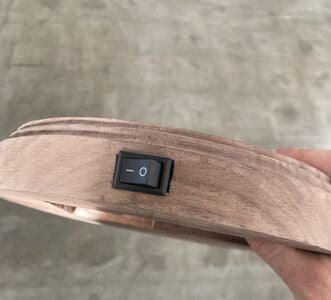 on/off switch in base

Maintenance
[edit | edit source]Maintenance for the Caring Hands is minimal. The Caring Hands only require:
- Dusting
- Occasional new batteries
- Occasional replacement light
Maintenance schedule
[edit | edit source]- Daily
- Enjoy the trophy's elegant and innovative design
- Weekly
- Enjoy the trophy's elegant and innovative design
- Monthly
- Enjoy the trophy's elegant and innovative design
- Yearly
- Dust trophy
- Every other year
- Change battery
Conclusion
[edit | edit source]Testing
[edit | edit source]We tested the LED to verify that it could handle the full output of the digital pins from the Arduino as stated by manufacturer specifications. The LED was connected directly to the Arduino via digital pin 9 and ran at max voltage and without a resistor for 24 hours running the heartbeat code, as well as an additional 24 hours directly from the 3.3V pin.
| Arduino Output (digital pins) | Arduino Output (3.3V pin) | LED Specifications |
|---|---|---|
| 3.3V | 3.3V | 3.2V-3.4V |
| 0.02A | 0.05A | 1A |
| Test | Result |
|---|---|
| 24hrs pulsing | OK, no heat buildup |
| 24hrs continuous | OK, low heat buildup |
Lessons learned
[edit | edit source]During the process of designing and constructing the trophy, Team Egg learned many things about crafting the base, 3D printing and modeling, and electronics. When constructing the base, Team Egg learned how to make a custom jig for the tablesaw to cut a circle, how to use a router table, and how to carve out large areas of wood using a drill press and a chisel. If this project were to be done again, regarding the base, more delicate chiseling technique would be used, and chiseling on hard surfaces such as concrete would be avoided. The base split when being chiseled aggressively on top of concrete.
When modeling and printing the sculptural component of the trophy, Team Egg learned that modeling hands from scratch would have been better than using premade assets found online. That is because these premade assets were not made to be repositioned in the ways that were needed, and while the creation of initial models was much faster, repositioning and fine tuning took significantly more time. Team Egg also found that organic supports were superior to grid supports. Lightning infill was good for hollow and non load bearing components.
In terms of the electronic components of the trophy, Team Egg learned that using LEDs with low blue light was needed to create the right color of light when shined through the transparent red heart. Team Egg learned how to calculate the resistance needed for the wiring. If the project were redone, Team Egg would use a printed circuit board (PCB) instead of an Arduino for the programming to save money and size. The Arduino had much more computing power than what was needed for the project and cost much more than a PCB.
Next steps
[edit | edit source]The Caring Hands Trophy will be presented to the winners in the Health, Nutrition and Clinical Sciences category at the 2025 CSU Student Research Awards at Cal Poly Humboldt in April 2025.
Troubleshooting
[edit | edit source]| Problem | Suggestion |
|---|---|
| Does not turn on | Check/Change batteries |
| Does not turn on after changing batteries | Check that all wires are connected to the Arduino in
appropriate places (what are the appropriate places) |
| Does not turn on after checking the wires | Contact Samuel Holtman |
Team
[edit | edit source]Team Egg consists of:
References
[edit | edit source]
| License | CC-BY-SA-4.0 |
|---|---|
| Organizations | Cal Poly Humboldt |
| Cite as | Lonny, HerrSinklar, TangledMango (2024–2026). "CSU Research Competition 2025 Health, Nutrition, and Clinical Sciences trophy". Appropedia. Retrieved October 3, 2026. |