


CASA Student Farm mobile shade

| Authors | Joseph Katz Logan Westerfield Austin Detrick Joel Pimentel |
|---|---|
| Location | The following coordinate was not recognized: Geocoding failed.2000 Foster Ave, Arcata, California, United States |
| Status | Deployed |
| Years | 2025 |
| Uses | shade, UV protection, Rain protection |

The Mobile Shade Structure was built in Fall of 2025 by "Shade Incorporated". It was built for the Cal Poly Humboldt Universities student farm in Arcata, CA. It was designed to survive its environment and provide safe and reliable protection from that environment for farm visitors and workers.
Background
[edit | edit source]Cal Poly Humboldt purchased 16 acres of land, part of which is going to be a farm. Our team was assigned to make a mobile shade structure for the workers and visitors to have a place to rest.
Problem statement
[edit | edit source]The objective of this project is to create a mobile shade structure that can be easily moved around the farm to provide reliable sun, wind, and rain protection for one-two picnic tables and their occupants. Once built, this solution will make outdoor rest and work areas more comfortable, usable, and flexible throughout the day. It will allow workers and visitors to gather in shaded, weather-protected spaces without needing permanent installations, improving comfort, productivity, and overall usability of the farm’s outdoor areas.
Criteria
[edit | edit source]| Criteria | Description | Weight (1-10) |
|---|---|---|
| Be able to move with four people or fewer | Choosing materials and a design that stay lightweight enough to carry but still heavy or anchored enough to remain stable in 20 mph winds. | 7 |
| Be able to fit two picnic tables as well as multiple occupants | Determining the exact area and dimensions needed so two tables and several people can fit comfortably under the shade. | 3 |
| Corrosion-resistant and stable under load | Selecting materials that are affordable, long-lasting, environmentally friendly, and resistant to rust while remaining strong under weight. | 10 |
| Survive weather including sun, rain and wind | Deciding which metal, wood, or composite material—and what thickness—will hold up best under different weather conditions. | 10 |
| Survive weather including sun, rain and wind | Using a canopy or cover material that is water-resistant, UV-resistant, and durable during long-term outdoor exposure. | 8 |
| To have something to represent indigenous people and culture / the design of the underground railroad freedom quilt patterns, | Choosing culturally meaningful colors, symbols, and patterns, and deciding where they should be placed on the structure. | 3 |
Prototyping
[edit | edit source]- These prototypes were made in order to test the overall functionality of our final decision
Test:
- Amount of shade produced
- Structurally sound
- Any unexpected outcomes
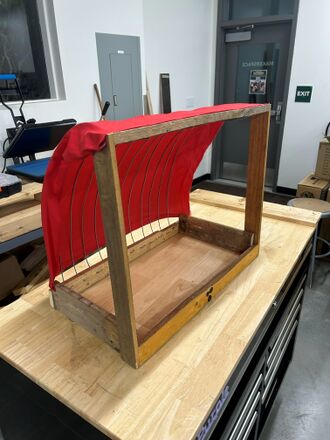
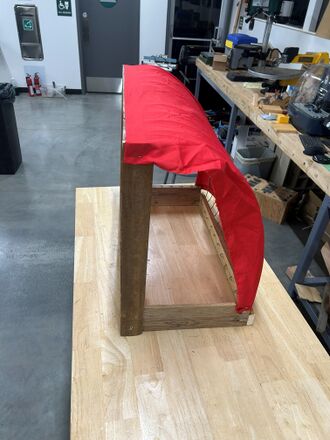
First Prototype: shown in the images below
[edit | edit source]-
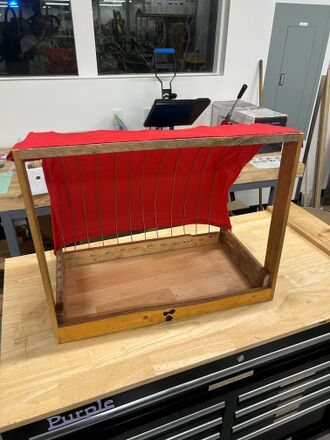 * Built using scrap wood, cloth, and metal wires * Used to test shade coverage and overall structural integrity * Discovered an unexpected force due to tension in the metal wire
 -
-


Second Prototype: shown in the images below
[edit | edit source]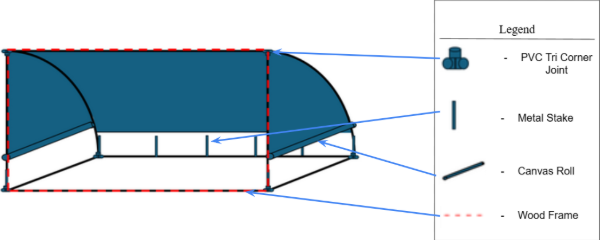
- 3-D digital design created to visualize metal stakes, canvas rolls, and front wooden frame
- Stakes allowed for greater structural integrity
- Wooden front frame satisfied clients desires

Final product
[edit | edit source]Our final design stemmed from our criteria and how best we could meet those goals within our budget and time allotments. We reduced our overall design size and shape to being a nine foot wide, twelve foot long, and nine foot high structure. It is shaped like a quarter of a circle exoskeleton made out of lightweight PVC and wood material that we were able to recycle from local sources. Recycling this materiel decreased our overall carbon footprint while also keeping our budget low while still creating a larger stronger structure. The shape has a curved face on one end that allows wind and rain to easily shed off the structure without putting added stress and pressure on it. The material used for the covering of the exoskeleton is a breathable, 100% polyester canvas tarp. Its breathability allows rain to shed off without trapping any moisture. Its 100% polyester composition allows for maximum UV protection in lightweight system. This canvas material coupled with our exoskeleton will allow the mobile shade structure to survive many months in its final location and enable it to provide continual weather protection for farm goers and visitors.
Construction
[edit | edit source]First, we confirmed the final construction location with the client. Then, we marked all recycled pressure-treated wood for cutting and moved the pieces into position as seen in Image 2.. Next, we cut the two vertical supports and attached them to the base wood pieces.
We added brackets to both the inside and outside of the frame. After building the main frame for the front end of the structure, we drove the steel concrete stake supports for the curved side into the ground, as shown in Image 6. We then added a PVC pipe that the stakes pass through to keep them aligned. The PVC was screwed into the wood using a screw and a metal pipe support, and the other end was pushed down onto the concrete stakes.
After that, we added a central main support using a beam anchor. Once the frame was complete, we placed the canvas over the top and folded it to fit the structure. We finished by tying the sides and back of the canvas to the frame.
- Construction gallery
-
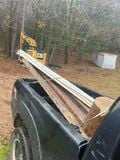 Image 1: Materials loaded into truck and ready to be shipped to the farm.
 -
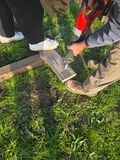 Image 2: Cutting the vertical supports to fit the base board.
 -
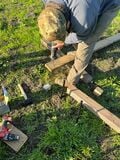 Image 3: Drilling the vertical support board
 -
 Image 4: The vertical support fitted over the 4x4 base board.
 -
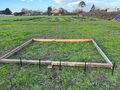 Image 5: Rough layout the front frame and Ground stakes
 -
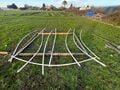 Image 6: Rough layout of the curved PVC ends and the front frame.
 -
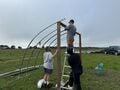 Image 7: Cutting of excess PVC


Video's
[edit | edit source]Bill of materials
[edit | edit source]| Item | Amount | Cost per unit | Total |
|---|---|---|---|
| Canvas Material — Mytee.com | 1 | USD 160.00 | USD 160.00 |
| Concrete Stakes — Ace hardware | 6 | USD 7.99 | USD 47.94 |
| Tarp clips — Ace hardware | 2 | USD 7.49 | USD 14.98 |
| Simpson Tie — Ace Hardware | 4 | USD 4.99 | USD 19.96 |
| 3/8 in by 75 ft diamond braid rope — Harbor Freight | 2 | USD 8.99 | USD 17.98 |
| Moss Green Rust-Oleum painters touch 2X Ultra Cover paint. — Ace Hardware | 2 | USD 7.99 | USD 15.98 |
| Recycled PVC 13ft poles | 7 | USD 0.00 | USD 0.00 |
| Recycled treated wood 12 ft boards | 4 | USD 0.00 | USD 0.00 |
| Simpson tie bracket — Ace Hardware | 1 | USD 17.99 | USD 17.99 |
| Grand total | USD 294.83EUR 253.55 <br />GBP 215.23 <br />CAD 365.59 <br />MXN 6,147.21 <br />INR 22,068.03 <br /> | ||
Operation - to move tarp for different amounts of shade coverage.
[edit | edit source]Loosen or tighten ropes to desired state
Move canvas material to desired positions on the side of the structure
Maintenance
[edit | edit source]- maintenance on PVC and wood frame:
Maintenance schedule
[edit | edit source]- Daily
- Check to see if structure is seated in ground and not leaning in any one direction
- Monthly
- Check on PVC frame for any breaks or failures.
- Check on wood frame for splintering, bending or twisting
- Yearly
- Check on canvas for any tears or potential
- Every 5 years
- Replace materials as needed.
Conclusion
[edit | edit source]Discussion
[edit | edit source]The structure we enacted covers a large amount of shade and offers protection from the elements in the form of a 9ft wide by 9ft tall and 12 ft long area.
Lessons learned
[edit | edit source]We learned that constructing anything on the farm had to be built to withstand multiple elements such as wind, rain, and sun. We incorporated our structure with resiliency to those conditions.
In the future
[edit | edit source]The farm will be able to move and alter the structure without compromising any of its materials and will be able to paint and draw messages on the canvas as they see fit. Aiding in their goal of offering a inclusive and welcoming environment.
Troubleshooting
[edit | edit source]| Problem | Suggestion |
|---|---|
| Canvas Tear | Tape/ repair with strong material until appropriate budgeting can replace the tarp. |
| Material bends or mishapes | Remove the structure from service and replace the applicable material |
Team
[edit | edit source]Introduce team and semester in the following format:
- Logan Westerfield
- Joel Pimentel
- Joseph Katz
- Austin Detrick
References
[edit | edit source]
| Authors | Lonny, Joseph Katz, Austin Detrick, Logan Westerfield, Joel Pimentel |
|---|---|
| License | CC-BY-SA-4.0 |
| Organizations | Cal Poly Humboldt |
| Cite as | Lonny, Joseph Katz, Austin Detrick, Logan Westerfield, Joel Pimentel (2025–2026). "CASA Student Farm mobile shade". Appropedia. Retrieved October 14, 2026. |