Please leave comments using the talk page. The course runs until mid December 2026. It is currently notopen edit.
Greetings from the Humboldt Hooligans! This page is dedicated to the process of designing and building our irrigation system to cater to the Black Ecologies garden at the CASA student farm, at California Polytechnic State University Humboldt. We are a team of 4 Engineering students tasked with providing a low-tech irrigation system to a new and growing program. Our project took place during the Spring semester of 2026, enjoy!
Our low-tech irrigation system is a project designed for the CASA Student Farm at Cal Poly Humboldt, specifically serving the Black Ecologies Garden on the campus-owned student-run farm. Our design responds to the direct needs of the agriculture program to support the Black Ecologies Garden’s mission to nurture the community through growing natural, nutritious foods and promoting Food Sovereignty. All while minimizing the environmental footprint that inefficient irrigation has. Our design prides itself on its “low-tech” label and its commitment to maximizing water-use efficiency, further aligning with the CASA farms' mission.
The purpose of this Literature Review is to summarize key information regarding our client, types of irrigation, materials, and plants we will be watering. Due to the information present in this section, our team was able to come up with a final design.
Client Information
The size of the garden that our irrigation system will be put into is roughly 8,000 sq ft. The garden is in a circle shape with walkways and a big area in the middle. These walkways will split the garden up into four big sections or garden rooms. From there each section will be split off even more. There are about 10 garden beds within these garden rooms. The plants that our irrigation system will be watering are an array of trees, shrubs, perennials, annuals, and medicinal herbs. There will also be plants lining the outer edge of this circle garden. There will be no overhead coverage of this garden to protect it from weather. On the south and west sides of the garden, there will be a fence, as this garden is located on one of the corners of the farm. The soil that the client is using for the garden is composted and rich in microbial life. The client plans to put in the plants within the first 2-3 weeks of March. The client has assistants and a team who will be on the farm regularly who can turn the irrigation system on. Although the client prefers the more automated the better.
Humboldt Weather
Humboldt County’s weather is overall mild. In the summer, the temperature reaches up to the mid-80s. While in winter it stays between mid-30s and high 50s. The county gets an average of about 55 inches of rainfall per year (Humboldt County). This rain is spread out between the months of October and April. Summers are foggy in Arcata, due to the close proximity to the Pacific Ocean. This constant moisture combined with coastal air and humidity are all factors that will factor into how we choose materials. Due to the constant rain in the winter months, irrigation systems must account for both seasonal water availability and proper drainage to prevent oversaturation of the soil and possible overwatering of the plants. During the hotter months, the system must efficiently distribute water to all plants without wasting resources. Moisture and salt-exposure due to coastal air will cause corrosion in certain materials.
Soil Water Retention
Water retention in soils is strongly influenced by texture, structure, and biological activity. Coarse-textured soils retain less water than finer textured soils with the same matric potential. Matric potential is the potential a soil has to hold on to water due to adhesive properties. Compacted soil will have a lower saturated water content and lower air- entry potential (Tyson E. Ochsner). Movement of water through soil occurs because of differences in soil water potential—water flows from areas of higher potential (wetter soil) to lower potential (drier soil). When compost rich in microbial life is incorporated into soil, it can significantly improve water retention and overall soil structure. The soil we will be working with at the farm uses compost and has high microbial life present. The high levels of organic matter that is contained in compost increases the soil’s capacity to hold water. These aggregates improve both drainage and moisture storage, allowing soils to retain plant-available water while still maintaining adequate aeration (Tyson E. Ochsner). The increased organic matter also acts like a sponge, absorbing and slowly releasing water, which moderates fluctuations in soil moisture. As a result, soils amended with biologically active compost tend to have higher water-holding capacity, improved infiltration, and more efficient water movement driven by gradients in soil water potential (Tyson E. Ochsner). This combination of physical structure and living microbial processes makes compost-enriched soils more resilient to both drought and excessive rainfall.
Irrigation Styles in Other California Community Gardens
The University of Georgia found that for every square foot of garden space you need about a gallon of water to properly water the plants there (Davin Bearle and Robert Westerfield). We will need to consider this when we think about water storage options. The Community Learning Garden at the University of Maryland and the garden initiatives at Johns Hopkins University’s Homewood Campus both demonstrate how college community gardens can integrate sustainable irrigation systems that recycle stormwater and reduce reliance on potable water. At the University of Maryland, rainwater runoff from a nearby parking lot is directed into a bioretention facility, where the water is slowed and naturally filtered through layers of soil, plant roots, and microorganisms. After filtration, the water is pumped into rain barrels that feed a drip-irrigation system, allowing water to be delivered directly to plant roots in a controlled and efficient manner (Community Learning Garden). This method not only conserves water but also minimizes evaporation, reduces surface runoff, and prevents unnecessary strain on campus water infrastructure. Similarly, Johns Hopkins University has developed innovative rainwater harvesting systems through its Campus as a Living Lab initiative. Students designed structures such as inverted collection canopies and dew-capture nets to funnel precipitation into storage tanks for later irrigation use. The stored rainwater is then redistributed to garden beds, decreasing the need for treated drinking water while helping manage stormwater that might otherwise contribute to erosion or flooding (Gunanthan Qi, Vara, and Tanvi Gadhia). At the farm currently, there is a rainwater catch that can be attached to an irrigation system which can be modeled after these other community garden irrigation systems.
What is Water Irrigation? What are the methods of Irrigation?
Water irrigation is the artificial delivery of water to grow plants and crops. Farm irrigation systems supplement rainfall or compensate for its lack and automate manual methods. There are many irrigation methods used at different scales, but all can be summarized into three basic types: surface irrigation, sprinkler irrigation, and micro-irrigation.
Evaluating System Efficiency
Regarding the effectiveness of these irrigation tactics, it is worth noting that evaluating their efficiency is subjective, as different techniques have different objectives. These irrigation objectives are often different under the conditions in which the techniques are most applicable. Over the years, the definition of efficiency in comparison hasn’t been exactly uniform. If we keep things simple and view irrigation with a broad lens, recognizing that each method has its own strengths and weaknesses, then the most effective irrigation systems are designed, installed, and maintained to distribute water as uniformly as possible. Only when and where it is needed (WUE). Under certain conditions, each method would be preferred over the others. Our irrigation system will be a system afterall, so we’ll overlook hand watering.
Micro Irrigation & Low-Pressure Systems
Micro irrigation, especially drip irrigation, stands out as the most efficient and water-conserving irrigation method, delivering water directly to plant root zones through emitters for optimal moisture throughout all growth stages. This approach eliminates runoff, evaporation, and erosion and can work with all soil types and terrain and environments, like hillsides or windy areas. Drip systems are the golden child of micro-irrigation, as they promote healthy root growth, reduce invasive weed growth by restricting water, and can be easily automated with controllers and timers for consistent watering. That concise automation results in significant water and cost savings. They are flexible and can be adjusted as plants grow or change, since their components can be adjusted.
However, drip irrigation requires routine maintenance due to the risk of clogged or dislodged emitters and potential damage from rodents, pets, or gardening tools. Unlike sprinklers, issues may go unnoticed until plants show distress because components are concealed under mulch. Smart controllers and flow meters can help avoid these issues. Despite some effort to perfect the finicky system with consistent attention, its upkeep becomes minimal and is overshadowed by the overwhelming advantages of drip irrigation.
A drip irrigation system was shown to boost final yield by 30–40% while saving 50–60% of water compared with traditional irrigation methods. Improved water-use efficiency, higher yields, healthier plants, and system adaptability make drip irrigation seem pretty appealing.
The importance of Irrigation System Durability
Irrigation systems are exposed to the outdoor elements and stresses such as UV radiation, differences in temperatures, weather, and maybe different types of chemical exposure. The most common materials used for outdoor irrigation systems are PVC pipe, polyethylene, brass, and stainless steel. PVC has the biggest advantage of being cost-effective and much cheaper than other materials. Polyethylene is very similar and is popular in drip systems. Copper and stainless steel piping is very expensive, but it is obviously the most durable. PVC is overall the best as it serves the same purpose as all the other materials while still being cheap and super durable. Systems operating at higher temperatures need more durable material, but for the purpose of this project, there isn’t really any powerful pressure involved. In general, the environment that the irrigation system is being used in can determine which materials are used in order to be most efficient, and last as long as possible.
Simplified Irrigation Design
This book written by Pete Melby is very useful in giving straightforward directions on how to create a simple irrigation system and the supplies that are needed. He is very precise in this book about what type of irrigation he is intending on teaching the reader which is sprinkler irrigation. In a few later chapters, the book expresses different ways to simply lay out your pipe system in order to be most efficient. PVC is a super popular option because it is easy to work with, and requires less effort in order to get to the same end goal. In a later section, it talks about how digging trenches for your irrigation system, or making a subsurface system is better hidden from the elements. The size of an irrigation pipe is determined basically on how much water is needed to fit through it at a certain rate. For a huge area that requires a large amount of water, you may use larger pipes compared to the area our project relates to.
Efficient and Sustainable Irrigation Methods
This journal article, part of “The University of Chicago Press Journals”, talks about different impacts from different types of irrigation. This journal isn’t directly talking about materials, but relates as the method determines the materials used in the process. Irrigation that used piped systems had better conservation benefits and water sustainability. A main point is made as the organization doesn’t want people to think of irrigation as a tool for conservation, but rather a technique in improving agricultural water productivity.
Materials Used for Irrigation Fittings
The durability and efficiency of an irrigation system is determined by the materials used in the creation of the design. The following shows the negatives and positives of different materials used for an irrigation system. (Simonson, 2023)
Plastic - Used because of its lightweight components, easy to work with, and corrosion resistant
Metal - Used when system uses super high pressure or needs to be super heavy duty and durable
Plastic Types
PVC
Less expensive
Handles different types of pressures
Easy to work with and apply to your project
Can crack in cold temperatures
Long periods of sun exposure degrades PVC
Metal
Withstand high pressures
Highly resistant to corrosion
Compatible with a wide range of materials
Much more expensive compared to other plastic materials
Come in limited sizes
Possible expansion due to temperature changes which can cause leakage
Choosing the Materials that will Maximize your Project Outcome
The materials that you decide to use for your project or irrigation installation greatly determines how it turns out as a final product. The general material used, PVC pipe, is durable and especially in underground installation as it is super durable. Other components of a project like emitters and valves are determined on which type of irrigation you choose. Emitters are super useful in drip irrigation as they regulate water delivered to plants. For choosing the best materials for your irrigation system, look at the climate, soil type, water sources, and overall type of project that is being decided to be created
PlantTypes
Different types of irrigation, the effect they have on plants, Source type : Website
Irrigation methods vary widely and can yield better results depending on what type you choose. In order to ensure our product has the best effect on the plants, we must first observe how plants react to different methods. This article discusses the effects of 3 types of watering methods and what might be necessary to take into consideration.
Referencing the first method mentioned which is “Drip irrigation”, there can be a wide range of benefits when the proper methods are used, however there are risks to consider. Some examples of proper practice are using several drip emitters per plant, and keeping them equally spaced from one another. However when proper methods aren't instilled, long-term risks arise when using methods such as single point source drip irrigation. This can cause plants to only develop roots wherever the drips are being administered, making the plants weaker and more susceptible to wind/rain disturbing or carrying them away. Another big, long term, risk was stated thereafter, “summer drip irrigation directly on the root ball fosters the soil pathogens that can kill established drought tolerant California natives.” This is extremely threatening to plants and if our group chooses to move forward with something like this we would need to make sure our design is put into proper practice and does not harm the plants.
Plant types: Perennials, Source type : Book
Based on our client meeting, the main plants we are aiming to provide irrigation for are as follows: Perennials, medicinal herbs, shrubs, small trees, and annuals. Our client mentioned perennials being one of the main plant types we would be providing irrigation for. According to this book, Perennials generally last anywhere from 2 years to multiple decades with proper care. They are types of plants whose top growth tends to die back each winter, however their roots remain and they grow back around the spring. Based upon the “plant needs” section alongside most of the perennials that are shown, They need frequent watering when first being introduced to a garden, however once established they can thrive under less frequent watering. This information is useful to take into consideration for our design because it means we will need to have some way of adjusting the amount of water given to plants as they grow (Asakawa 171-174).
Plant types: Annuals, Source type : Journal + Book
Plant types: Shrubs, Source type: Book
One of the main elements that will make up the garden are the shrubs. After carefully researching this book “Moisture Requirements” under each shrub type, it is safe to say that as a general ‘rule of thumb’ these plants require infrequent, thorough watering. Some can go days and even weeks without water, but need deep and thorough irrigation when it is time. Certain species can thrive off of mother nature alone, especially here in Humboldt county where rain occurs fairly often. However it is important the farm consider the specific types of shrub they are planting, because in special cases certain shrubs require specific watering needs that may need to be further researched and taken care of individually. It is not realistic to have one irrigation system that can properly meet the needs of every single plant, however it is more than possible for it to reach the needs of most.
Upon researching the main types of plants that will be relying upon our system it is necessary to say we need some way of adjusting the water flow to meet the needs of the different plants. However, for special cases I believe certain shrubs that are drown-prone from overwatering may want to be left out of the system and simply watered per instruction of the person in charge of the garden and/or staff.
Although our client did not provide specific plants that will be in the garden, with the species/types that were provided, we can conclude that our design will need to be adjustable to meet the varieties of watering needs throughout the garden. Our design will benefit immensely from this research because we are now more knowledgeable and aware of more constraints and needs we must incorporate into the irrigation system to establish a long lasting and reliable water source for our client ("Watering").
Our low-tech water irrigation system developed for the Critical Agriculture Studies & Agroecology (CASA) student operated farm is directly focused on serving the needs of the “Black Ecologies Garden” this garden specializes in the growth of vegetable crops and it is our teams mission is to nurture these food crops as sustainably and as effectively as possible.
Durability is in regard to the toughness of our materials, nothing that easily deteriorated or broken, but can withstand different weather conditions.
10
Cost
Cost is using the least amount of money possible to coordinate with our provided budget.
7
Adjustability
Adjustability concerns the permanence of the components; a great system will have easily interchangeable components for adaptability or ease of repair.
8
Environmentally friendly
Environmental friendliness is our focus on water-use efficiency, prioritizing precision to minimize water waste.
6
Automation
Automation is merely for the ease of operation for the system's owner, a consideration of accessibility or convenience, such as whether the system operates independently or manually.
8
Efficiency
Efficiency is the effectiveness of our system; we aim to maximize effectiveness.
Illustration proposing the wooden foundation that would support and elevate the water storage, thus making gravity-fed irrigation possible.
Our earliest prototypes were limited to the drawings we made that replicated some of the examples of rainwater catchment systems and how our water storage would mimic that function as a feature that would improve its sustainability, on top of that we gravitated towards a wooden structure that would elevate the storage and make the system integrate with a gravity-fed functionality if that were to be our desired method of irrigation, which at this point in our research, certainly seemed to be a desirable technique.
Illustration of the possible design features we could include in the water storage, the main body of the irrigation system.
Finishing our wood with polyacrylic to allow it to withstand the weather and be water resistant
The construction process for our final design was very efficient and allowed us to complete the construction in a reasonable amount of time. The construction process began with us cutting and obtaining all of our components for the stand that holds the water barrel in the system. Our next step was then to put all the components together which was a very smooth process. After the stand was completely constructed, we traveled to the farm with our needed supplies and installed the system at the CASA farm. The farm is still at the underdeveloped state, so there are no plants yet planted at the area where our system is going to be used. This required us to create a general design that would work as if there were plants currently planted.
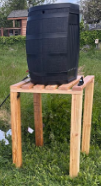
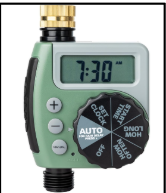
Shown below is our finished Irrigation system, we installed it at the farm on April 26, 2026. Here you can see the finished product and how it works, we built an elevated stand to ensure the gravity-fed system can reach the furthest plants from it. There is a water-timer attachment that allows users to control the amount of time, and consequently how much, the plants are being watered. This is especially important for an ever-changing garden, and we were pleased to deliver a system that can adapt to the needs of any.
Water storage barrel which can be connected to the rain catchment system if desiredConnect the system to the rain catchment system with a hose running from the water barrel to the catchment system or fill the barrel manually. This depends on the location of your system and what is most efficient.
Connect the automated faucet timer to the water storage spigot which will then connect to the main irrigation line controlling the flow of water. This faucet timer requires four steps which are very simple.
Setting the current time
Start time
Duration (how long)
Automated faucet timerFrequency (how often)
Open spigot directly connected to the water storage barrel which allows the water flow to be controlled by the timer instead of the manually operated spigot already on the water barrel.
Steps: Maintenance starts with a close inspection. CASA members who are familiar with the system and the crops its irrigating should perform the inspection, they'll be able to determine the integrity of the system as reflected on the yield of the crops under its care, if the crops are determined to be healthy, the system is working smoothly, if the crops have inconsistencies or are in poor condition, the system may have problems that need to be addressed, start by observing the small tubes that branch out to the crops and the emitters that drip the water to the crops. Accuracy and consistency are a must; leaks or obstructions can throw off irrigation precision, potentially dehydrating or over-watering the crops. Then start looking at the overarching components, like the main Polyethylene (PE) tubing line, smooth out any kinks or obstructions to ensure the water flows smoothly, and verify the tube's health. Deterioration and damage are possibilities, but given the PE tubes' durability, they shouldn't be a frequent concern. Lastly, observe the water tank, the faucet timer, and the spigot connectors. If the connections are tight, the timer is programmed correctly, and the water tank is in good condition and kept adequately full, the system is in great health and can continue operation.
After much prototyping, testing our final design for running water through tubes for drip irrigations was successful. As you can see to the right, our prototype helped us determine our final product. We used the same tubing material here as in our final design to test the emitters, check for leaks, and overall function.
To first test our design, we mocked up a prototype that acted as a small portion of the tubing used in our final design. Using a pressurized sink to test for functionality, the outcome was successful and we moved forward with our product.
Our team learned to thrive whilst working collaboratively with one another. Together, we faced many challenges throughout our design process. We have had prototypes fail, plans go wrong, and we have had many changes to our criteria throughout this process. One of the biggest changes our team faced was the shift between the site we were catering to. We originally started off with criteria for a different garden on the farm, however deeper into the semester we were chosen to irrigate a different plot. While this was an unexpected turn, our team worked hard to adjust and together our ability to pivot on projects has strengthened.
We aimed to make this project as efficient, yet simple as possible. We wanted our design to be replicable, should it suit the farms future needs. As far as out team goes, we hope to see our design nurturing and providing for the new garden this fall.