


Financial Sustainability in Makerspaces


Many makerspaces operate as community-driven initiatives but face challenges in achieving financial sustainability - often being dependent on grants. This article presents experience-based insights from the Tolocar project and its work with Ukrainian makerspaces, summarizing key lessons and practical tools for makerspaces to support them on their journey. The focus is on how makerspaces can develop sustainable business models while maintaining social impact.
Practical Tools
[edit | edit source]Workbook for Makerspaces
The workbook is a structured, practice-oriented tool that guides makerspace teams through key steps toward financial sustainability. It supports analyzing the organization's current situation, identifying costs and income gaps, developing business model ideas, and translating these into concrete action plans. The workbook encourages makerspaces to test assumptions, refine ideas, and move from reflection to implementation in a structured way. It can be applied during workshops, team strategy sessions, or as part of longer-term capacity development programs.
“It allowed me to step back and really look at what we are doing. I realized there are things we hadn’t thought about before, and things we are missing.” - workshop participant about the workbook.
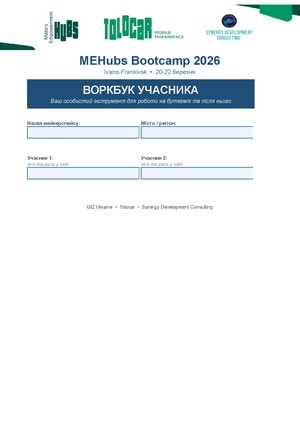
The workbook was developed by Synergy, as part of Tolocar's capacity development program for Ukrainian makerspaces. It was first applied during a workshop for makerspaces part of the Maker Empowerment Hubs program.
Makerspace Business Model Catalogue
The business model catalogue provides an overview of different revenue-generating approaches that makerspaces can adopt or adapt. It presents a range of potential revenue streams for makerspaces (like training and events to equipment access and production services). Rather than providing a single solution, the catalogue serves as a source of inspiration to help makerspaces identify suitable income streams based on their existing resources and capacities.
File:Makerspace-Business-models-catalogue-UA.pdf
The catalogue was originally developed within the MAKE project, compiled by Anna Sera Lowe, Martin Oloo, and Gertrude Mawuena Goh. With their support, it was translated and adapted to the Ukrainian context within the Tolocar project, by the Ukrainian Maker Association.
Lessons Learned
[edit | edit source]Initial resistance to revenue generation can be overcome through reframing
Introducing topics such as financial models and revenue generation can initially create resistance, particularly among organizations with a strong non-profit identity like many makerspaces are. Discussing income streams feels counterintuitive or even at odds with their mission. However, this perception often shifts once financial sustainability is reframed as a means to strengthen, rather than compromise, social impact. During the workshop Tolocar carried out, participants increasingly recognized that generating revenue enables greater independence from short-term funding and allows them to sustain and expand their activities.
As reflected in the discussions:
“At first it feels wrong to think about money in this way, but then you realize it actually helps you continue your work.”
The tension was clearly expressed by participants:
“There is this feeling that if you start earning money, it’s no longer social work.”
At the same time, there is growing recognition that:
“What we do has value, and it should be valued.”
Community is a key asset.
Across makerspaces, strong communities are a central factor for sustainability. It contributes to peer learning, collaboration, and outreach through shared networks. Rather than focusing only on equipment or infrastructure, makerspaces benefit from actively building and maintaining engaged communities.
Basic financial planning is the foundation of creating revenue streams.
A clear understanding of costs, revenues, and financial targets is essential for identifying viable income opportunities. Rather than being a purely administrative task, financial planning enables makerspaces to make informed decisions about which activities can generate revenue and how to structure them effectively. Tools such as cost calculations and break-even analysis helped participants translate ideas into realistic financial models.
Testing and iteration are more effective than long-term planning.
Instead of developing complex strategies upfront, it is more effective to test small-scale ideas and adapt them based on real demand.
“You don’t need to build something big immediately—you can try small things first.”
Implementation requires clear responsibilities.
A common challenge is the lack of clearly defined roles within teams, which can slow down or prevent implementation. Introducing simple planning and role-definition tools helped translate ideas into concrete actions.
Participants recognized this issue:
“We often have ideas, but it’s not clear who is responsible for what.”
| License | CC-BY-SA-4.0 |
|---|---|
| Cite as | Sarahmariaj (2026). "Financial Sustainability in Makerspaces". Appropedia. Retrieved October 18, 2026. |