Jump to content

Developing an Open-Source Pediatric Hand Prosthesis (v4)

From Appropedia
This photo depicts the final version 4 of the hand prosthesis laying flat on a table. The prosthesis is printed from red PETG with black latex inserts on the fingertips and on the palm. You can see white Dyneema strings as tensors.
Current Model (v4) with latex grip elements

This open-source project provides a lightweight, low-cost 3D-printed hand prosthesis for children, enabling everyday tasks like catching balls, riding a bike, or holding objects. Developed at TU Berlin, the design builds on the Kinetic Hand by Mat Bowtell but improves comfort, durability, and adjustability—all for under €10 in materials. Our goal: A prosthesis that grows with the child and empowers them to explore the world independently. All design files and documentation are open-source and available on GitHub, allowing others to replicate, adapt, or further develop the solution.

Key Design Features

[edit | edit source]
Design Overview
Feature Solution Benefit
Custom Fit Uniform scaling (no geometry modification) Fits 9-year-olds out of the box
Materials PETG (body), TPU (joints), Dyneema® (strings) Durable, flexible, low-stretch
Grip Optimization Latex/hot-glue grip surfaces Better hold on smooth or irregular objects
Modularity Compatible with e-NABLE parts Easy repairs/replacements
Cost <€10 (filament + hardware) <1 % of commercial prostheses

Development Process

[edit | edit source]

Iterative Improvements

[edit | edit source]
Version history
Version Status Name Key Features Date
v1 Proof of Concept First Working Model (Flexy-Hand 2 by Gyrobot)
  • Identified issues: too large size, limited adjustability, poor grip, visible cables
  • Used nylon strings → observed loss of force due to elasticity
  • Basis for further research and benchmarking
April 2025
v2 Working prototype Fit & Geometry Adaptation
  • Scaled Kinetic Hand by MatBowtell model for individual fit
  • Adjusted wrist socket and gauntlet geometry
  • Tested various scaling strategies (uniform vs. proportional)
  • Settled on PETG and TPU for main components and Dyneema® for cords
May 2025
v3 Prototype Grip Optimization & Cable Routing
  • Added grip surface testing (TPU, latex, hot glue)
  • Settled on uniform scaling to keep wire channels functional
  • Initial user feedback integrated
  • Tuned in prinitng settings for optimal joint strength
June 2025
v4 Functional and tested Final Prototype
  • Custom string tensioning clamp for one-handed operation
  • Latex grip surfaces for improved usability
  • Joints printed from softer TPU
July 2025
The image shows the main body and wrist-mounted actuator on a 3D-printers bed printed from red PETG.
Printing the parts for the main body (Flexy Hand 2 by Gyrobot)
The image shows multiple 3D-printed parts scattered on a table on a cutting mat. The parts are partly cleaned up, but some still have a brim and stringing.
Cleaning up the printed parts (Flexy Hand 2 by Gyrobot)
The image shows a 3D-printed cylinder with a grippy, textured hot-glue insert on one side.
Test piece of a grip element with in-place hot-glue injection moulding using the process we developed. The mould is achieved by clipping on a piece printed with fuzzy skin. Then, the hot glue is injected through a hole in the mould. Sugar water is used as a release agent.

Challenges and Solutions

[edit | edit source]

Poor Fit

[edit | edit source]
  • tested non-proportional scaling (but settled on uniform scaling)
  • printed multiple test pieces and incorporated user feedback

Low Grip Strength

[edit | edit source]
  • replaced stretchy Nylon tensors with Dyneema® for reduced backlash
  • selected softer TPU for hinges to lower required actuation force
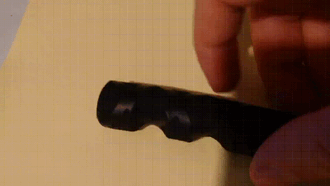
  • The GIF depicts a prosthetic finger consisting of three phalanxes wrapped in a black, textured heat shrink tubing. The finger is actuated (bent) and springs back into the original form, after being released.
    A prototype of a print-in-place prosthetic finger we designed, using heat shrink tubing for the flexible joints. This design reduces assembly time to 30 s per finger and provides a smooth, waterproof surface with no exposed joint hardware. The tubing is made from PVC and is designed to be a grip for fishing rods, thus the textured surface. It has yet to be tested for repeated bending cycles.
    added grip elements from latex/ developed process for in-place hot glue injection moulding

Material Selection

[edit | edit source]
  • selected PETG for main components for increased chemical resistance and durability
  • rejected PLA for low heat resistance (e.g. prosthesis left in a car in the summer)

Tensioner Adjustments

[edit | edit source]
  • developed new tensioner for one-handed adjustment

Results and User Feedback

[edit | edit source]

Metrics

[edit | edit source]
  • Cost: <10 € per piece
  • Weight: ~260 g
  • Print Time: ~8 hours
  • Assembly Time: ~2 hours

First-Time User Experience

[edit | edit source]

Within days, the child could:

  • Hold and drink from a water bottle (previously required two hands).
  • Catch a ball during play (improved hand-eye coordination).
  • Ride a bicycle while gripping the handlebars.

Current Limitations

[edit | edit source]
  • Precision tasks (e.g., holding a pen) remain difficult.
  • Full closure requires significant wrist force (focus of next iteration).
  • Separate movement of fingers

How to replicate this project

[edit | edit source]

Materials & Tools

[edit | edit source]
  • 3D Printer: FDM (PETG/TPU).
  • Files: GitHub Repository (STL files, assembly guide).
  • Time: ~8 hours print time, 2 hours assembly.
  • Additional Materials: Dyneema Small Screws, Latex or hot glue
  • Tools: needle-nose pliers, box cutter, small screwdriver

Step-by-Step Guide (Short Version)

[edit | edit source]
  1. Measure the user’s hand (following the instructions provided in the PDF for the Kinetic Hand).
  2. Print parts (PETG for rigidity, TPU for flexible components).
  3. Assemble (follow the official guide in the PDF for the Kinetic Hand).
  4. Adjust tension (use the new screw-based tensor for easy calibration).
  5. Test & iterate (involve the user for feedback!).

For a more detailed documentation, please refer to our Quick Start Guide on GitHub.

Community Contribution & Future Work

[edit | edit source]

How to contribute

[edit | edit source]
  • Test our design? Share feedback via GitHub Issues.
  • Improve it? Fork the repo and submit pull requests!
  • Need help? Join the e-NABLE Forum (we plan to post updates there soon).

We are not in yet in contact with e-NABLE, but we plan to share our findings with them directly.

Planned Upgrades

[edit | edit source]
Feature Status How You Can Help
Hot-glue grip pads Prototyped
  • Test durability with daily use
  • model new fingers for hot-glue inserts on fingertips and phalanxes
Heat-shrink joints In development
  • Stress-test with cycling loads
Improved print settings In development
  • create optimised printing profiles for faster and more reliable prints with greater strength

Frequently Asked Questions

[edit | edit source]

Can this be scaled for adults?

[edit | edit source]

Yes! The Kinetic Hand by Mat Bowtell was originally designed for adults, and our design is still built for this purpose. Use uniform scaling to achieve a good fit.

Credits & Acknowledgements

[edit | edit source]

We gratefully acknowledge the open-source foundation by:

This project was developed as part of the course “3D-Druck in der Mechanik” (en: “3D-printing in mechanics”) at TU Berlin, supervised by Prof. Dr. C. Völlmecke, Yating Ou (M.Sc.), and Narges Panjalipoursangari (M.Sc.).

Special thanks to our young user and his family, for their continuous feedback and further improvements to the design.


Page data
Keywords prosthesis, 3D-printed, hand prosthesis, paediatric prosthesis
SDG
Authors
License CC-BY-NC-SA-4.0
Organizations Technical University Berlin
Language English (en)
Related 0 subpages, 0 pages link here
Views 24 page views (analytics)
Created September 19, 2025 by 212.104.214.225
Last edit September 19, 2025 by StandardWikitext bot
Cookies help us deliver our services. By using our services, you agree to our use of cookies.