


CASA Student Farm accessible pathways

| Authors | Ella Owen |
|---|---|
| Location | Arcata, United States |
| Status | Deployed |
| Made | Yes |
| Replicated | No |
| Uses | education, science |

Designed and built in Fall 2025 for Cal Poly Humboldt's new agricultural program, this project focuses on creating an accessible, sustainable, and adaptable pathway for the university's developing student farm. Our team, The Mooos, set out to solve the problem of difficult, uneven, and muddy terrain that limits access for students, staff, visitors, and individuals using mobility devices. Motivated by the clients' goals for inclusivity, environmental reasonability, and long-term education use, we created a modular wooden pallet pathway system that improves year-round access while remaining moveable, expandable, and low impact. This design serves future agriculture students, community members, and anyone navigating the farms learning spaces.
Background
This project was completed in Fall 2025 by The Mooos, a four-student team in Cal Poly Humboldt’s Engineering 205 course, in collaboration with our client, Dr. Renee Byrd. Cal Poly Humboldt recently acquired a 28-acre property less than a mile from campus to develop its new Agricultural Program, set to launch in Fall 2026. Our team was tasked with addressing a major issue on the new 2-acre student farm plot: the lack of any accessible or defined pathway. Because the land was previously used as a cattle farm, the soil is compacted, uneven, and becomes extremely muddy in Humboldt’s heavy rainfall, creating barriers for students, instructors, visitors, and users with mobility aids. The goal of the project was to research, design, and build an adaptable, environmentally conscious pathway system that meets ADA considerations while aligning with the program’s mission of sustainability, inclusivity, and respect for the land. This background shaped the need for a safe, functional, and future-expandable walkway for everyone accessing the new farm space.
Problem statement
[edit | edit source]The objective of this project is to design and build an accessible, adaptable, and environmentally conscious pathway system for the new Cal Poly Humboldt student farm to ensure safe, year-round access for all users. Once implemented, this solution will replace the current uneven, muddy, and difficult-to-navigate terrain with a stable, ADA aware walkway that supports students, staff, visitors, and individuals using mobility devices. The finished pathway will improve accessibility, reduce safety hazards, support the Agricultural Program’s sustainability goals, and create a functional route that future classes can expand and maintain as the farm continues to grow.
Criteria
[edit | edit source]To guide our design decisions, we identified key criteria based on ADA requirements, site conditions, sustainability goals, and the client’s needs. These criteria helped us evaluate each pathway option and determine which design best fits the project’s constraints. Each constraint is assigned a weight from 0–10 to show its importance in the final decision.
| Criteria | Description | Weight (1-10) |
|---|---|---|
| Accessibilty (ADA) | Must be usable by all mobility levels | 10 |
| Safety | Must reduce tripping/slipping hazards | 9 |
| Cost/Budget | Must stay within the $300 budget | 8 |
| Weather Resistance | Must perform well in heavy rain/mud | 9 |
| Durability | Must withstand long tern use | 8 |
| Environmental Impact | Should be sustainable and low impact | 8 |
| Modularity | Must be movable and expandable | 8 |
| Ease of installation | Must be buildable by a small student team | 7 |
| Soil constraints | Must work on compact, uneven farm soil | 7 |
| Maintenance Requirements | Should require minimal upkeep | 7 |
| Aesthetics | Should follow curvy, colorful, waterlike design | 6 |
Prototyping
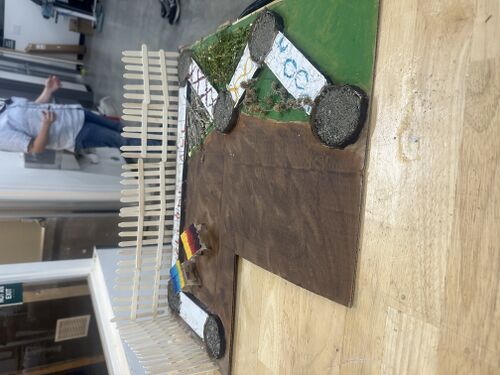
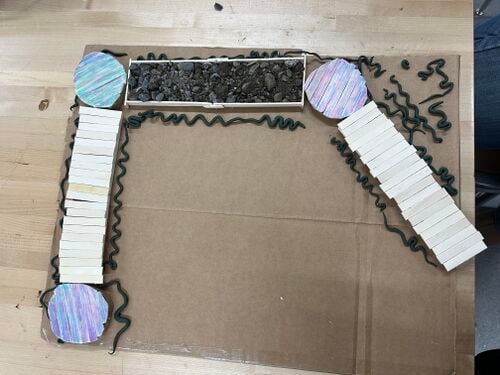
[edit | edit source]Our prototyping process began with simple hand-drawn sketches to explore different tile shapes, dimensions, and connection methods. We then created basic digital drawings to refine the layout and ensure the pathway could curve naturally while remaining ADA-conscious. Early prototypes using pallet wood revealed several issues—some sections flexed too much, absorbed water, or sat unevenly on the compacted soil. These failures helped us understand the need for sanding, sealing, reinforcing the pallets, and adding a bark layer underneath for drainage and leveling.
- Sample gallery
-
-


Final product
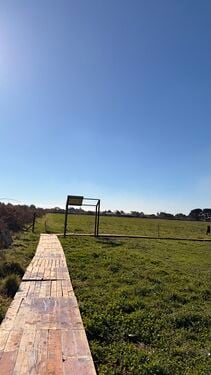
[edit | edit source]Our final product is a modular, accessible wooden-pallet pathway system designed to provide a safe, stable route across the new Cal Poly Humboldt student farm. At the widest level, the pathway is made of reinforced wooden pallet tiles arranged in a continuous, line that follows the natural flow of the landscape and the client’s request for a water-inspired design. Included are pallets that are circular shaped to change the direction that the pallets go creating an almost zig zag pattern to add shape and dimension. The pathway creates a firm, slip-resistant walking surface while remaining moveable and expandable for future agriculture classes.
Each pallet tile is sanded, sealed, and reinforced to ensure durability in Humboldt’s rainy climate. Beneath every pallet is a leveled base of bark and soil that improves drainage and prevents the walkway from sinking into the compacted ground. The spaces between tiles are aligned to minimize level changes and support ADA conscious transitions. The final layout balance's structure, sustainability, and aesthetics combining reused materials with a natural look that fits the farm environment.
Construction
[edit | edit source]This section provides a complete, detailed explanation of how our final pathway system was constructed. The build process is broken into clear steps, from preparing the site to assembling and installing each pallet tile.
Overview of the Final Build
Our final project is a modular, ADA-conscious wooden pallet pathway designed to create a stable, accessible walking surface across the uneven and muddy terrain of the Cal Poly Humboldt student farm. Each pathway tile is made from reclaimed wooden pallets that were reinforced, sanded, and sealed for durability. The tiles rest on a compacted soil-and-bark base that provides leveling, stability, and drainage in Humboldt’s heavy rainfall.
Step-by-Step Build Instructions
[edit | edit source]Step 1: Site Preparation
[edit | edit source]- Measure and mark the pathway layout according to client needs using pink flags
- Remove surface debris (sticks, rocks, leaves).
- Scrape and level the soil using shovels, rakes, and a hand tamper.
- Test for low spots and adjust to avoid future puddling
Step 2: Creating the Drainage Base
[edit | edit source]- Spread a 1–2-inch layer of bark or wood chips along the marked path.
- Rake the bark until it forms an even layer and fills small dips in the soil.
- Test by stepping on the bark ensure it compresses evenly and does not expose dirt.
- Add additional bark where sinking occurs.
Step 3: Preparing the Wooden Pallets
[edit | edit source]- Choose sturdy pallets with minimal cracks.
- Remove any damaged boards and reinforce weak areas using replacement boards.
- remove all the bottom boards from the pallets so they do not rot
- Sand the top surface to remove splinters and create a safer walking surface.
- Apply sealant to protect the wood from moisture and rot.
Step 4: Reinforcing the Pallets
[edit | edit source]- Strengthen the underside using additional support beams if needed.
- Secure all loose or unstable planks with screws.
- Ensure all nails are removed or fully embedded for safety.
Step 5: Placing and Leveling the Pallets
[edit | edit source]- Set each pallet onto the bark base following the pathway layout.
- Adjust bark underneath each pallet until the walking surface is level and stable.
- Ensure no tile shifts underweight re-level as needed.
- Align pallets closely to minimize gaps and maintain ADA-conscious transitions.
- Use 4-inch blocks of wood to connect each of the pallets to make sure the pallets are secure
Step 6: Final Adjustments and Testing
[edit | edit source]- Walk the entire path to identify unstable or uneven areas.
- Add more bark beneath problem sections to tighten the fit.
- Test drainage by pouring water onto the pathway and observing runoff.
- Make final adjustments to ensure a safe, slip-resistant surface.
- Sample gallery
-
Summary of What We Built
[edit | edit source]The completed pathway is a modular, moveable, and environmentally friendly walking system constructed entirely from reclaimed wooden pallets and natural bark. It provides:
- a firm, stable walking surface
- improved accessibility
- drainage suitable for Humboldt’s climate
- a design that can be expanded or relocated by future classes
This final structure succeeds in meeting the client’s needs for sustainability, aesthetics, and inclusivity while remaining within the $300 project budget.
Video instructions
[edit | edit source]Bill of materials
[edit | edit source]| Item | Amount | Cost per unit | Total |
|---|---|---|---|
| Sealant for wood — 2 gallons, get at tractor supply | 1 | USD 91.00 | USD 91.00 |
| 1 and 1/4 inch nails — 1 pound pack, get at ace hardware | 1 | USD 8.99 | USD 8.99 |
| Grand total | USD 99.99EUR 85.99 <br />GBP 72.99 <br />CAD 123.99 <br />MXN 2,084.79 <br />INR 7,484.25 <br /> | ||
Operation
[edit | edit source]This section explains how to properly operate the system using clear, step-by-step instructions.
Once you pick which side is better using a crow bar you are going to pull apart the other side of the pallet. Making sure to leave 2 of the planks on the pallets on the edge to maintain the level of the pallet.
Maintenance
[edit | edit source]Regular maintenance is essential to keep the wooden pallet pathway safe, accessible, and functional throughout Humboldt’s wet climate and heavy farm use. Because the pathway is built from natural materials reclaimed wood, bark, and leveled soil it requires periodic checks to ensure stability, proper drainage, and continued ADA-conscious performance. Maintenance can be performed by agriculture students, farm staff, or future Engineering 205 teams as part of ongoing farm stewardship.
Maintenance schedule
[edit | edit source]This is when to maintain what. Please keep the format the same as it populates the kiosk in CCAT.
Daily
- Clear leaves, sticks, and mud from the top of the pallets to prevent slipping.
- Visually inspect for any loose boards, lifted edges, or tripping hazards.
Weekly
- Check pallet stability to ensure none are rocking, shifting, or sinking into the bark layer.
- Rake and redistribute bark under any uneven sections to maintain level transitions.
Monthly
- Inspect the drainage performance after rainfall to ensure water flows through the bark and does not pool on the walkway.
- Add fresh bark to low areas where compression or erosion has occurred.
Yearly
- Reseal the pallet wood to protect against moisture, rot, and long-term weathering.
- Tighten or replace any screws, fasteners, or reinforcing boards showing wear.
Every 2-3 years
- Replace pallets that show significant structural deterioration or warping.
- Re-level the entire pathway by lifting each pallet, refreshing the bark layer, and re-compacting the soil base.
Conclusion
[edit | edit source]Testing results
[edit | edit source]In conclusion we noticed that rain went through the pallets and onto the ground which kept the pallets rot free and stable. Additionally, through different testing we saw that the pallets were sturdy enough to hold weight and maintain stability over time.
Discussion
[edit | edit source]Looking at the results we see a study pathway that is build to last. Additionally, we learned how to work in groups and work with others. It was interesting to see of how we could create something with all the criteria while fitting into other constraints as well. It challenged us not only as engineering but as students and people to learn.
Lessons learned
[edit | edit source]Through this project we learned that communication is key. Not only that but we learned how to communicate to the client to get the answers needed to perfect our project. We also learned the basic concepts of designs but not only that, but how to apply it in a real world setting.
Next steps
[edit | edit source]I would love to fix the farm at least once a month to see if there is any maintenance along with possibly looking into expanding the path in the future.
Troubleshooting
[edit | edit source]| Problem | Suggestion |
|---|---|
| Broken pallet board | looking at the instructional video |
| uneven or unlevel | look at the maintenance list |
| Another issue | contact Ella Owen (ero15@humboldt.edu) |
Team
[edit | edit source]The Mooos
ENGR 205-introduction to design
Fall 2025
Cal Poly Humboldt
- Ella Owen
- Nallely Salas Gallegos
- Jorrin Cayton
- Victor Moroianu
References
[edit | edit source]
| License | CC-BY-SA-4.0 |
|---|---|
| Organizations | Cal Poly Humboldt |
| Cite as | Lonny Grafman (2025–2026). "CASA Student Farm accessible pathways". Appropedia. Retrieved October 11, 2026. |