| Location | Michigan, USA |
|---|---|
| Status | Designed Modelled Prototyped Verified |
| Verified by | MOST |
| Cost | USD 700 |
| Hardware license | CERN-OHL-S |
|---|---|
| Certifications | Start OSHWA certification |
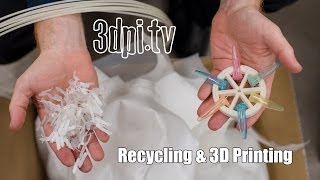
A RecycleBot is a waste plastic extruder that creates 3-D printer filament from waste plastic and natural polymers.
Notice: Check out the new Open Source 3-D Filament Diameter Sensor for Recycling, Winding and Additive Manufacturing Machines. Why it is needed Filamentive survey
In order to assist researchers explore the full potential of distributed recycling of post-consumer polymer waste, this article describes a recyclebot, which is a waste plastic extruder capable of making commercial quality 3-D printing filament. The device design takes advantage of both the open source hardware methodology and the paradigm developed by the open source self-replicating rapid prototyper (RepRap) 3-D printer community. Specifically, this paper describes the design, fabrication and operation of a RepRapable Recyclebot, which refers to the Recyclebot's ability to provide the filament needed to largely replicate the parts for the Recyclebot on any type of RepRap 3-D printer. The device costs less than $700 in mate rials and can be fabricated in about 24 h. Filament is produced at 0.4 kg/h using 0.24 kWh/kg with a diameter ±4.6%. Thus, filament can be manufactured from commercial pellets for <22% of commercial filament costs. In addition, it can fabricate recycled waste plastic into filament for 2.5 cents/kg, which is <1000X commercial filament costs. The system can fabricate filament from polymers with extrusion temperatures <250 °C and is thus capable of manufacturing custom filament over a wide range of thermopolymers and composites for material science studies of new materials and recyclability studies, as well as research on novel applications of fused filament based 3-D printing.
Aubrey L. Woern, Joseph R. McCaslin, Adam M. Pringle, and Joshua M. Pearce. RepRapable Recyclebot: Open Source 3-D Printable Extruder for Converting Plastic to 3-D Printing Filament. HardwareX 4C (2018) e00026 doi: https://doi.org/10.1016/j.ohx.2018.e00026 open access

A low-cost, open source, self-replicating rapid prototyper (RepRap) has been developed, which greatly expands the potential user base of rapid prototypers. The operating cost of the RepRap can be further reduced using waste polymers as feedstock. Centralized recycling of polymers is often uneconomic and energy intensive due to transportation embodied energy. This paper provides a proof of concept for high-value recycling of waste polymers at distributed creation sites.
Previous designs of waste plastic extruders (also known as RecycleBots) were evaluated using a weighted evaluation matrix. An updated design was completed and the description and analysis of the design is presented including component summary, testing procedures, a basic life cycle analysis and extrusion results. The filament was tested for consistency of density and diameter while quantifying electricity consumption.
Filament was successfully extruded at an average rate of 90 mm/min and used to print parts. The filament averaged 2.805±0.003mm diameter with 87% of samples between 2.540± 0.003mm and 3.081± 0.003mm. The average mass was 0.564 ± 0.001 g/100mm length. Energy use was 0.06 kWh/m.
The success of the Recyclebot further reduces RepRap operating costs, which enables distributed in-home, value added, plastic recycling. This has implications for municipal waste management programs as in-home recycling could reduce cost and greenhouse gas emissions associated with waste collection and transportation as well as the environmental impact of manufacturing custom plastic parts.
This paper reports on the first technical evaluation of a feedstock filament for the RepRap from waste plastic material made in a distributed recycling device.
Christian Baechler, Matthew DeVuono, and Joshua M. Pearce, "Distributed Recycling of Waste Polymer into RepRap Feedstock" Rapid Prototyping Journal, 19(2), pp. 118-125 (2013). open access
Full technical information, BOMs and build instructions found at the links below. Also when designing consider Improving recyclebot concepts
Igor Cudnik of Poznan University of Technology resolved i2c (right now working on adding it as a preproccesor instruction, and move all config to config.h file). He made also a whole new electric scheme, to make it easier for electrical newbies. Eventually he is working on CAD models to make them fully parametric and accessible from FreeCAD.
All of his changes can be found on my codeberg repo: https://codeberg.org/309631/recyclebotV6.2
Assumptions:
Payback time in kg produced = recyclebot cost/(commercial filament cost avoided - (elec+plastic))
Worst case = (filastruder+filawinder)/(commercial filament cost avoided - high end pellets -elec recyclebot)=$450/($35-$10.10)=18kg
Best case = filastruder plus floor winding/(commercial filament cost avoided - recycled plastic) = $290/($35-0.1) = 8.3kg
Rich case = filastruder+filawinder/(commercial filament cost avoided - recycled plastic) = $450/($35-0.1) = 12.8kg
Then you stick the filament in your RepRap and print $1000s of dollars of goods for pennies: see Life-cycle economic analysis of distributed manufacturing with open-source 3-D printers
These symbols are meant to indicate the type of plastic, not its recyclability.
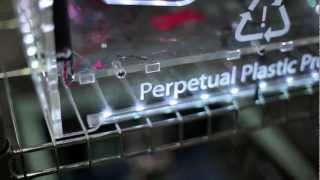
| Perpetual Plastic Project |
|---|
|
Perpetual Plastic Project - Giant Room Size RecycleBot that takes people through all the steps now joined by Ultimaker |
| The New Scientist - Ethical Filament Story |
|---|
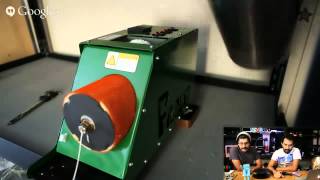
| AdaFruit Industries:3D Hangouts with Matt Griffin, Noe & Pedro Ruiz |
|---|
| Authors | Joshua M. Pearce |
|---|---|
| License | CC-BY-SA-3.0 |
| Organizations | MOST, MTU |
| Cite as | Joshua M. Pearce (2011–2026). "Recyclebot". Appropedia. Retrieved October 3, 2026. |