


File:ChatGPT Image Jan 19, 2026, 08 29 16 PM.png
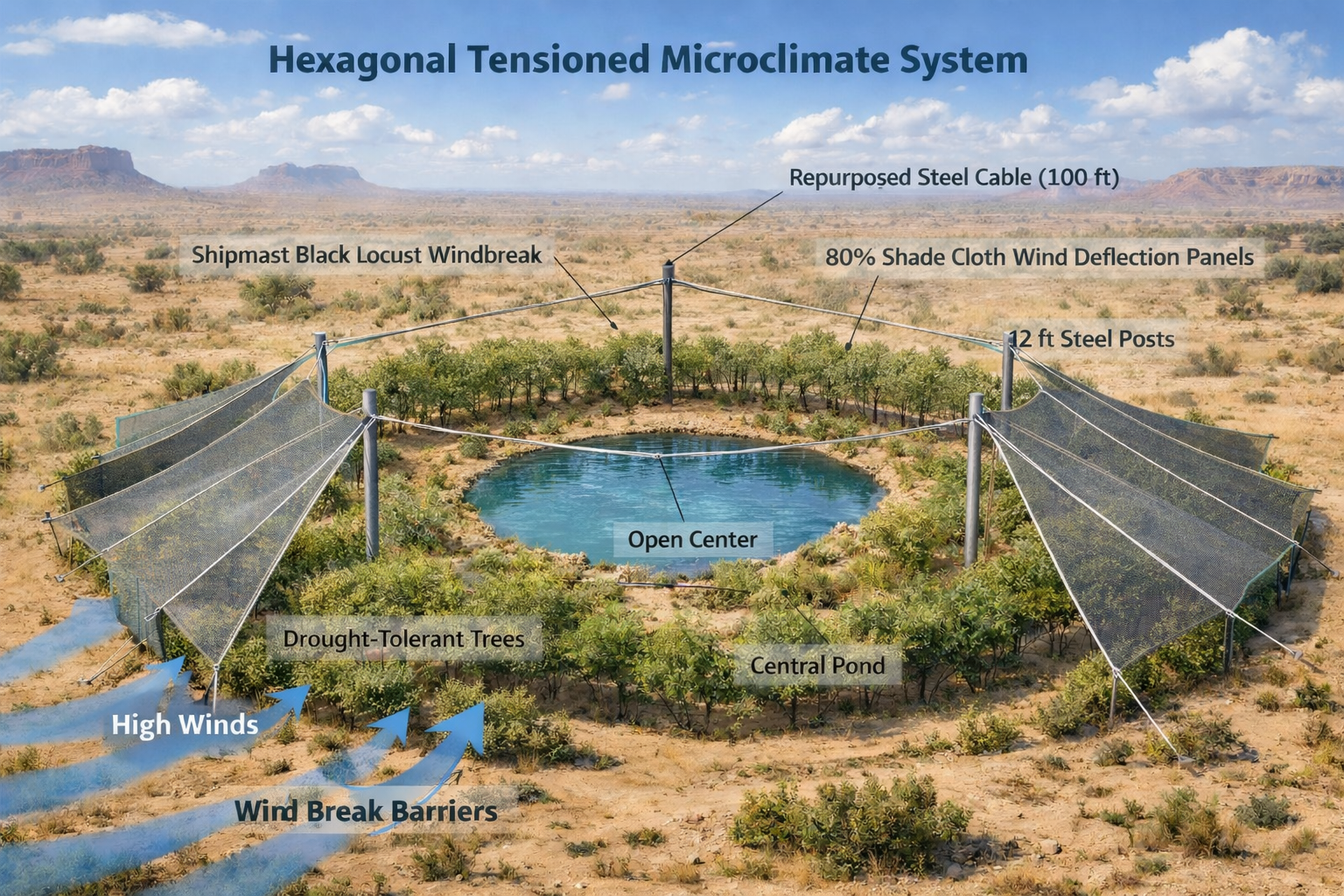

- Abstract
A hexagonal cable-tensioned structure using repurposed elevator traction cable to create protected microclimate zones for food forest establishment in high-wind desert environments. The system functions as "nurse infrastructure" — temporary scaffolding that protects establishing trees until living windbreaks mature and take over the protective function.
This design addresses a common challenge in arid land restoration: young trees need wind protection to establish, but living windbreaks take years to mature. The tensioned cable system bridges this gap while incorporating graceful failure modes that protect permanent infrastructure investment.
- Background
- The Problem
High desert environments present compounding challenges for food forest establishment:
- Wind speeds reaching 75-80 mph stress young trees
- Evapotranspiration rates exceed plant tolerance during establishment
- Traditional windbreaks take 5-10 years to become functional
- Rigid structures fail catastrophically under extreme wind loads
- Young trees often die before protective vegetation matures
- Design Philosophy
This system applies tensegrity principles to agricultural infrastructure. Rather than building rigid structures that must resist maximum loads, the design:
1. Distributes loads across a cable network 2. Incorporates designed failure points (fuses) that protect permanent infrastructure 3. Creates graduated protection zones from perimeter to center 4. Functions as scaffolding for an ecosystem that eventually becomes self-protecting
The steel and cable hold space while roots establish.
- System Overview
- Geometry
Hexagonal plan with 6 posts at vertices, approximately 100 ft between posts.
- Key measurements:**
- Perimeter: ~600 ft total cable
- Interior area: ~25,000 sq ft (0.6 acres)
- Post height: 12 ft
- Central feature: Excavated pond
- Concentric Zone Structure
The system creates graduated protection from outside to center:
``` Zone 1: Property fence (outermost) — legal boundary, irrigation line Zone 2: Shipmast Black Locust row — nitrogen-fixing windbreak Zone 3: Outer ring species — secondary windbreak inside locust Zone 4: Hex cable structure — microclimate infrastructure Zone 5: Inner ring — pond zone, maximum protection Zone 6: Central pond — thermal mass, humidity, irrigation reserve ```
- Materials
- Primary Structure
- Vertical members:**
- 6 steel pipes, 12 ft tall, at hexagon vertices
- Anchored in concrete or with screw anchors depending on soil
- Counter-tensioned outward with radial guy wires
- Primary cables:**
- 1/2" steel elevator traction cable (repurposed)
- Breaking strength: 20,000+ lbs
- Forms perimeter hexagon and radial spokes to center
- Why elevator cable:** Elevator traction cable is overbuilt for this application, which is exactly right. It's designed for life-safety applications with high fatigue resistance. When elevators are modernized, the old cable is typically scrapped. Acquiring a barrel of used cable repurposes industrial waste into permanent agricultural infrastructure.
- Secondary Structure
- Cable sandwich grid:**
- 1/8" or 3/16" aircraft cable
- Upper and lower grids capture shade cloth between them
- Triangulated pattern distributes point loads across network
- Membrane:**
- 80% Aluminet shade cloth
- Reduces solar load and evapotranspiration stress
- Becomes a compression element between cable layers, not a tension element holding its own edges
- Designed Failure Elements
- Deployable down-ties:**
- Rope to ground anchor
- 8-10 ft 4×4 timber as gravity anchor/lever
- Can be deployed at any point along perimeter
- Timber is the designed "fuse"
- Failure Hierarchy
The system incorporates a designed failure sequence that protects permanent infrastructure:
1. **Wood post (4×4) fails first** — sacrificial fuse, snaps or pulls out 2. **Shade cloth fails second** — tears or grommets pull through 3. **Aircraft cable stays intact** — grid remains ready for new cloth 4. **Primary elevator cable stays intact** — structure untouched 5. **Steel posts and anchors stay intact** — rebuild from top down
This means: after an extreme wind event, you replace timber fuses and potentially shade cloth. The expensive, permanent infrastructure survives.
- Wind Wedge System
Solid or semi-solid barriers positioned outside the hex perimeter, between the cable structure and outer planting zones.
- Function:**
- Break 80 mph wind to 40-50 mph before it reaches the membrane
- Protect establishing food forest plantings
- Reduce frequency of fuse failures
- Options:**
- Solid fence sections
- Fabric on frames
- Living fast-starts with temporary protection
- Hybrid approaches
- Planting Zones
- Zone 2: Shipmast Black Locust Row
Planted just inside property fence with dedicated irrigation.
- Why Shipmast Locust:**
- Nitrogen fixation improves soil for all downwind plantings
- Fast establishment — functional windbreak in 3-5 years
- Evolved in Appalachian ridges; tolerates extreme wind
- Rot-resistant heartwood provides perpetual fence post supply
- Coppices aggressively — cut it and it grows back harder
- Shipmast variety has upright growth habit, less aggressive spreading
- Zone 3: Outer Ring (Inside Locust)
Four species selected for wind tolerance, drought adaptation, and complementary function:
- 1. Desert Willow (Chilopsis linearis)**
- Native, fast-growing, drought-proof
- 15-25 ft height, won't compete with locust canopy
- Deep taproot, no surface root competition
- Flowers feed pollinators all summer
- 2. New Mexico Olive (Forestiera neomexicana)**
- Native, extremely hardy
- Dense growth fills wind gaps between other trees
- Wildlife food — birds distribute seeds
- Tolerates poor soil that locust is improving
- 3. Pinyon Pine**
- Native, belongs in the landscape
- Slow establishment but permanent — 200+ year lifespan
- Edible nuts, high value crop
- Wind-resistant once established
- 4. Jujube**
- Extreme drought and heat tolerance
- Produces fruit in conditions that kill other trees
- Thorny — adds security function to perimeter
- Minimal water requirement once established
- Zone 5: Inner Ring (Pond Zone)
Protected by cable infrastructure and outer windbreaks. Benefits from pond thermal mass and humidity.
- Fruit trees:**
- Fig
- Pomegranate
- Apricot
- Asian Pear
- Berries and shrubs:**
- Goji
- Elderberry
- Currant
- Gooseberry
- Mulberry (dwarf varieties)
- Zone 6: Central Pond
- Design:**
- Long shallow wedge shape, deepening to 8-10 ft
- 12" deep ledges (4 ft wide) on both sides
- Ledges support emergent vegetation (cattails, rushes, water iris)
- Functions:**
- Thermal mass — buffers temperature swings
- Humidity source — raises local humidity for fruit trees
- Irrigation reserve
- Ecosystem habitat (fish, frogs, dragonflies for pest control)
- Fire suppression reserve
- Potential aquaponics integration
- Excavation:** Mini excavator, spoil becomes berms for additional wind protection or hugulkultur mounds.
- Construction Sequence
- Phase 1: Posts and Primary Cable
1. Set 6 steel posts at hexagon vertices 2. Install ground anchors for radial counter-tension 3. Run 1/2" elevator cable around perimeter 4. Run radial cables from vertices to center 5. Tension system
- Phase 2: Secondary Cable Grid
1. Install aircraft cable in triangulated pattern 2. Upper layer first, then lower layer 3. Tension to design specification
- Phase 3: Membrane and Down-Ties
1. Install shade cloth between cable layers 2. Attach with grommets or sewn sleeves 3. Position ground anchors for down-tie system 4. Pre-cut timber fuses
- Phase 4: Pond Excavation
1. Excavate wedge-shaped pond at center 2. Create ledges for emergent vegetation 3. Line if soil doesn't seal (bentonite clay or EPDM liner) 4. Use spoil for berms
- Phase 5: Planting
1. Install irrigation to property perimeter 2. Plant Shipmast Locust row (Zone 2) 3. Plant outer ring species (Zone 3) 4. Plant inner ring fruit trees and shrubs (Zone 5) 5. Plant pond margins (Zone 6)
- 10-Year Succession Timeline
- Year 0-2:**
Cable infrastructure provides establishment climate. Wind wedges protect perimeter. All planting zones installed. High maintenance period — irrigation, replacement of any failed starts.
- Year 3-5:**
Locust windbreak becoming functional. Outer ring species establishing. Inner orchard beginning production. Cable system still primary wind protection.
- Year 5-7:**
Living windbreaks taking over perimeter protection. Food forest canopy beginning to close. Cable system becoming secondary/backup.
- Year 8-10:**
Living system provides own windbreak and shade. Cable infrastructure optional — can be removed, repurposed, or retained as backup for extreme events.
- The steel is the nurse structure. The trees are the succession target.**
- Bill of Materials
| Item | Quantity | Notes | |------|----------|-------| | Steel pipe, 12 ft | 6 | Posts at vertices | | 1/2" elevator cable | ~800 ft | Perimeter + radials | | 1/8" aircraft cable | ~2000 ft | Secondary grid | | 80% Aluminet shade cloth | ~25,000 sq ft | Membrane | | Ground anchors | 12+ | For counter-tension | | 4×4 timber, 8-10 ft | 12+ | Sacrificial fuses | | Rope | 600+ ft | Down-tie system | | Cable clamps, thimbles | Various | Hardware | | Concrete | As needed | Post foundations | | Shipmast Locust | 50-100 | Perimeter windbreak | | Outer ring trees | 20-40 | 4 species mix | | Inner ring fruit trees | 12-24 | Zone 5 | | Berry shrubs | 24-48 | Zone 5 | | Pond liner or bentonite | As needed | Depends on soil |
- Cost Considerations
- Major cost drivers:**
- Steel posts and anchors
- Mini excavator rental or purchase
- Trees and shrubs
- Irrigation installation
- Cost reduction strategies:**
- Repurposed elevator cable (often free or very cheap)
- DIY excavation with rented equipment
- Bare root trees planted in dormant season
- Phased installation over multiple years
- Design Variations
- Smaller Scale
Scale hex to 50 ft sides for ~6,000 sq ft protected area. All principles apply; adjust materials proportionally.
- Without Pond
System functions for wind/shade management without central pond. Loses thermal mass and humidity benefits.
- Different Climates
Core tensegrity and failure hierarchy principles apply anywhere. Adjust:
- Species selection for local climate
- Membrane density (more shade in hotter climates)
- Wind wedge requirements
- Related Systems
- References
- Fuller, R. Buckminster. Synergetics: Explorations in the Geometry of Thinking.
- Mollison, Bill. Permaculture: A Designers' Manual.
- Lancaster, Brad. Rainwater Harvesting for Drylands and Beyond.
- Project Status
In development. Design documentation phase. Site preparation beginning 2026.
- Author
Kevin Mears Buckminster Fuller Institute Design Science Studio, 2026 cohort. Former elevator constructor with 8 years experience at federal facilities. Background in tensioned cable systems informs the structural approach.
- License
This work is shared under CC-BY-SA-4.0. Copy, adapt, improve, and share freely with attribution.
---
- Documentation created January 2026*
| Date created | Unknown |
|---|---|
| Author | Unknown |
| Date uploaded | January 20, 2026 |
| Uploader | GiftedSavant |
| License | Unknown |
File history
Click on a date/time to view the file as it appeared at that time.
| Date/Time | Thumbnail | Dimensions | User | Comment | |
|---|---|---|---|---|---|
| current | 04:30, 20 January 2026 | | 1,536 × 1,024 (2.96 MB) | GiftedSavant (talk | contribs) |
You cannot overwrite this file.
File usage
There are no pages that use this file.