| Manufacturing files | https://www.thingiverse.com/thing:4023136 |
|---|---|
| Hardware license | CERN-OHL-S |
| Certifications | Start OSHWA certification |
| Authors | Dan Brinks |
|---|---|
| Status | Designed Prototyped |
| Years | 2019 |
| Made | Yes |
| Replicated | No |
| Cost | USD 1.37 |
Use (recycled) Lithium Ion Batteries instead of Alkaline (AA, AAA, C, etc) for consumer electronics. Electric/electronic devices, designed to run on 3 volts (traditionally 2 AA, AAA, C, D alkaline batteries), are quite prolific around the world. Some devices are troublesome to swap batteries on - the time/date must be re-set, or they may be in a difficult to access location. Some devices are designed to operate on 3 volts minimum, and don't work well at all on the 2.4v output from a pair of traditional rechargeable batteries. In this case, users are forced to continue buying and discarding/recycling single-use alkaline batteries. Alternatively, the device may be replaced, with one that works better on rechargeable cells. Either route here results in material being discarded, likely ending up in a landfill.
I propose to use rechargeable lithium ion batteries, in place of traditional alkaline, NI-MH or NiCd cells. Lithium ion cells boast a very high power density, storage efficiency, and a low self discharge rate. This makes this ideal to power many electronics already existing around the world. Some circuitry must be added, as the maximum voltage of a standard Li-Ion cell is ~4.2 volts, which could cause problems or even destroy some electronics. Also, Li-Ion batteries do not tolerate being discharged beyond a certain threshold - usually about 2.5 volts. We'll also add a cell protection circuit to prevent the charge from going below critical.
Finally - brand new Li-Ion cells are available on the market - but they are more expensive than traditional alkaline cells by far. For this project, we'll use cells recycled from an old laptop battery pack. Often, when laptop battery packs age or fail, some cells will degrade much faster than others. Even if a pack is completely nonfunctional (in a laptop), often some individual cells within the pack still have useful life. The packs can be carefully disassembled, and individual cells charged and tested. For this project, we'll use "18650" Lithium Ion cells, that were harvested from a non-functioning 2007-era laptop.
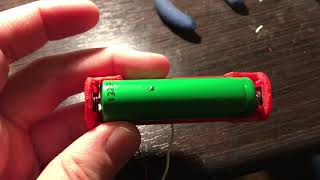
These components are needed in this design:
| Quantity | Name | Description | Unit cost (USD) |
|---|---|---|---|
| 2 | Spring type battery connectors | Steel spring style battery connectors are preferred, for ease of use and reliability. These are inserted and soldered to in the 3D printed 18650 cell holder. They're available from many sources, with a name like "Metal Batteries Spring Contact Plate". Alternatively, purchase an individual 18650 cell holder, approx. $0.35 US | $0.04 |
| 1 | Li-Ion protection board | The protection board prevents the Li-Ion cell from being discharged beyond a safe point | $0.19 |
| 1 | 3 volt regulator circuit | This can be done with any standard voltage regulator, and the correct resistors. Recommend a low standby current design - 3volt regulators are available as an assembled PCB from many sources (recommend chip 6206A) | $0.95 |
| 1 | 18650 Li-Ion cell | Try to source this for free, from your (or your friends) non-functional laptop battery, USB power bank, etc. | $0.00 |
| 30cm | Small wire | Wire used for electrical connections | |
| 10g | Solder | A small amount of solder used for electrical connections | |
| 5g | Adhesive | A small amount of epoxy, glue or double sided tape. For mounting circuit boards. | |
| Total: | $1.22 |
Find the printed design on thingiverse - along with URL for BOM components (appropedia won't let me use ali express links)
This design uses about 7 grams of filament, for a plastic cost of approximately $0.15 US.
Print time estimate: 60 minutes
Assembly time estimate: 40 minutes
These instructions will walk you through wiring up the battery terminals to the input of the Li-Ion protection board, and then connecting the output of that protection board to the 3 volt regulator circuit.
However - I think it is more appropriate to compare the cost of the above design with what most consumers would be doing, buying and throwing away Alkaline AA cells. A 48-pack of AA cells can be purchased for $14 US, yielding a per-cell price of $0.29. Assuming 2 AA batteries would need to be replaced in a device each year, this design pays for itself in just over 2 years time. If an environmental cost is factored into the production/disposal of alkaline AA's, the payoff time is shorter.
This design benefits almost any community that has:
As an example, this design benefits the Michigan Tech (Houghton, MI) community.
| License | CC-BY-SA-3.0 |
|---|---|
| Organizations | MTU, Michigan_Tech's_Open_Sustainability_Technology_Lab, MY4777 |
| Cite as | Dlbrinks (2019–2024). "Use Li-ion Batteries Instead of Alkaline". Appropedia. Retrieved October 3, 2026. |