| Authors | Gerald C. Anzalone Chenlong Zhang Bas Wijnen Paul G. Sanders Joshua M. Pearce |
|---|---|
| Location | Michigan, USA |
| Status | Designed Modelled Prototyped Verified |
| Verified by | MOST |
| Cost | USD 1,194.13 |
| Hardware license | CERN-OHL-S |
|---|---|
| Certifications | Start OSHWA certification |

Technical progress in the open-source self replicating rapid prototyper (RepRap) community has enabled a distributed form of additive manufacturing to expand rapidly using polymer-based materials. However, the lack of an open-source metal alternative and the high capital costs and slow throughput of proprietary commercialized metal 3-D printers has severely restricted their deployment. The applications of commercialized metal 3-D printers are limited to only rapid prototyping and expensive finished products. This severely restricts the access of the technology for small and medium enterprises, the developing world and for use in laboratories. This paper reports on the development of a <$2000 open-source metal 3-D printer. The metal 3-D printer is controlled with an open-source micro-controller and is a combination of a low-cost commercial gas-metal MIG welder and a derivative of the Rostock, a deltabot RepRap. The bill of materials, electrical and mechanical design schematics, and basic construction and operating procedures are provided. A preliminary technical analysis of the properties of the 3-D printer and the resultant steel products are performed. The results of printing customized functional metal parts are discussed and conclusions are drawn about the potential for the technology and the future work necessary for the mass distribution of this technology.
For the latest MOST metal RepRap 3D printer see this
New software: Slicer and process improvements for open-source GMAW-based metal 3-D printing
| Item | Number | Cost(USD) | Source |
|---|---|---|---|
| All 12 Printed Parts @ $40/kg | $12.00 | Local RepRap | |
| All Fasteners | $2.00 | http://www.mcmaster.com/ | |
| M3 nut | 90 | ||
| M3x10 mm screw | 12 | ||
| M3x12mm screw | 48 | ||
| M3x20mm screw | 12 | ||
| M3x8mm set screw | 6 | ||
| M3washer | 102 | ||
| M8nut | 6 | ||
| M8set screw | 3 | ||
| 152mm x 152mm ceramic insulation | 1 | $ 4.00 | |
| Rods,bearings and ties | http://www.amazon.com/ | ||
| 300mm x 8mm smooth rod | 6 | $25.00 | |
| 304.8mm carbon fiber rod | 6 | $6.00 | |
| 608zz bearings | 6 | $2.40 | |
| LM8UUbearings | 6 | $6.00 | |
| Small wire ties | 3 | $0.50 | |
| Tie rod end | 24 | $ 8.00 | |
| 600mm T5 belt | 3 | $ 5.90 | http://www.polytechdesign.com/ |
| 241mm x 51mm x 4mm Aluminum plate | 3 | $114.00 | Local machine shop |
| NEMA17 Stepper motor (1.8 deg.,5.5kg-cm holding torque, 750mm wire) | 3 | $39.00 | http://www.kysanelectronics.com/ |
| Mechanical limit switch | 3 | $3.33 | http://www.digikey.com/ |
| Melzi Microcontroller board | 1 | $120.00 | http://web.archive.org/web/20160304170259/http://matterfy.com/ |
| Millermatic 140 Auto-set MIG Welder with Cart | 1 | $836.00 | http://www.millerwelds.com/ |
| Power supply | 1 | $8.00 | (Recycled)/Internet |
| Wires | 1 | $ 2.00 | (Recycled)/Internet |
| Total | $1,194.13 |

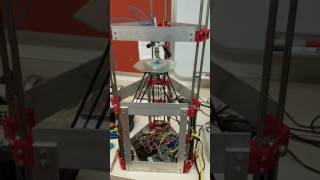
Print these STL files on any flavor of RepRap. The red parts in the image on the right are the printed parts. The SCAD if you need it.
If you have made a RepRap before this will be easy -- if you are not familiar with RepRaps or Deltabots like the Rostock - more detailed build instructions are available at the MOST Prusa RepRap build page and the Delta Build Overview:MOST. Those links will give details on how, for example, you can braid the wires or configure the Melzi/Arduino microcontroller. This concept, however, is not limited to this specific design and should of course work for most RepRap printers -- you just need the fire proofing and your own welder...good luck! If you get it to work - please drop us a line.
This ends the single pillar build. 3 pillars should be built in parallel. 241mm X 51mm aluminum plates are attached to both bottom and top plastics to make the frame a triangular prism shape.

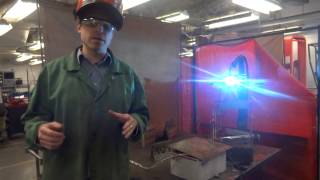
Metal 3D printing exposes you to welding for longer periods of time than is normal for routine welding. You should ensure that all of your skin is covered by something to avoid "sun burns".
The stage is controlled like a regular RepRap Delta 3-D printer. For a primer on the nomenclature try this. Download Repetier firmware and host software, use Arduino to upload the firmware to the stage, and set up Cura on the host. This will work on any type of computer but we recommend the free and open source Debian. Models can be created and modified with any 3-D editor, such as OpenSCAD, Blender or a CAD application like FreeCAD (for a more detailed list of free open source CAD programs go here. The model should be exported as an STL file. That is loaded into Cura and sliced to a toolpath. It may take a few tries to get all the settings right. The GCode is saved to disk and opened with Repetier Host, which sends it to the stage. When the platform reaches the welding gun, switch on the welder by plugging in cable leading to the switch (which is to be held pressed with a wire tie). While the print is going, pay attention to the distance between the gun and the object. This should start out at approximately 7 mm and remain the same. If it increases, either decrease the layer height, or slow down the movement (this can be done during the print with Repetier Host). If it decreases, do the opposite.
While the whole setup is still highly experimental, some parts are more experimental than others. Some features are listed here that are being tested with various levels of success. Cura will attempt to adjust the "line width" of the deposited filament by changing its feedrate. Currently the welder does not support any such adjustment, so some parts get more material than they should, while others get less. To solve this, a plugin for Cura was developed which converts these feedrate changes into nozzle speed changes. The plugin can be found with the scad file on github. This plugin also supports adding in custom commands when travel ends or starts. This can be used to activate a relay for switching the welder power.
Britain
Canada
China
Denmark
France
Germany
India
Italy
Japan
Lithuania
Malaysia
Norway
Poland
Romania
Russia
Spain
| Authors | Joshua M. Pearce |
|---|---|
| License | CC-BY-SA-3.0 |
| Organizations | MOST, MTU |
| Cite as | Joshua M. Pearce (2013–2025). "Open-source metal 3-D printer". Appropedia. Retrieved October 3, 2026. |