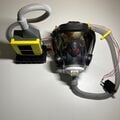
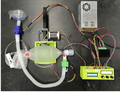
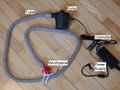
Over the rest of the semester MOST and well as the MTU Open Source Hardware Enterprise will be documenting, building and testing open source ventilators. If you want to help please do.
Must be able to manually control the peak inspiratory pressure (PIP), tidal volume, inspiration to expiration ratio (i:e), breathes per minute (BPM), and peak end-expiratory pressure (PEEP).
Possible short term solution would be connecting multiple patients to a single ventilator that would allow for adjustments of the PIP value. This is complicated when considering pandemics such as COVID-19.
Document that describes the medical devices that may become short supply during the COVID-19 pandemic.
Non-invasive ventilation machines (CPAP, BIPAP, hi-flo oxygen) are discouraged since they aerosolize the virus during exhalation.
The real problem may be the short-staffed respiratory therapists, and the amount of time to train them on invasive respiratory methods, and the capacity of hospitals than the possibility of running out of ventilators.
3D-printed valves for ventilators work, however they are patented so the STL files are not given. Only hospitals can 3D print the part during an emergency
STL file of the venturi valves are not given due to the hospital requirement being fulfilled. Only in an emergency can 3D printing produce a replica of medical components, and it requires expansive machinery.
The UK is looking for reliable rapidly manufactured ventilation systems.
The RMVS must:
* Be reliable (work for >= 14 days at 24 hours/day).
* Provide two settings for volume of air/air O2 mix deliverd per cylce/breath (450 ml +/- 10 ml per breath and 350 ml +/- 10 ml per breath)
* Provide the air/air O2 mix at a peak pressure of 250 mm H2O
* Patient supply pipework to remain pressurized at all times to 150 mm H2O
* Have an adjustable rate of 12-20 cycles/breaths per minute.
* Deliver at least 400 ml of air/air O2 mix in no more than 1.5 seconds.
* Built from O2 safe components.
* Capable of breathing for an unconscious patient. Ability to sense when a patient is breathing is desirable.
* Supply pure air and air O2 mix at a range of concentrations (at 50% and 100% O2).
* Support connections for hospital O2 supplies.
* Be compatible with standard COTS catheter mount fittings (Male: 15 mm; Female: 22 mm).
* Fail SAFE: having alarms for at least pressure loss and O2 loss.
IGS enterprise has given its focus to constructing three versions of a pandemic ventilator throughout the past few years. These specifications were given for use of either rebuilding the machine to be used during the COVID-19 outbreak or taking key components to use in the open source ventilator (see above). This ventilator had achieved a price tag of below 2000 USD, the most expensive component being the compressor.
Select on of the four modes using the user interface on the ventilator (for the IGS ventilator):
*Continuous mechanical ventilation (CMV): used when a patient is not breathing on their own
*Inverse ratio ventilation (IRV): used when a patients inhale lasts longer than their exhales(i.e 2:1 instead of 1:2)
*Pressure support ventilation (PSV): when a patient has trouble completing a breath thus resulting in negative pressure during a breathing circuit
*Assist Control (AC): used when a patient needs support for every breath
Confirm that the peak inspiratory pressure (PIP), respiratory rate (RR), positive end expiratory pressure (PEEP), inspiratroy:expiratory ration (i:e), and tidal volume (TV) are accurate by using the Michigan Instruments software package that accompanies the lung (downloaded in the MI USB drive).
Test the alarms by unplugging the machine, wiring, and appropriate tubing. The accessories that should be tested are:
*Low Pressure Alarm: Decrease the PIP value using the ventilators user interface to an abnormal value.

*High Pressure Alarm: Increase the PIP value using the ventilators user interface to an abnormal value.

*Oxygen Concentration Alarm: Increase/decrease the percentage of oxygen per breathe to above/below the safety range (19.5-23.5%) by mechanically increasing/decreasing the amount of O2 entering the ventilator and using an O2 sensor.

*Battery Backup Alarm: Unplug the ventilator's primary battery from the voltage source.

*Wire Disconnection Alarm: Unplug a wire from the circuit board in the ventilator while it is running.

*Oxygen Tube Disconnection Alarm: Unplug the oxygen intake tube from the ventilator while the machine is on.

*Mechanical Failure/Fatigue (# of cycles): Leave the machine running for extended periods of time (a few hours, days, weeks) and observe any inaccuracies.
Ventilator Specifications that Have to be Achieved:
	*RR: 6-40 breathes per minute (BPM) [Note: RR between 6-9 BPM are only for Assist Control]
	*TV: 200-800 mL (based on patient weight)
	*I:E: 1:2, best if adjustable between 1:1-1:4
	* Assist Control based on Trigger Sensitivity: when a patient inspires, they can cause a dip of between 2-7 cm H2O, with respect to PEEP pressure
	*Maximum airway pressure limited to 40 cm H2O and must be continually monitored
	*Plateau pressure limited to a max 30 cm H2O
	*Passive mechanical blow-off valve fixed at 40 cm H2O is strongly recommended
	*Plateau pressure and PEEP readings required for clinician MIT Clinical
	*PEEP: 5-15 cm H2O (many patients need 10-15 cm H2O)
	*Alarms must be present for failure conditions and the switch to manual clinician override must be immediate
	*Room air for ventilation is fine for emergency scenarios
	*HEPA filtration on patients exhalation, or between vent and patient, is required due to COVID-19 being airborne
Ideal Values that Should be Targeted for a Healthy Patient:
FDA’s enforcement policy for certain modifications to ventilators and accessories and other respiratory devices during COVID-19: https://www.fda.gov/media/136318/download








 https://opensource.com/article/20/3/volunteer-covid19 Contribute to open source healthcare projects for COVID-19
 https://theconversation.com/as-the-coronavirus-interrupts-global-supply-chains-people-have-an-alternative-make-it-at-home-133218 As the coronavirus interrupts global supply chains, people have an alternative – make it at home