Download these pages as a PDF so you can print them or read them offline.
Booklet
Download these pages as a PDF that you can print, fold and staple into a booklet.
This project was part of the Summer 2013 Practivistas Dominicana project, led by Lonny Grafman in the Dominican Republic. Five students, three from Cal Poly Humboldt (HSU) in California and two from Universidad Iberoamericana (UNIBE) in Santo Domingo, collaborated with the community of Las Malvinas to construct three walls for a "Botica Popular" in the community. This experimented with cinder blocks, or concrete masonry units (CMUs) made of various upcycled materials such as sawdust, paper and rice hulls mixed with cement and pressed using an industrial cinder block maker. At the same time another team worked on building an internal wall out of ecoladrillo, or upcycled plastic bottles.
Las Malvinas is a rural barrio on the Northern outskirts of Santo Domingo, next to the La Isabela industrial zone. Las Malvinas and Practavistas began working together in 2012, when together they built a schoolhouse out of ecoladrillo and papercrete blocks. Through a series of public meetings Las Malvinas community members have identified and prioritized a list of needs. On that list are access to running water and medicine. To address the need for water a team of motivated community leaders constructed a large cistern (approx. 50 cubic meters). An engineer from UNIBE assisted in the design. To address the need for medicine the two student teams mentioned above worked with community members to construct a Botica Popular. The Botica Popular sits partially on top of the cistern and is approximately 6 meters long and 3 meters wide.
Botica Popular
Boticas populares are neighborhood pharmacies that provide medications at cost price. They are part of government public health campaign called El Programa de Medicamentos Esenciales or "Essential Drugs Program" (PROMESE). Established in 1984 by presidential decree, PROMESE is the Dominican Republic's central supplier of medications and medical supplies with a mission of ensuring quality, low-cost access to the nation's public health system, Sistema Publico Nacional de Salud. PROMESE has provided greater medical coverage to the population by optimizing public health spending with the implementation of an economy of scale and buying medications and medical supplies in larger volumes. The "Essential Drugs Program" directly serves public and military hospitals, boticas populares, and rural clinics.
For boticas populares, the program fronts the medications and accepts payment at cost price upon distribution to the patient. Las Malvinas does not have a local clinic or hospital. The nearest hospital is Moscosos Puello about 5 km away.
Objective
The community of Las Malvinas is seeking to construct a Botica Popular, or government-funded pharmacy, in their community. The objective of this project was to build two of the four walls of the Botica using alternative masonry and to erect the complete Botica by 5 July 2013. This student team fabricated building blocks with sawdust, rice hulls or paper mixed with cement and pressed in an industrial block press. With the climate in the Dominican Republic, the blocks need to be able to withstand heat, rain and the test of time.
Part of the objective of this project was to find a building material, specifically a fiber-concrete mixture, that the community will be able to utilize in the future to make more blocks for other projects. As such, final product should be composed of locally purchased or acquired materials, and have a low cost, both monetary and environmental.
Entirely concrete cinderblocks have a high embedded energy, with an average of 0.67 MJ/kg and 0.073 kg Co2 per kg with a density of 1450 kg/m3. The new blocks should have less embedded energy per block.
Criteria
This section was designed to assist in the determination of the different aspects of this project. The group chose these criteria based on the expectations of the client, the class and personal interest. Weighing the criteria allows for focus on certain elements of the project to ensure satisfaction with the final product.
Criteria
Constraints
Our Weight (0-10)
Aesthetics
Must resemble local architecture
6
Production Cost
Must cost less to produce than the common cinder block
10
Durability
Must withstand elements, impact and pressure
9
Material Locality
Must attain materials within or near Las Malvinas
7
Potential for Reproduction
Ease of access to materials as well as documentation
8
Safety
Must be safe both structurally and in the process of creation
10
Community Involvement
Must include the local community members in the creation of this project
10
Environmental Impact
Blocks should have a smaller footprint than concrete blocks
Gather materials. We received misprinted newspaper from Listin Diario - a newspaper based in Santo Domingo. Cost was minimal, they only asked for what they would otherwise have received from the recycling center. Sand, cement, lime, rice hull ash and drying agent were also used in our blocks. The drying agent was necessary due to continual rains and the slow drying time of paper and rice hull blocks.
Tear paper for pulping. Initially we did this by hand, but later we has access to a paper shredder (recommended)
Soak paper in water and lime. Approximately 1/8 bag of lime was used in a 55 gallon barrel full of paper and water. Paper should be soaked overnight before pulping, although we also experimented with dry-pulping paper.
Pulp paper. We used a drill and ingenious welded attachment for pulping. Paper should be throughly wet for the pulping process for ease of pulping and to make smaller pulp. We experimented with pulping only damp paper to decrease drying time, however due to some confusion in block placement after pressing we were unable to tell how this affected the blocks. Drier paper cannot be pulped as thoroughly as wet paper, and this could account for a discrepancy we discovered in the strength of our papercrete blocks.
Dry the paper. It should be moist but excrete no water when squeezed so that excess water will not disrupt the ratios in the mixture and wash away cement in pressing. Ideally we tried to do this in the sun to avoid compaction of pulped paper, however due to continued rain we resorted to other means of drying the paper. We put the paper in rice hull bags and pressed it to remove excess moisture before laying it in the sun. This significantly accelerated drying time and we dry-pulped it afterwards to reduce large chunks. Dry-pulped paper did not have to be pressed and thus did not have to be re-pulped. Another method that was suggested was a centrifuge, and this would likely be effective.
Mix and press. We had access to an industrial cement mixer and block presser for this step. The final mixture we used for papercrete was 3 wheelbarrows pulped and dried paper (assuming one wheelbarrow = 5 five-gallon buckets), 1.5 wheelbarrows sand, 2 five-gallon buckets of rice ash, 1 bag cement and 6 fluid ounces of Vinaldom SA-600, the quick-drying agent. Water was added as needed.
Have caution after the blocks are pressed to minimize breakage in between the machine and the drying area. Carrying by hand is recommended.
Wet blocks periodically as they dry to reduce cracking and ensure proper set of blocks. Papercrete tends to hold moisture so use discretion.
Make HullKrete
Image
Step
Gather materials. We received a donation of rice hulls and rice ash from a nearby distillery that burns the hulls for energy. Sand and gravel were donated from the block factory and cement was purchased from the same. A quick-dry additive, Vinaldom-600, was purchased at a nearby ferreteria (hardware store).
Prepare mixture - we had two final successful mixtures. The first mixture contained 2.5 wheelbarrows (1 wheelbarrow = 5 five-gallon buckets) of rice hull, 2 wheelbarrows sand, one wheelbarrow gravel, one bag cement and 4 fl. oz of the V-600. The second mixture was exactly the same with and added half-wheelbarrow of rice hull, bringing the total up to 3.
Mix thoroughly and press, we used and industrial cement mixer and mixed dry ingredients first, adding the drying agent diluted with water. Add water until the mixture holds together, but is not overly saturated.
Have caution after the blocks are pressed to minimize breakage in between the machine and the drying area. Carrying by hand is recommended.
Wet blocks periodically as they dry to reduce cracking and ensure proper set of blocks. This is particularly important in hot areas, try to keep blocks out of direct sunlight if this is the case.
Strength Testing
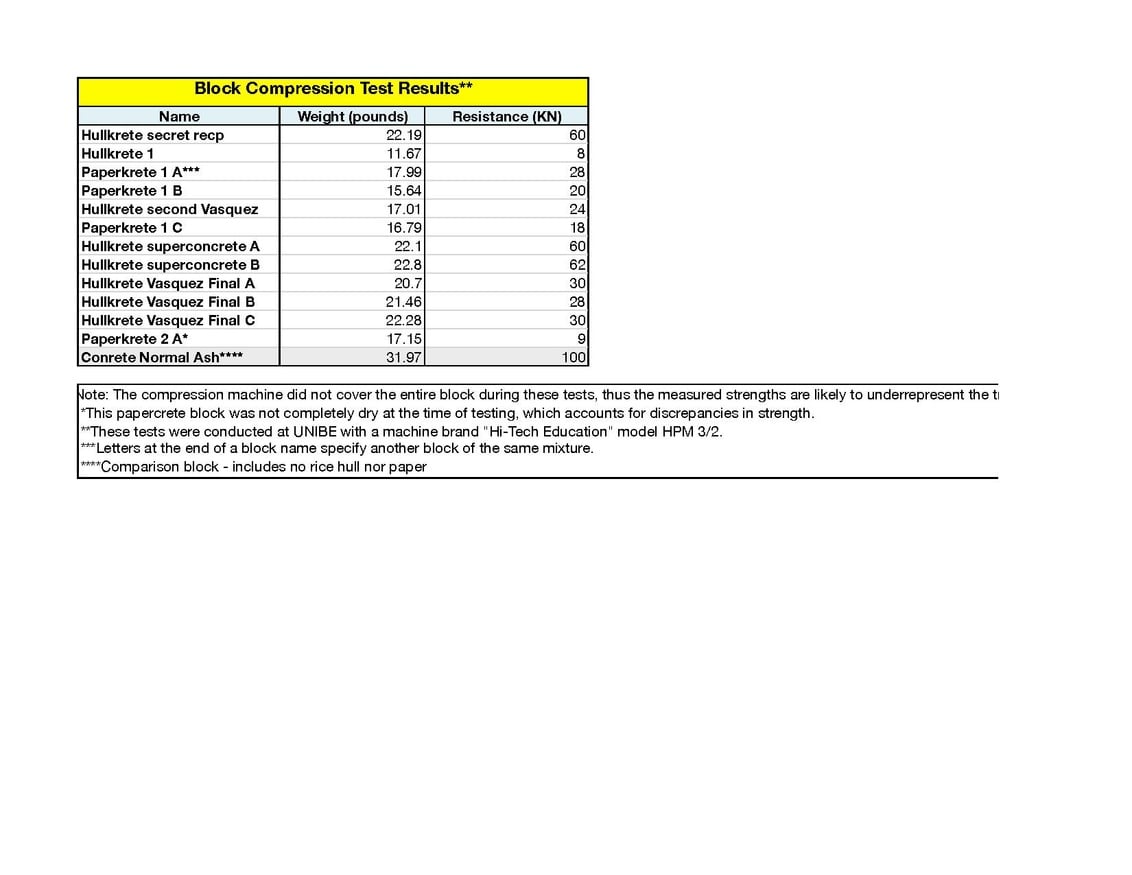
With the help of Julio, a student and fellow Practavista, we were able to strength-test samples of the blocks with UNIBE facilities. The results can be accessed here: .
Price Comparison
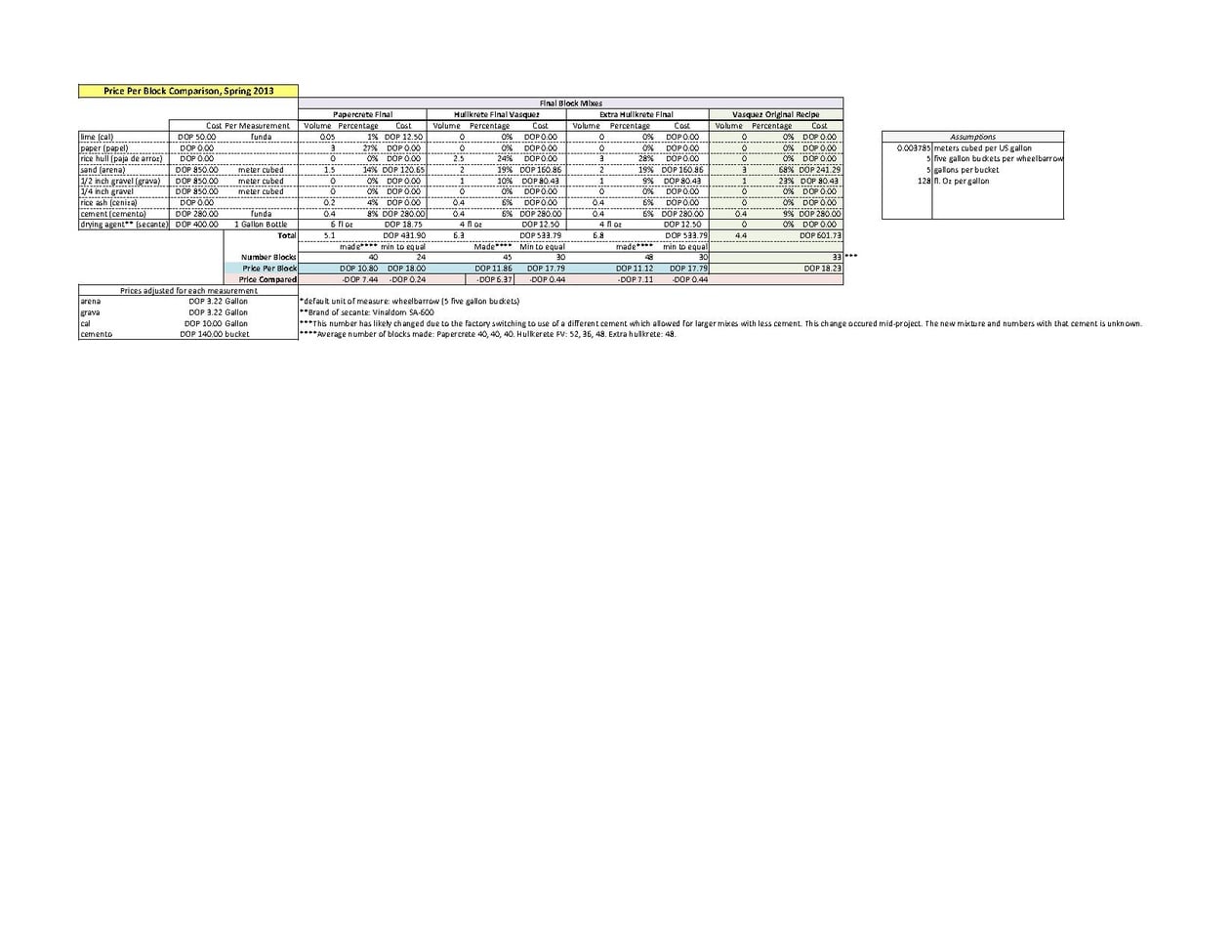
We conducted a price comparative analysis between the final block mixes and the blocks made at the factory. Both the blocks of rice hull and the blocks of papercrete were cheaper than standard blocks found at the factory based upon price comparisons of materials. This links to view the chart, which also includes the final mixtures we used and the number of blocks from each mixture.
Budget
Following is our budget for this project. Costs in both Dominican pesos (DR $) and US Dollars (US $) are included.
Material
Quantity
Source
Cost per unit (DR$)
Cost per unit (US$)
Total Cost (US$)
Rice Hulls
35 bags
Collected from the brewery
200.00
4.90(labor and bag purchase)
4.90
Paper
550 pounds
Acquired from Listin Diario
580.00(recycle fee), 800.00(shredding)
14.00(recycle fee), 19.50(shredding)
33.50
Cement
21 (94 pound bags)
Purchased from block factory
280.00/bag
6.83
143.43
Lime
local hardware store
50.00/bag
1.22/bag
12.20
Sand and gravel
buckets
Provided by block factory
0.00
0.00
0.00
Rice Fly Ash
3 bags
Provided by brewery
0.00
0.00
0.00
Paper pulper
Attachment for power drill
Created by community member
Building materials
Buckets, barrels, applicators, shovels, etc.
Borrowed from various community members
0.00
0.00
0.00
Transportation of materials
Use of trucks
Community members
0.00
0.00
0.00
Tarp
1 large
Hardware store
Safety equipment
Gloves and dust masks
Local stores
164.00/gloves 82.00/masks
4.00/gloves 2.00/masks
6.00
Block pressing machine and mixer
Presses 4 blocks at a time
Block factory
0.00
0.00
0.00
Sawdust
4 barrels of various textures
Acquired from coffin maker
0.00
0.00
0.00
Secante (cement drying agent)
1 gallon
Purchased from hardware store
400.00
9.75
9.75
Total Cost
$209.78
Timeline
This timeline includes information about our progress throughout the project. It records the amount of time and preparation involved in creating both the blocks and the constructing the Botica Popular.
Friday June 7, 2013
Our group had an opportunity to meet Jacob, an Engineering student at UNIBE who showed us his experiments with sawdust-concrete and recycled styrofoam-concrete. He had been experimenting with different ratios of sawdust to concrete and testing the strength of different mixes. His experiments also included using wire to increase the tensile strength of the concrete slabs. He will likely be a useful contact while working on this project.
Making Blocks
Saturday June 8
First day to work on mixes. We went to Las Malvinas in the morning and, with Ginger's help, secured a barrel of sawdust from the coffin manufacturer who will be providing that material and the block-making site next door where we and members of the community will be doing experiments and making blocks with sawdust and other materials. We also were given two bags of lime and loaned two barrels for mixing the sawdust, lime and water to soak. After an initial mix, the owner of the plant arrived and made some changes to the mixture we had put together, encouraging us to "go big" with our experiments. There was a high level of interest from the community members who came to work with us - they really ended up taking over much of the work, sifting, mixing and all the while peppering us with questions. A kid from the community spent most of the afternoon with us helping mix the sawdust, lime and water. We will be returning to the site on Wednesday to try more mixes and Thursday is the day to press blocks.
Wednesday, June 12
Our sawdust for blocks. We tested with both pre-soaked sawdust and dry sawdust.We returned to Las Malvinas and found our sawdust mixture in good shape. The coffin manufacturer next door gave us two more barrels of sawdust and we doubled the amount in our existing bucket, making a moist, but much drier, sawdust and lime mixture. The owner of the block making company will be allowing us to use his industrial cement mixer (if we have enough mix to fill it). We also discovered that there is not only ample rice hulls nearby, but ample ash from burnt rice hulls that is a waste product and the cement company already uses it. So we will be experimenting with using rice hull ash as well to reduce the amount of cement in our mixtures.
Thursday, June 13
Sawdust-crete fresh off the press First day of block making for our first tests! We ended up with four mixes, three of sawdust and one of rice hull. We totaled 113 blocks with three bags of cement, and that was good because at the site they usually make around 33 blocks per bag, so we are at least on par with their mixes in terms of cement used. The owner not only allowed us to use their machine, but also their industrial cement mixer. It was an excellent learning experience for all concerned, and testing the blocks begins on Saturday. We also obtained two barrels of very fine sawdust to experiment with in our next mixtures.
Ingredient
Type of measurement
Mix 1 Qty
Mix 2 Qty
Mix 3 Qty
Mix 4 Qty
Sand
5 gallon bucket
2
2
1.5
1.5
Gravel
5 gallon bucket
0
2
0.5
0.5
Sawdust
5 gallon bucket
14
14
10
0
Rice Hull
5 gallon bucket
0
0
0
10
Cement
Bag (90 lbs)
1
1
0.5
0.5
Rice Hull Ash (RHA)
5 gallon bucket
1/4
1/4
1/6
1/6
Lime
Bag (approx. 1 5-gallon bucket)
1
1
2/3
2/3
Number Blocks
27
39
23
24
Compression Test
Crumbled
Crumbled
Crumbled
Held up
Saturday, June 15
First round of dry HullKreteWe returned to Las Malvinas to test the blocks from Thursday. The rice hull blocks were nearly dry and the sawdust blocks were not dry yet. The rice hull blocks appeared the most structurally sound, although it is difficult to ascertain with the sawdust blocks still being so wet. Pulerimo, a community member, offered his advice that the blocks do not have enough cement, which is making them crumble. Our next mixtures will contain a greater amount of cement, and likely of RHA as well. It is possible that we will focus on rice hull blocks for the Botica, although we need to do more experimentation before that is certain. Work continues on the cistern, which will be part of the foundation of the Botica.
Sunday, June 16
Ricecrete blocks hold up in the compression testWork continues on the cistern, which will form the base for half the Botica.
Assessed the blocks again, sawdust blocks are still wet, rice hull blocks are closer to dry. The sawdust may not be used in the final round, testing will continue before this is a final determination. The rice hull blocks were found capable of supporting human weight, and general consensus is that they will work well with more cement. Papercrete is also going to be tested in the next round.
The very fine sawdust from the coffin manufacturers proved challenging to sift. It may not be used in blocks, it might be used in the finish for the Botica.
Monday, June 17
Sought sources for waste newspaper. Attempted several contacts.
Determined plan of action for block testing round 2.
Tuesday, June 18
A source for newspaper for making papercrete was secured.
We tore up and set paper to soak in water and lime for testing on Thursday or Friday.
Determined that using the 4 inch sized block forms will not make a significant difference for the tests: the forms in the machine will not be changed back to 6 inch blocks until Monday.
Seeking a paint mixer to pulp the paper for blocks.
Wednesday, June 19
A paper-tearing party on a sunny afternoonSpent at least 3 hours tearing paper for block making several kids from the community came to help. We added more paper to the existing mixture and are hoping to find a paint mixer or similar for tomorrow. If one can't be found we may have to think of some other method to pulp the paper.
Secured the rice hull source for tests and block making, we should have rice hulls to use tomorrow.
Joel found an admixture that we can use to accelerate the drying of the blocks. We will be experimenting with adding it when we make the test blocks.
Thursday, June 20
30 bags of rice in Julio's truckWent to a brewery nearby Las Malvinas and obtained 30 bags of rice hull for block making. Upon measurement, each of these bags hold approximately 7.5-8.5 5 gallon buckets of rice hull.
Worked on leveling the area that will be underneath the floor of the Botica, it was built up with a large pile of dirt from the cistern.
Discussed need for a paper pulper. Initially we were going to find a paint mixer, however some community members knew a welder nearby who would be able to weld us a tool for pulping paper.
Friday, June 21
Tore more newspaper
The paper pulping machine in its final incarnationWe received the new paper pulping bit and drill today. It underwent a few changes from its original state and worked well to pulp the paper we had set to soak. We worked with different amounts of water in the paper mixture in order to determine how much was needed to pulp the paper most effectively and not leave it too wet for block making.
Saturday, June 22
In order to dry out the paper we soaked, the pulp was put into rice hull bags and pressed by stepping on it until it was dry enough to be used in the mixture. This was even more effective with the added weight of giving a kid a piggy back ride.
One the paper was dry enough and the workers were ready, we pressed six more mixtures, this time adding a drying agent to accelerate the rate of set and reduce dry time of the blocks. None of these mixtures contained sawdust.
Sunday, June 23
Plastering commenced on the cistern today, and some of our group had the opportunity to help with that process and learn cement plastering skills.
More paper was pulped and torn today as well as laid out to dry for the next block pressing
Monday, June 24
Weighing out 300 lbs of paper from Listin DiarioAcquired about 300 pounds of newspaper from Listin Diario.
Shredded more paper by hand, Joell contacted a friend with a paper shredder to accelerate that process.
Pulped paper and set out on a tarp to dry in the sun. This process has been slowed by daily rain.
Tuesday, June 25
Pulped the paper from the day before.
Worked to dry paper for pressing blocks on Thursday
Received the shredded paper in the evening and set it to soak.
First HullKrete blocks are laid for the Botica! Work begun on the Botica. Community members determined that the blocks from the previous round of tests are strong enough to build with and began work on the storage room for medicines.
Wednesday, June 26
Discussed block pressing with respect to day, community involvement and mixes to use. We are working on a spreadsheet to determine the relative cost of different blocks to aid in determining which mixture to use for the Botica.
Pulped more paper for block pressing tomorrow.
Thursday, June 27
Pulped and dried more newspaper, we are going to experiment with pulping methods. One version of paper pulping involves immersing the paper in water and pulping while very wet, then allowing the paper to dry before adding it to concrete. Another possibility is that the paper can be wetted minimally and pulped, allowing for more expediency in the making of papercrete.
A sudden rainstorm kept us from being able to press blocks, they shall be pressed tomorrow instead.
Friday, June 28
Pulped yet more paper.
Lay paper out to dry=.
Made first part of blocks for the Botica, three different rice-hull crete (HullKrete). Because of measuring error, one set of blocks had to be retried. The owner of the block factory offered a mixture of his own and we also re-tried the first HullKrete mixture with increased cement.
Re-analyzed the spreadsheet for determining relative cost of fibercrete blocks versus conventional blocks.
Communicated with Jacob to see if he is interested in testing the blocks at UNIBE with a machine. He is, and the tests will take place on Monday.
Final Blocks/Final Test round 1
Ingredient
Type of measurement
HullKrete Final Weirdness
HullKrete Vasquez Final
Original HullKrete Revisited
Sand
5 gallon bucket
10
10
3
Gravel
5 gallon bucket
2
5
1
Rice Hull
5 gallon bucket
15
12.5
20
Cement
Bag (95 lbs)
1.5
1
1.5
Rice Hull Ash (RHA)
5 gallon bucket
1.25
0
0.5
Lime
Bag (approx. 1 5-gallon bucket)
0
0
1
AS 600 (Drying Agent)
Fluid Ounces
6
4
6
Number repetitions of mixture
2
1
1
Total Number Blocks
60
52
Machine broke halfway through pressing. Incomplete.
Testing
1 wheelbarrow=5 five-gallon buckets
Saturday, June 29
Pressed over 300 blocks: most were HullKrete with two different mixtures and there were three different mixtures for papercrete: one containing wet-pulped paper only, one with "dry - pulped" paper only and one with a mixture of the two. Work on the Botica recommences when the blocks are dry. Work continues on the cistern, and wood for the cap is being accumulated.
Final Blocks Round 2
Ingredient
Type of measurement
HullKrete Final Vasquez*
Extra HullKrete Final
Papercrete Final Wet Pulp
Papercrete Final Dry Pulp
Papercrete Final Mix
Sand
5 gallon bucket
12 (10 +2 of a sand-clay mixture)
12 (10 +2 of a sand-clay mixture)
7.5
7.5
7.5
Gravel
5 gallon bucket
5
5
0
0
0
Paper Pulp
5 gallon bucket
0
0
15 wet pulped
15 dry pulped
10 dry, 5 wet pulped
Rice Hull
5 gallon bucket
12.5
15
0
0
0
Cement
Bag (95 lbs)
1
1
1
1
1
Rice Hull Ash (RHA)
5 gallon bucket
2
2
2
2
2
AS 600 (Drying Agent)
Fluid Ounces
4
4
6
6
6
Number repetitions of mixture
3
1
1
1
1
Total Number Blocks
Testing
1 wheelbarrow=5 five-gallon buckets
*This mix was repeated and changed slightly
Building the Botica
The walls begin to go up for the Botica.
Capping the cistern
Wooden part of cap is completed and more blocks have been laid.
Walls inch ever higher, cistern cap has been cemented.
Once the cistern cap was dry, the third wall could go up
Johnny laying mexcla for blocks.
Progress after a long day's work
Walls up! The Botica is taking shape.
The blocks are laid and the sancocho and fiesta begin!
As the walls are finished, the plastering commences
Biga has been poured, plastering continues and preparations continue for placing the roof.
The truth window for the outer walls.
The Botica as of July 20th. The community continues finishing it.
Sunday, June 30
Tying rebar for the cistern cap The wood for the cistern cap was placed today and the cap should be done within the next couple of days.
Blocks that were pressed on Friday were dry enough today to use for construction, so several feet of height was added to the walls of the Botica storage area today. A cement and sand-based mortar is being used and the holes of the blocks for the storage area are being filled with concrete. The filling is added for increased security purposes.
Monday, July 1
The cap for the cistern was created. This involved tying in rebar on the wood cap and then pouring and leveling cement.
Tuesday, July 2
We used a hydraulic machine to test the blocks' compressive strengthBlocks from several different mixtures were tested at UNIBE with the help of Jacob.
The cistern cap was dry today and building commenced.
All three walls are in progress and columns for the interior wall were built with blocks.
Wednesday, July 3
One wall completed, another one nearly finished and the third is approximately two thirds done. One more full workday and the walls will be finished.
Thursday, July 4
Second wall finished, third wall will be finished either Friday or Saturday.
Final presentations in La Zona Colonial Centro Cultural de Espana took place in the evening.
Friday, July 5
Dancing on the cistern cap - the perfect stage! Final presentation and celebration in Las Malvinas.
Saturday, July 6
Plastering is under way on the walls.
A wood frame was build for pouring the biga - essentially a concrete cap to the walls that will increase the structural strength of the building.
Biga poured.
Sunday, July 7
Work continued in preparation for laying the roof of the Botica.
Ecoladrillo wall plastered
Plastering continues on the HullKrete walls, a truth window is added on the east wall.