Fuel cells are emerging as an attractive power supply source for applications such as distributed generation power systems
and electrical vehicles. Hybrid fuel cell technology can be applied to various fields: electricity power plants, automotive manufacturing,
cogeneration, smartphone, construction and etc. Hybrid fuel cells has the following advantages: cleanness, high efficiency and high
reliability. Fuel cells operate without the efficiency limitation of the Carnot cycle and without the pollution associated withe the combustion
of fossil fuels.[1] However, there are also disadvantages: it cannot store energy, the response is slow, difficult to cold start
and its output voltage fluctuates with the load.[2]
See Fuel cellW on Wikipedia.
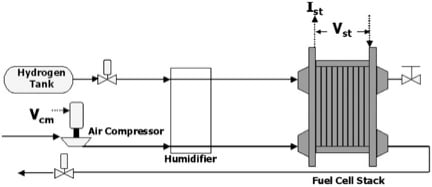
Simple fuel cell and air compressor power system.
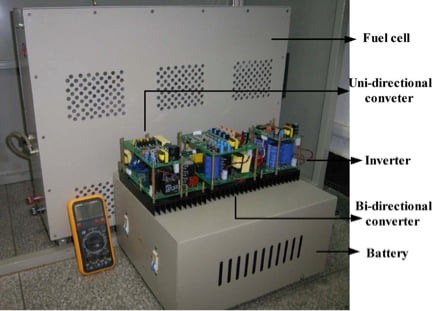
Photograph of the hybrid fuel cell power system.
Types Fuel Cells
Electricity, water and heat can be produced when hydrogen and oxygen combined as a fuel cell. If compared to batteries
which has limited lifespan, the fuel cell will produce electricity as long as the fuel (hydrogen) is supplied, and nver losing its charge.[3]
- Polymer Electrolyte Membrane (PEM)
Polymer electrolyte membrane (PEM) fuel cells employ a polymer membrane with acid side groups to conduct protons from the
anode to cathode. Water management in the fuel cell is critical for PEM fuel cell operation. Sufficient water must be absorbed into
the membrane to ionize the acid groups; excess water can flood the cathode of the fuel cell diminishing fuel cell performance
limiting the power output.[4]
See Youtube video of How PEM Fuel Cell works.
- Direct Methanol Fuel Cell
- Alkaline Fuel Cells
- Phosphoric Acid Fuel Cells
- Molten Carbonate Fuel Cell
- Solid Oxide Fuel Cell
- Regenerative Fuel Cell
For comparison of fuel cells, see here[5]