| Part of | Tibial Fracture Fixation Pediatric Distal Forearm Fractures Uniplanar External Fixation Humeral Fracture Fixation |
|---|---|
| Required time | 1 hour |
| Equipment | 3D Printed Adult Male Tibial Bone Models Arbutus Medical HEX Drill Kit Tibial Shaft Simulator |

This skills module allows medical officers and surgeons who are not orthopedic specialists to become confident and competent in performing bicortical drilling as part of modular external fixation procedures for open tibial shaft fractures performed in regions without specialist coverage.
By the end of this module, learners will be able to:
To overcome the drawbacks of 3D printed plastic melting at high drilling temperatures, this module trains the learner to irrigate during bicortical drilling, which is a standard orthopedic surgical practice to reduce the risk of thermal osteonecrosis.[1][2] This provides continuous cooling to prevent melting of the 3D printed plastic bone model.

The Tibial Shaft Simulator and Clay Backstop for Plunge Depth Measurement will be used in this module.
This Tibial Shaft Simulator uses the 3D Printed Adult Tibial Bone Model #3 which accurately simulates bone length and diameter, external contour, cross-sectional shape, bicortical anatomy, cortical hardness, cancellous bone porosity, and microstructure, and far cortex thickness for non-obese adults at left tibial shaft fracture pin drilling sites for modular external fixation.[3][4][5][6][7][8][9][10][11][12]
The Tibial Shaft Simulator teaches bicortical drilling skills useful for modular external fixation and that are transferable to the performance of other limb-saving and life-saving surgeries that require hardware stabilization and fixation.
Please print out the Training Logbook below and write your name and date of training at the bottom of the page.
| # | Training Goal | Trial #1 Plunge Depth (in mm) | Trial #2 Plunge Depth (in mm) | Trial #3 Plunge Depth (in mm) | Average Plunge Depth for Trials #1 to #3 (in mm) |
|---|---|---|---|---|---|
| 1 | Irrigation | ||||
| 2 | Bicortical Drilling Skills Checklist |
| # | Action | Check box if response is "YES' |
|---|---|---|
| 1 | Check that the drill bit is sharp before use. | |
| 2 | Adjust operating room table to be at elbow level. | |
| 3 | Direct an assistant to perform irrigation to reduce thermal osteonecrosis. | |
| 4 | Maintain the drill parallel with your forearm to maintain better control of the drill. | |
| 5 | Hold the drill with your dominant hand and position the drill sleeve with your non-dominant hand. | |
| 6 | Normally, the drill sleeve is positioned directly on the bone. When training on the Tibial Shaft Simulator, you will need to hold the drill sleeve 3.0 mm above the bone model to avoid having plastic stands entangled in the drill sleeve. | |
| 7 | Start drilling the hole perpendicular to the bone surface. | |
| 8 | Once penetration starts, re-insert the drill into the initial entry point and adjust to the desired direction. | |
| 9 | The drill trajectory angle relative to the saggital plane (tibial crest) should be 30-60 degrees. |
| # | Training Goal | Trial #0 Plunge Depth (in mm) | Trial #1 Plunge Depth (in mm) | Trial #2 Plunge Depth (in mm) | Trial #3 Plunge Depth (in mm) | Average Plunge Depth for Trials #1 to #3 (in mm) |
|---|---|---|---|---|---|---|
| 1 | Drill by sound | |||||
| 2 | Drill by feel | |||||
| 3 | Drill by sound and feel |
| # | Trial #1 Plunge Depth (in mm) | Trial #2 Plunge Depth (in mm) | Trial #3 Plunge Depth (in mm) | Average Plunge Depth for Trials #1 to #3 (in mm) |
|---|---|---|---|---|
| 1 | ||||
| 2 | ||||
| 3 |
Learner's Name:
Evaluator's Name:
Date of Training:
Oscillogram of Bicortical Drilling of a Tibial Fracture

Play this audio file to identify the acoustic changes of the drill as it progresses through the near cortex, cancellous bone, and the outer layer of the far cortex, and is backed out of the drilled hole.
Now it's time to put these two sensory inputs (sound and tactile feedback) together during bicortical drilling training!
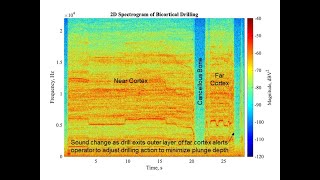
2D and 3D Spectrograms of Bicortical Drilling of a Tibial Fracture
Play the video and audio files simultaneously to identify the acoustic changes of the drill as it progresses through the near cortex, cancellous bone, and the outer layer of the far cortex, and is backed out of the drilled hole.
Please fill out the printed Training Logbook for your records.
This work is funded by a grant from the Intuitive Foundation. Any research, findings, conclusions, or recommendations expressed in this work are those of the author(s), and not of the Intuitive Foundation.
| Authors | Julielynn Wong |
|---|---|
| License | CC-BY-SA-4.0 |
| Cite as | Julielynn Wong (2021–2025). "Bicortical Drilling Skills". Appropedia. Retrieved September 29, 2026. |