| Authors | Little H.A. Tanikella N.G. J. Reich M. Fiedler M.J. Snabes S.L. Joshua M. Pearce |
|---|---|
| Location | The following coordinate was not recognized: Geocoding failed.Michigan, USA |
| Status | Designed Modelled Prototyped Verified |
| Verified by | MOST re:3D |
| Links | https://www.academia.edu/44181380/Towards_Distributed_Recycling_with_Additive_Manufacturing_of_PET_Flake_Feedstocks| https://www.mdpi.com/1996-1944/13/19/4273%7C MDPI.com] https://www.preprints.org/manuscript/202007.0707/v1| |
| Design files | https://osf.io/q2bkd/ |
|---|---|
| Hardware license | CERN-OHL-S |
| Certifications | Start OSHWA certification |





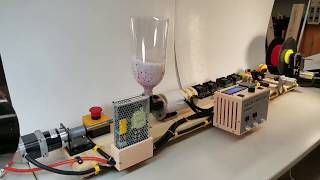
This study explores the potential to reach a circular economy for post-consumer Recycled Polyethylene Terephthalate (rPET) packaging and bottles by using it as a Distributed Recycling for Additive Manufacturing (DRAM) feedstock. Specifically, for the first time, rPET water bottle flake is processed using only an open source toolchain with Fused Particle Fabrication (FPF) or Fused Granular Fabrication (FGF) processing rather than first converting it to filament. In this study, first the impact of granulation, sifting, and heating (and their sequential combination) is quantified on the shape and size distribution of the rPET flakes. Then 3D printing tests were performed on the rPET flake with two different feed systems: an external feeder and feed tube augmented with a motorized auger screw, and an extruder-mounted hopper that enables direct 3D printing. Two Gigabot X machines were used, each with the different feed systems, and one without and the latter with extended part cooling. 3D print settings were optimized based on thermal characterization, and both systems were shown to 3D print rPET directly from shredded water bottles. Mechanical testing showed the importance of isolating rPET from moisture and that geometry was important for uniform extrusion. The mechanical strength of 3D-printed parts with FPF and inconsistent flow is lower than optimized fused filament, but adequate for a wide range of applications. Future work is needed to improve consistency and enable water bottles to be used as a widespread DRAM feedstock.
- Cooling system, sifters, motorized auger crammer<ref>https://osf.io/q2bkd/<ref>* Just the code<ref>https://osf.io/fsjk9/<ref>* All source files for Gigabot X
- https://re3d.org/
- re3D on SketchFab