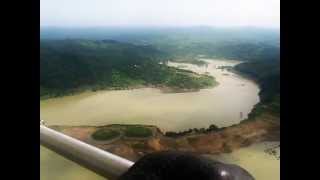
"Designed to minimise social and environmental disturbance, the Swinna Poreba reservoir project in southern Poland, is intended to reduce the risk of flooding and generate hydroelectric power." [1]

The Swinna Poreba reservoir project is in southern Poland on the Skawa River within the upper Vistula drainage basin, 7 km south of the city of Wadowice. The project is intended to generate hydroelectric power, regulate the downstream river flow, reduce the risk of flooding, store drinking water and create opportunities for recreation and tourism.[2] Construction began in 1987 but was interrupted in the 1990s due to project finance issues.[3] In 2002, the Regional Board for Water Management awarded Skanska S.A. Hydro-engineering the $174 million contract to complete the 54 meter high, 620 meter long clay core dam, two 300 meter outlet tunnels, 440 meter spillway concrete channel, retaining walls, discharge channel and cement injection gallery.[4]
The Swinna Poreba project is socially and environmentally complex due to the creation of a reservoir and relocation of part of the Swinna Poreba village. The project relocated 377 households, three schools, two recreation centres, two administration buildings, a nursery and eight light industrial units. The majority of the community are being relocated within the Swinna Poreba village and to a nearby town to maintain community relationships.[5] From an environmental perspective, the Swinna Poreba area does not contain any endangered species and is not an environmentally protected area.[6]
The dam will allow better control of the Skawa River and is expected to reduce the severity of flooding along the Vistula River and in the city of Kraków. Serious flooding currently occurs in Kraków. In July 2001, 10 people were killed and over 10,000 made homeless by severe flooding along the Vistula River, west of Kraków.[7]

Between 2003 and 2007, approximately 400 people have been employed on the project. Roughly 90% of project workers were employed from the surrounding communities and it has been estimated that the project has reduced district unemployment by almost 70%. Between 30 and 35 permanent positions were created at the power plant. The Regional Board for Water Management has estimated that approximately 300 local jobs will be created as a direct result of tourism related activities.[8]
Skanska is responsible for the clean up of the valley, which includes disassembling abandoned buildings and backfilling the remaining ruins with soil, backfilling existing pits, and removing approximately 35,000 meters cubed of asphalt and other potentially toxic materials. By 2007 11,500 trees had been cleared from the 135-hectare area below the maximum reservoir water height. Approximately 700 young trees were relocated to the Las Wolski Park in Kraków.[9] Once operational the 3.8MW hydroelectric power plant is estimated to generate approximately 14.5 GWh of energy per year. At present the energy for the region is generated in two conventional coal power plants. The hydroelectric power plant is expected to generate energy equivalent to approximately 22,254 tons of carbon dioxide emissions per year.
In 2007, the Society for Earth and the Polish Green Network investigated the environmental and social impact of seven dams in Poland. The report states:
| License | CC-BY-SA-3.0 |
|---|---|
| Cite as | ScottieMeyers (2011–2025). "Swinna Poreba Reservoir Project". Appropedia. Retrieved October 3, 2026. |