According to the Appropriate transport manual, sustainable transportation is a strategy for the flow of people and goods across the Earth that meets the needs of the present without compromising the ability of future generations to meet their own needs. Transportation accounted for 32.6% of US green house gas emissions in 2005. . In addition to the widely publicized environmental consequences of driving automobiles, it is also socially and economically costly:
Land use: Parking and roads use valuable land resources.
Transportation equity: Driving, with all of its expenses, costs the average U.S. household $7,000 per year per vehicle .
Economics: Most of the money spent on driving leaves a local economy, weakening it.
Community: Travelers outside of their cars interact more with their physical environment and each other.
Safety: The presence of pedestrians and cyclists make our neighborhoods safer from crime. Conversely, 42,000 Americans are killed in car accidents every year.
Health: Increasingly, Americans are suffering from weight-related illnesses. This is partly attributable to the decline in active transportation use and availability.
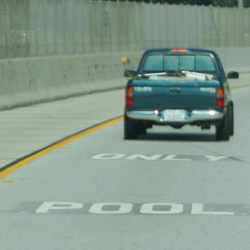
Building and encouraging alternatives to the single-occupant vehicle, or, for short "alternative transportation," is imperative. Some alternative transportation advocates have taken to using the term Sustainable Transportation instead of the previous, widely-used "alternative transportation" term to avoid sidelining their interest from the mainstream. One way of encouraging such reform is changing the technical practice of transport planning to reflect these concerns - see the transport modeling reform page.
Many efficient, practical, and inexpensive sustainable transportation technologies already exist, meaning activism, policy work, and planning research is most often more crucial to developing sustainable transportation than technology development.
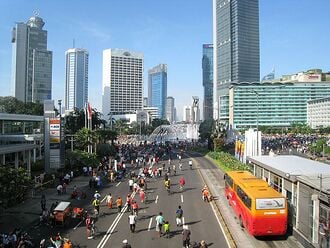
Taking action in favor of sustainable transport also include supporting a local car-share program that uses highly fuel efficient vehicles, work with your community officials, attend city council meetings and become involved in your local government in order to influence decision making, help to educate community leaders about the benefits of creating "walkable" and "bicycle-friendly" cities and towns, try to live close to public transport and good bike routes so you have plenty options on commuting and shopping, use your car less and even consider selling it.
The Citroën 2CVW is a rare example of a car that was designed (in the 1930's) for the poorer segment of society, to be extremely efficient and low-cost. And yet it was also considered a very comfortable car, in its own way, with a flexibility of use that many more expensive cars lacked. Its lack of modern safety features make it an unsuitable car for most settings today - however in affordability and efficiency remains unsurpassed. Its remarkable fuel-efficiency is still unsurpassed by modern micro-cars, and perhaps even by the latest petrol-electric hybrid vehicles.W
The Volkswagen BeetleW also had many similar characteristics as the 2CV, though not as extreme, eccentric or efficient.
The Tata NanoW is marketed in India as a cheap small family car that most workers would afford. But concerns have been going about the quality, safety and reliability of that product.[1][2][3]
Vehicles for the developing world
BUV, from the Institute of Affordable Transportation, produces extremely basic three-wheeled open vehicles for passengers and goods, has the motto "Basic Vehicles - Changed Lives".
Other vehicles with an emphasis on basic design and low cost include the Indian companies Bajaj AutoW which makes tuk-tuks (motorized rickshaws) and Tata which makes the Tata Nano, a tiny low cost vehicle for city use.
Such basic design requires compromises on safety features. This may be offset by a very low top speed, or a target use where moderate to high speed crashes are rare (very remote areas, or in very heavy traffic in large cities).
Modern fuel-efficient cars
Some modern diesel cars can get better mileage than petrol hybrid electric vehicles. The Opel Eco Speedster (a concept car) gets up to 113 mpg (2.5 L/100km[4]). See The Opel Eco Speedster Says: Diesels Can Rip and Sip at the Same Time on treehugger.com; or Ultimatecarpage.com page (with a few technical comments).
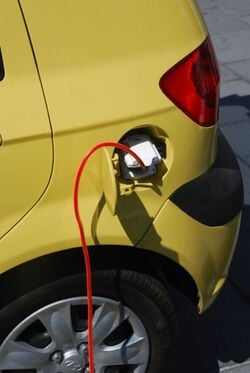
Solar-charged vehicles have a good mileage and do not use combustion.
Retro-fitted technology
Devices to save the energy from braking have been developed to fit to trucks. Due to the expense, they are only cost-effective for large trucks, where heavy fuel use and long distances covered make it worthwhile.[verification needed]
Pedicabs are among the simplest, lowest cost forms of transport. The traditional pedicab is pedal-powered, but motorized pedicabs (perhaps consisting motorcycles with a passenger section attached) are also in use in various cities in Asia.
Vehicle production
A carbon-zero Volvo plant:
The Volvo Trucks' manufacturing plant in Ghent, Belgium has become the first vehicle manufacturing facility in the world to operate without releasing any carbon dioxide. The Volvo Group intends to make all of their vehicle manufacturing plants carbon-zero as part of the European Union-wide goal of reducing carbon dioxide emissions by twenty percent by 2020.[5]
To determine a vehicle type based on various factors (including cost, speed,...) use the table below.
Note: While this table may be a useful starting guide, please also bear in mind several caveats of the difficulty of quantifying modes of transport for a direct comparison. 2 particular issues are highlighted below
Regarding 'cost', there is the issue of direct 'cost' to the user in terms of e.g. buying a vehicle and paying for maintenance, versus the indirect costs paid by the larger society, and ultimately subsidised by e.g. taxation. Whilst the "infrastructure investment" heading tries to capture some of this issue, in the case of the automobile particularly this is challenging as "infrastructure" involves not just roads but arguably a global network of oil rigs, steel mines and rubber plantations, refineries, shipping, a network of petrol stations, etc. Whilst bicycles and other modes do draw on the same global infrastructure, the automobile drives it to a far greater degree.
Secondly, the "cost" of any mode of transport involves negative externalities. Whilst some of these are included in the table below in the "Environmental, aesthetic and social impacts" column, again especially for car based transport these are now understood to be very broad - I.E. "social" impacts needs to include the very high cost of millions of car-related road deaths and trauma - as well as in affluent societies, we are now identifying the link between a car-based lifestyle and increasing rates of obesity and related illnesses.
▼This page is inaccurate
You can help Appropedia by reviewing and editing this page to make it more accurate. Comment: The content of this table is disputed as the methodology for awarding points has not been disclosed. This is being disussed on the talkpage
Old vehicles can be made completely ecologic by means of changes to the propulsion technology. These changes include changing IC-engines to run on a emissionless fuel, or swapping out the engine altogether for ie a electric motor,...
See also
SkyCab and Shweeb: railed vehicles suspended above the ground that can be directed to a specific destination (unlike most public transport vehicles as city buses,...) See also http://www.sakaramenta.com/
There are many websites and groups around the world with a significant focus on sustainable transportation, in different contexts and countries.
Some of the significant research and communication centers focused primarily on this topic and working towards broad, systematic change are:
The EMBARQ project, http://www.embarq.org/:- "EMBARQ's mission is to catalyze and help implement sustainable transport solutions to improve quality of life in cities."
The World Streets website and community, http://worldstreets.wordpress.com/:- "World Streets consistently argues for and supports Equity-Based Transportation Policies in the interest of efficiency, economy and environment. (Click to get started.)."
The Streets Blog website, http://www.streetsblog.org/:- "Streetsblog is a daily news source connecting people to information about sustainable transportation and livable communities."
Other useful information sources:
Better transport section of the freely available e-Book, 'Sustainable Energy: Without the Hot Air, by Professor David MacKay. Includes details of energy use requirements of different transport modes.