
This protocol is for the Open source solar spectrum project that helps in collecting data on solar flux variations depending on wavelength and the angle of tilt, differentiating between direct and diffuse solar light.
This protocol is for the Open source solar spectrum project that helps in collecting data on solar flux variations depending on wavelength and the angle of tilt, differentiating between direct and diffuse solar light.
Since the UV part of the spectrum is not calibrated correctly, due to the low radiation halogen bulb in this part of the spectrum, we have to calibrate the Bolivian detector with a UV lamp, and merge both reference files to get a calibration in the whole spectrum range.
Instead of the calibrated light source, use both lamps (UV reptile and Halogen Bulb) and use the sent spectrums of the lamps as a referece '.lmp' files.
This is a spectrometer calibration using a calibrated light source:MOST
From here on out - this is how we are going to do it:
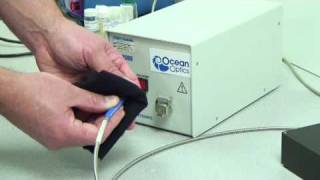
Follow the step by step Calibration in previous section using the calibrated light source:MOST. The spectrometer is a USB2000+ VIS-NIR spectrometer with a range from 350 nm to 1000 nm. The calibration is done using the CC-3-UV-S cosine corrector.
After calibrating a spectrometer, the ExoTerra Repti Glo 10.0 Compact 26W reptile light's absolute irradiance is measured. This reptile light will serve as a calibrated light source for calibrating other spectrometers when the option of using a calibrated light source like the calibrated light source:MOST is not possible.
The optical set up for the spectrometer should be the exact same as when it was calibrated. Note: if your optics are different the lamp calibration file from MOST is the actual power at each wavelength for your light source, which can be used for any optics setup.
In our case, this was the USB2000+ spectrometer connected to a 600 micron fiber optic cable with the CC-3-UV-S cosine corrector attachment. The reptile light is placed in a common desk lamp. The desk lamp is connected to a Variac Power Supply set to output 120V, which is verified by measuring with a multimeter. All of the irradiance measurements are done within a sealed cardboard box to minimize external light exposure. The desk lamp goes into the cardboard box through a hole cut on one side, and the is sealed in place using black duct tape. Please refer to Figure 1a and 1b. On the other side of the cardboard box is the fiber optic cable with the cosine corrector. Please refer to Figure 1c. The total setup can be seen in Figure 1d. The distance between the reptile light bulb and fiber cable is 50.2 cm.


| License | CC-BY-SA-3.0 |
|---|---|
| Cite as | Xinxu (2012–2025). "Spectrometer and light source calibration: MOST". Appropedia. Retrieved October 4, 2026. |