
Save the world board game

Save The Planet Board Game is free and open-source DIY cooperative board game. In the Save the Planet Game you and your family and friends can work together to save the planet to win, while learning how to save the planet in real life. The beginner option is appropriate for children 4 and up and the advanced option is a fun game for teens up to any age. This game is open-source so you are encouraged to build on it - make it better, add more good deeds, make a local deed list and make more advanced derivatives. Have fun!

Making the Game (v2)

If you have a RepRap you can 3-D print this card holder.
  1. Print out in color the two pages of the main board, the beginner and advanced Good Deeds cards and the two pages of the penalty pollution squares. If you have a RepRap you can also 3-D print this card holder.
  2. If you print on cardstock then just cut out the pieces with scissors -- if you print on normal paper then trim the outer edge with scissors then use a glue stick to stick them to the back of cereal boxes.
  3. Cut out the deeds and penalty pollution squares and cut the big pollution image into a puzzle.
  4. For a more durable game laminate everything (you can also skip the cardboard if you do this).
  5. Obtain 4 avatars - these can be pieces from other games, little toys, strips of colored paper, pebbles or 4 different coins. Again if you have access to a RepRap you can print custom figurines or your 3-D print avatars like the pieces from Democratic Chess for a useful list see the derivatives here.
  6. Obtain one normal 6 sided die (or dice) from one of the following ways:
    1. Steal one of the dice from Monopoly
    2. If you have a 3D printer or access to one - print one from a open design here
    3. Use 6 pennies - heads =1 and tails =0 throw them and add your points together if you get zero - try again.

Playing the Game

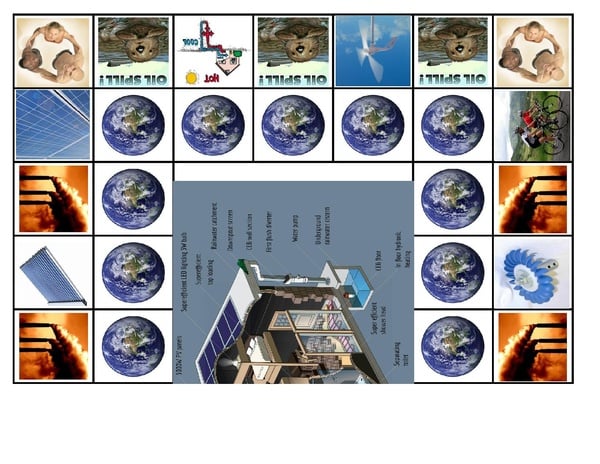
Synopsis: Play this game as a team - with one another not against one another. Your goal is to clear the pollution pieces (housing on a river of waste and litter) to let the passive solar eco-home see the sun before the oil and coal industry ruin the planet with pollution.

Main board. Click here to print it
  1. Each person places their avatars on the Ubuntu[1] circles in the corners of the game board. 4 avatars can play simultaneously (If you have for more than four people that want to play - share an avatar.)
  2. Stack all of pollution penalty pieces in a pile.
  3. Choose either the Beginner (white border) or Advanced (black border) Good Deed Cards and spread them face down next to the board
  4. Assemble the pollution puzzle in the middle of the board on top of the eco-home. Your goal is to work as a team to take the pollution puzzle apart and make a nice sustainable home by doing Good Deeds to save the planet. You win when the Eco-home shows through and you still have some earth images not covered with pollution penalties.
  5. Youngest player rolls first and turns proceed clockwise. A player rolls the die, moves his avatar the number of spaces shown and does what the space shows.
  6. If you land on a renewable energy square (solar photovoltaic,[2] wind power, microhydro, geothermal, solar thermal, biomass (wood stove), passive solar) you earn one Good Deed card. If you have 3 Good Deed cards you can turn them in to remove a piece of the pollution puzzle. If you remove all the pollution puzzle pieces you win!
  7. If you land on the hybrid solar wind system double block you get two Good Deed cards. Likewise if you land on the climate change double block you get two pollution penalty cards.
  8. If you land on a sustainable transportation square (walking, bicycles, electric car, or train) you may move your avatar anywhere on the board.
  9. Pollution penalties. Click here to print them
    If you land on either an oil spill or coal plant emissions you must put the appropriate pollution penalty card on one of the exposed squares on the ring of earths. 'If all of your earths are covered with pollution penalty cards you all lose and the game is over unless you "make a save" by completing one of the Good Deeds as a team in real life'[3] to remove one penalty card (e.g. starting a compost pile or writing as a family to your elected representative).
  10. If you land on one of the ubuntu corners your team can pool your Good Deed cards to get 3 in order to remove a pollution puzzle piece.
  11. On your turn you may trade in a Good Deed card to remove a pollution penalty card.
  12. In the normal game play continues until the world is lost and completely polluted in which case your team loses or until all of the pollution puzzle is disassembled and you win. If having any pollution on the earth makes you mad you can continue to play and try to extract all the pollution penalties from the circle of earth. If you can do this - your team has dominated the game. Nice work! Hint: the best way to do this is to actually do real new good deeds by making a bunch of saves in a row. Once you have beaten the beginner version try the more advanced version.

Good Deed Cards

Beginner

These are good deeds you and your family can do around your home. As most of them save physical resources, they not only shrink your environmental impact, but they also will save you money. The white bordered pieces:

Beginner Good Deed cards. Click here to print them

Advanced

The black bordered pieces:

Advanced Good Deed cards. Click here and go to Page 2 to print them

Version 1

  1. Print out in color the two pages of Good Deeds thumb and the 4 pages of the game board and penalty pollution squares thumb. If you have a RepRap you can print this handy box.
If you have a RepRap you can print this handy box.

Make this game better

If you like this game, please try to improve it. If you see red links above click on them and fill in the missing content. Provide more information and references for the good deeds listed above. If you have new ideas about good deeds or other ways you think we could change the game to make it more fun and a better learning experience for children and adults alike - please click one of the "edits" and list them here:

Game in a Box

This game was inspired by the 1980's game: A Beautiful Place - A Co-operative Ecology Game. The DIY game above is more detailed and advanced - but if you want to buy something in a box rather than make it yourself - I recommend it -- particularly for young children to start thinking ecologically. The award winning game practices what it preaches - the game is made in Canada using recycled boards and papers, soy-based inks, water based glues and safe paints. You can get it on Amazon -- and you might want to check out the other cooperative games by Family Pasttimes.

Appropedia Expansion Pack

Coming soon...

In the News

References

  1. ↑ Ubuntu is a Bantu term roughly translating to "human kindness." It is often used in a more philosophical sense to mean "the belief in a universal bond of sharing that connects all humanity". The term was made popular by a type of Linux, the free and open source operating system.
  2. ↑ Photovoltaics turn sunlight directly into electricity and is the most likely method to provide an energy intensive standard of living in a sustainable fashion. See: Joshua Pearce, "Photovoltaics - A Path to Sustainable Futures", Futures 34(7), 663-674, 2002.open access
  3. ↑ This must be a "new" Good Deed - e.g. your family can not get credit for recycling if you do that anyway.
  4. ↑ The spreadsheet is in ODS format - get your free copy of Libre Office to open it.
  5. ↑ http://smallplanet.org/books/diet-small-planet
  6. ↑ http://web.archive.org/web/20150710161550/http://www.bread.org/hunger/global//
  7. ↑ http://www.thesimpledollar.com/are-rechargeable-batteries-really-cost-effective/
  8. ↑ Joshua M. Pearce and Jason T. Hanlon, "Energy Conservation From Systematic Tire Pressure Regulation", Energy Policy, 35(4), pp. 2673-2677, 2007. open access
  9. ↑ http://www.downtoearth.org/environment/top-10-reasons
  10. ↑ https://www.opensecrets.org/lobby/indusclient.php?id=E01
  11. ↑ Environmental life cycle analysis of distributed 3-D printing and conventional manufacturing of polymer products
  12. ↑ Life-cycle economic analysis of distributed manufacturing with open-source 3-D printers
  13. ↑ Joshua M. Pearce, Sara J. Johnson, and Gabriel B. Grant, "3D-Mapping Optimization of Embodied Energy of Transportation", Resources, Conservation and Recycling, 51 pp. 435–453, 2007. open access
  14. ↑ http://web.archive.org/web/20160609211540/http://fishandboat.com:80/anglerboater/2001/ja2001/adoptlake.htm
Page data
License CC-BY-SA-3.0
Language English ()
Related 0 subpages, 0 pages link here
Views 148,906 page views (analytics)
Created January 13, 2014 by Joshua M. Pearce
Last edit February 19, 2026 by Irene Delgado