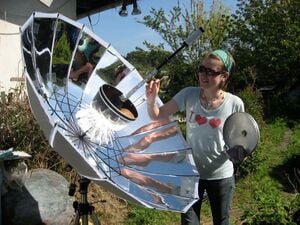
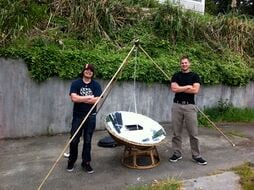
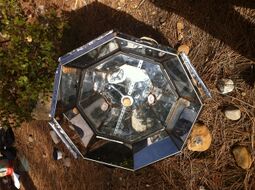
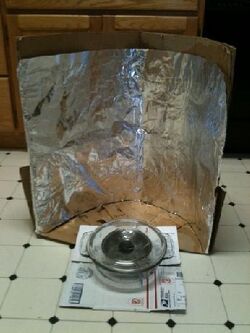
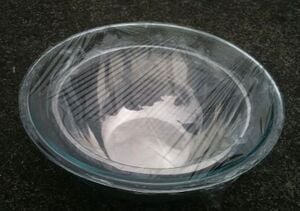
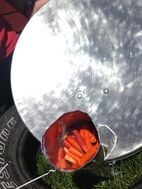
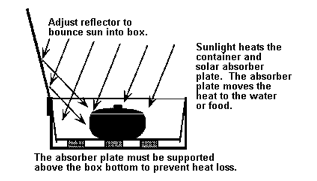
Close up of pot holding gimble made from small bike rim and coat hanger wire. Is baking cookies in a small pot on a black dish. Photo Credit:Bart Orlando
The word "Synergy" comes from the Greek words for "to work together". This project combines the existing parabolic shape and comfortable sitting cushion of the Papasan chair with the natural-source energy utilization of the solar cooker. My hope was that, in the spirit of synergy, the whole would be greater than the sum of the parts and that people may find the idea of owning a solar cooker more practical if they can also sit and read a book in it when its not in use. Compared to the traditional mono-functional Parabolic Solar Cooker, this project serves as a chair when not in use, which saves space and is less of a fire hazard than the traditional Parabolic Solar Cooker. It is built mostly from salvaged materials as to not contribute to consumption.
Bart Orlando
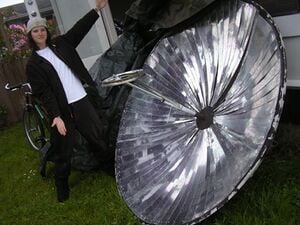
Local Solar Cooking expert and Appropriate Technology innovator Bart Orlando inspired and co-created this project. Bart offered his vision of the papasan chair solar cooker as a class project when he came to speak in front of the class at the beginning of the semester. Bart has been working with students in the Humboldt area for more than 15 years, building and designing pedal powered and solar powered prototypical educational displays. Working with Bart means that this project had the benefit of the innovative design that comes from years of experience. For more information on Bart's projects, visit these , , and Parabolic basket solar cooker web pages.
Bart Orlando's main web page students wishing to start a project with him is entitled
Projects With Bart.
Bart with 8' dish.
Literature Review
Daniels, Farrington. Direct use of the Suns Energy. New Haven and London: Yale University Press, 1964.
This book contains a brief overview of the applications and constructions of parabolic solar cookers. Also includes information of the many other ways to cook with the sun.
Halacy, DS Junior. The Coming Age of Solar Energy. New York: Harper and Row, 1963.
Contains an interesting historical overview of small solar projects, including parablolics.
McDaniels, David K. The Sun, Our Future Energy Source. New York: John Wiley and Sons, Inc, 1979.
A more technical look at the utilization of solar radiation, as well as solar-thermal applications.
Though it was heartening to see that there was literature on solar power, the books I found were not very helpful for this project. What was helpful was these links:
This project was designed with the following Criteria in mind:
Time – Must be able to be designed and constructed within the timeframe of one college semester, or about 4 months of part time labor.
Budget – No set budget, however the more materials that can be salvaged or easily acquired by most people, the better.
Durability – The project must be able to withstand periodic exposure to the elements, especially sun, over the course or years. Also, sitting in the chair must not damage the reflectors.
Portability - The device should be lightweight so that one person could move it without toil, and compact enough to be towed via bike trailer. Rattan, the fiber that many Papasan chairs are made from, is reasonably light weight- making reflector material the key issue in terms of weight.
Design - Should incorporate new improvements or previously not thought of innovations to the solar cooker plan. Should be stable in mild wind.
Synergy/Integration - Should be a multi functional device, capable of easily purifying water as well as cooking food, igniting paper or grass when needed, and still be able to fit easily into an everyday household setting.
Level of embedded energy - Materials should be found or salvaged so that it can be shown that this can be built without industrial equipment.
Ease of use - If multiple parts are to be used, then they should be safe, employ intuitive design, and not require the use of tools for operation.
Design
Solar Cooker Background
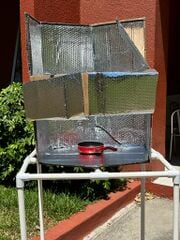
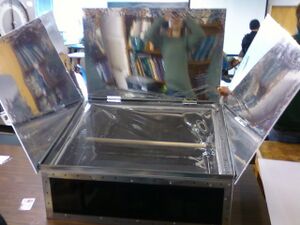
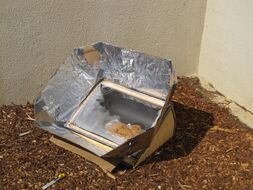
A solar cooker is used to concentrate sunlight onto a pot or dish. It can be used to bake, fry, make popcorn, cook rice, light fire, sterilize and boil water. This has potentially important applications in sun soaked areas where fuel for cooking is scarce, or where women must travel farther and farther from their villages to gather wood as fuel becomes more scarce. If solar cooking catches on it, it would become a new style of outdoor recreation similar to the barbecue, but one that is directly connected to the world at large (ie the sun) and has no carbon footprint (if people reused their plates and silverware).
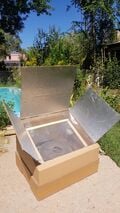
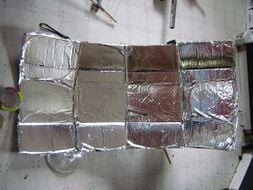
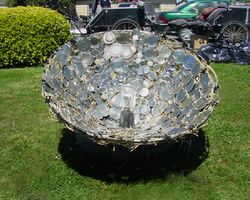
There are several shapes a solar cooker can take on, from box-like to parabolic, spherical, funnels and plane mirrors. Each form has different pros and cons in terms of construction, durability, materials, performance, etc. This Wikia page has pictures of all sorts of solar cookers.
So Why Parabolic?
Parabolic cookers seem to be heavier, and more expensive than the other types of solar cookers. Due to the fact that they focus light to a small area, they require constant tracking in relation to the sun to be effective(adjustments about every 15 minutes.) However, they have the advantage of being able to reach higher temperatures than the other cookers due to the intensity of the precise focus created. Other solar cookers, such as solar ovens use a greenhouse effect to trap heat in an enclosed area, whereas parabolic cookers actually concentrate the sunlight from a larger area into a smaller area.
Elements of a Parabolic Solar Cooker
Frame
This is the backbone of the cooker. It must be:
Strong enough to support the weight of the reflectors (and possibly the food, depending on the design)
Stable enough to face moderate winds without the risk of spilling hot/boiling food/liquid on the ground and people
Light enough to allow frequent adjustments to track the sun.
The frame can be constructed in a variety of ways; it can be cast from a mold, built from salvaged materials, such as satellite dishes, and even blackberry bushes, or be fabricated with new materials especially for the cooker. It can also utilize a pre-existing paraboloid (as in this case).
Papasan chair with cushion removed.
In this design, a used Papasan Chair provides a sturdy, lightweight, somewhat-stable backbone without the requisite of purchasing new materials. This design method is not available in all areas of the world, butRattan, the material this papasan chair's frame is made from is widespread throughout Asia, Africa, and Australia.
Reflector
The reflective surface itself can be a variety of materials. Sometimes a thin metal frame is built around a single piece of cast, polished metal.
This table compares different aspects of potential reflectors for the papasan chair solar cooker:
Material
Reflectivity
Weight
Internet price quote
Advantages
Disadvantages
Polished Anodized Aluminum
~95%
Light
~$7/square foot
Reflective, lightweight, can be salvaged, structurally durable, easily flexed and shaped
Easily scratched, not super cheap
Mylar
>98%
Super light
$30 for a 4'x'50 roll
Super reflective, super light, super cheap
Not good at standing up to the elements, forms 'bubbles' if glue starts to give, requires a rigid backing
Aluminum Foil
88% on bright side
Super light
$3.29 for 1.5'x70' roll
Extremely cheap and widely available
Not so reflective, corrodes when mixed with acidic juices, structurally weak, would only last one or 2 sessions
Can lids
70-80% (my estimate)
Light
FREE
Widely Available, effective, salvageable, did I mention free?!
Not super reflective, non-uniform shape is labor intensive to use
Acrylic Mirror
99%
Medium/Heavy
$78 for 1'x4' plane
Very reflective, nearly unbreakable
Comes in plane, likely very difficult to fit to parabola and still maintain reflectivity, super expensive
Glass Mirror
99%
Very heavy
At least $100/square foot
Super reflective, widespread- meaning it could be salvaged
Very expensive new, comes in rigid plane- could be broken to fit paraboloid in mosiac in exchange for a precise focus
Many potential materials with high reflectivity and strength are only available by special order from industrial companies. Though I have not tried to order or to ask for a donation of these fine products, the manufacturers usually deal in bulk.
In addition, I am not sure a special-order industrial super-reflector meets this projects criteria of salvageablility and wide availability. That said, a bulk roll of high quality reflective material may be a wise investment for the aspiring do-it-yourself solar technician.
Close up view of Bart's triangular aluminum reflectors, with carriage bolt.
This project ended up utilizing a previously-owned Anodized Polished Aluminum sheet donated by Bart Orlando. The sheet was previously cut into triangular facets with a plasma cutter for use in a different cooker some years ago. He purchased the 4'X 8' sheet new for $80, but professes that cheaper ones are periodically available at the local salvage yard.
Food holding device
The next part of the cooker is what is actually going to hold the food. This has to fit a few criteria. It must be:
Black, as to readily absorb the sun's rays.
Able to withstand intense energy without becoming toxic (no plastic pot-handles)
Rigged to either be suspended from a tripod from above or mounted across the rim-plane of the paraboloid.
Because the project is also functioning as a chair, we decided that a suspension would make more sense than a bar mounted across the parabola.
Some possibilities for holding the food that were considered in this project:
12" bike wheel rim with 3 hooks extending outwards at 120 degree angles. Unpainted coat-hanger wire woven in a grid on the inside of the rim would provide a flat grill-space for the cooking receptacle. The receptacle could be a tea kettle, frying pan, or cooking pot.
A product called a "HotPot" by Gaiam. This pot is specifically designed to cook with the sun's rays. This exemplifies a good solar food holder because it is conductive, black, and contains an air-insulated layer so that wind will not cool the pot. We decided to forgo buying one of these in favor of a more salvageable design.
The HotPot cooking vessel consists of a dark pot suspended inside a clear pot with a lid
A gallon sized tin can painted with black tempera paint. A wire coat hanger with a paper base can be unhooked from the paper, revealing a perfect holder for a gallon sized can. 2 holes are punctured in the can at 180 degree angles 1" from the top, and the coat hanger is hooked inside. This proved to be a good method for testing the cooker, however the inside of the can may possibly off-gas small amounts of toxic chemicals. To avoid this, fill the tin can with water, placing your food in a small or medium sized mason jar (with lid) inside of the tin can, and then cover the tin can with a matching-sized pot lid (no plastic) or aluminum foil. This will use the double-boiler effect and not toxify your food. This is the most easily salvageable/reusable design.
Using a mason jar inside of a tempera painted can.
Tempera painted can with pot lid.
A black stainless steel or cast-iron cooking pot with lid and suspension hooks would also be appropriate. No plastic can be present on the pot.
Suspension
The suspension mechanism holds the food over the focus from above while the cooker is being used.
We wanted a suspension mechanism that could be:
Easily adjusted
Lightweight
Strong
Stable in wind and around dogs, kids, etc
Easy to make
We went with a tripod constructed of bamboo and a bike inner tube, with a 1/2" width chain for suspension. The bamboo should be a least 1" thick for durability and strength. In addition to being a fascinating organism, Bamboo is a choice building material for sustainability.
Fun Math stuff
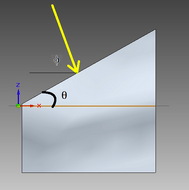
In math, a parabola is a conic section with the graph (y=x²) on a Cartesian plane. If that 2 dimensional image were to be "spun" around the y-axis, the resulting shape would be a paraboloid, the shape used by this cooker. Both parabolas and paraboloids have the effect of concentrating energy waves to a single point known as the focus. There are numerous examples of parabolas in the natural world.
A deep focused parabola is one that contains the focus within the form. A shallow focus parabola projects the focus outside of the form. For this reason, deep focused parabolic cookers are much safer than shallow because they don't project balls of incendiary light outside of the rim plane and accidentally burn things or people.
I highly recommend checking out this web page is a to help visualize this concept, and to see how incoming rays of energy focus to a point on a parabolic graph. Notice if you decrease the coefficient "a" past a certain point, the focus is projected outside of the parabola. For the parabolic equation y=ax2, if "a" is set at.3, the focus will occur at the asymptote parabola's "arms". Decrease "a" beyond that, and the focus will be outside of the parabola. The papasan chair we used has a parabolic focus just inside of the rim plane, its graph is estimated to be y=.37x2
Calculations
On a typical day of full sun, it is commonly approximated that a flat surface facing the sun will receive 1000 Watts of power per square meter.
The chair is approximately 4.2 feet in diameter and 18 inches deep. The amount of sunlight that the parabola is exposed to is limited to the cross sectional surface area of the aperture.
Equation Model
Cross sectional surface area in meters *(1000 Watts * square meters-1) * Reflectivity Coefficient of anodized aluminum = Watts per papasan solar cooker on sunny day.
Crunchy Numbers
Pi*r2 =Area of a circle in m2
141*0.70104m2 = 1.53m2
Area of circle in m2 * 1000 watts/m2 = Ideal power output in W (m2 cancel out)
53 m2 * 1000 W/m2 = 1530W
Ideal power output in W * Reflectivity coefficient of anodized aluminum = Reality-adjusted power output in W
1530W *.95 = 1453W
This means the papasan chair solar cooker can utilize over 1450W of power in full sun - not too shabby!
Factors unaccounted for -
Shadowing of cooker by cooking pot (not a huge difference)
Energy losses via imprecisely focused facets
Diffusion of light from scratched/dirty facets (Bart estimates that the reflectivity for this project is more along the lines of 90%)
Implementation
Since we were designing this project as we built it, our time frame was on the order of weeks and months, but this could feasibly be built in one to two days once all materials have been acquired.
To implement this project, you will need:
One Papasan Chair
One sheet of anodized aluminum (approx 4' x 8')
Access to a plasma cutter or beverly shear
A few feet of hemp twine
A power drill with 1/8" bit and one 1/4" bit
3 bamboo poles 8'x1"
7 feet of 1/2" width metal chain
2-3 used bike inner tubes
One 2" long 1/4" wide bolt with nut
1/4" ratchet head
one chopstick
one piece of paper, black
Materials for the food holding device are not included, because there are several options. To view these, click here.
Reflector
To cut your reflector from a sheet of anodized aluminum, you will want to first measure the radius of the chair, from the center point to the rim. It is important that the measurement of the radius includes the 3-dimensionality of the curve of the chair. Use this measurement to make triangles with 2 of the sides the length of the radius plus one inch and the 3rd side around 8 inches long.
This shows a material-saving layout for cutting the sections. Note that the triangles don't terminate at a point, so that a 1/4" mounting bolt will fit through it.
You may want to measure how many times the 3rd (8") side of the triangle will fit along the circumference of the chair to see how many facets to cut. Since people are going to be sitting on the chair, take care to round any sharp edges to a curve, and to sand any burrs.
Students using a beverly shear to cut aluminum facets.
Once the pieces are cut, gently flex them to fir the curved shape of the chair frame. Aluminum will maintain this shape once bent. First practice bending one to see how breakable it is before bending the rest.
Now is time to use the drill. Measure in about 1/2" in and down from the corner of both sides of the 8" length of each facet, and drill a 1/8" hole. This is where the string goes to mount the facet.
Stack all of the facets on top of one another and make a mark on the end piece you made for the bolt. Have someone with a steady hand press down on the facets so they don't slide and drill through the facets with your 1/4" drill bit. This will be easier than you'd expect, due to the softness of aluminum. Slide the bolt through and nut it so that the facets are like a fan.
The bolt is used to hold all of the facets together.
With the 1/4" bit, drill a small depression into the round circle of wood beneath where the cushion sits in the middle of your chair, so that the facets can sit in the center of the chair.
Now it is time to spread out the facets and tie them down to the outer rim of the chair with the hemp twine. Be sure that they are flexed to shape of the chair before tying them down so that you can get an accurate parabolic focus later on.
Note how the facets are tied down to the rim.
NOTE: It may be advisable to drill an additional hole 2/3 down the length of each mirror corresponding to where the frame lies under it, so that the mirrors can be tied close to the frame. This may facilitate a tighter focus. However, the chair we used was not a perfect parabola and it turned out that not having the additional ties allowed for a better focus.
Suspension
This part of the project is amazingly easy.
The top part of the tripod. With inner tube and chain.
Lay your 3 poles on the ground so that they are lying parallel next to each other. Spread your length of chain so that it too is parallel with the poles and has a few extra inches on one end of the poles. On this end, bundle the poles together so that the chain lies in the middle of all 3 of them.
Cut your bike inner tube so that the circle is opened. Now you can use it for lashing.
You may want a 3rd hand here to hold the poles with the chain in the middle while you wrap the tube around them once, about 6 inches from the ends of the poles. Tie the wrapping so it is tight, and then tightly wrap the rest of the length of tube around the poles, taking case to tie it so that it will not come undone.
Stand the poles up with the tie assembly facing up. Take a big breath and unfold it into the tripod that you just created! Make sure the chain can support the weight of a good tug without slipping. If it does not seem strong, take extra measures to make sure it is. Remember this will be holding boiling water!
Testing the focus with aiming device
Now that your cooker set up, on the next sunny day, take it outside. Watch the panels gleam. So shiny...
Now, look at the the facets; do they lie close to the frame? Does it look parabolic? Are the mirrors clean? If the facets float above the frame and look uneven, you may want to try the extra tie technique mentioned in the above "Reflector" section. This will allow for a better focus. If the mirrors are dirty, try using a small amount of citra-solv natural solvent and water on a rag to clean them.
Fabricate the aiming device by inserting the chopstick into the ratchet head on the end where the ratcheter usually goes. Plug this onto the nut in the center of your facets. This creates a sundial. Now you will be able to tell when the cooker is facing the sun because the chopstick will cast no shadow.
Note the shadow cast by the chopstick. This means the cooker is not aimed properly.
Now it is centered on the sun, and the stick casts no shadow.
(Note- If your chopstick catches on fire, it is probably well aimed.)
When it is aimed, and your mirrors are well shaped, a ball of concentrated light about 6inches in diameter should appear a few inches below the rim plane. Wearing your UV protected sunglasses, test this by placing your hand in the center till you find the hot spot. When you think your dish is well focused, try rolling the piece of black paper into a cylinder and float it in the hotspot. It should start to smoke and burst into flames within 30 seconds. If not, make sure your mirrors are clean and are forming a tight focus. Paper burns at 451 degrees Fahrenheit, so if your cooker can ignite paper it can boil water, fry, and cook. In other words, it passes the test.
Testing the focus by trying to burn black paper. Theres smoke...
Theres fire!
Now you are ready to cook! Your project should resemble this photo:
Notes on cooking
Solar cooking is an art. It requires cooperation with the elements.
It does not take any longer than cooking on a stove if the sun is out and there is no cloud cover or haze. It may take much less time than a stove depending on the dish size.
If your chair is not holding its position when you aim it towards the sun, there is a solution. An additional inner tube can be used to lash the rim of the chair to one of the bamboo poles. This will change where the focus is to closer to that pole, and may require that the other poles be adjusted so that the hanging pot sits in the focus. This is the most challenging part of solar cooking in my experience, but after a few sessions, it will become easy.
Parabolic solar cookers require adjustments to match the suns progress across the sky about every 15 minutes.
Besides posing a threat to the stability of your setup, Wind also has the potential to greatly reduce the temperature of your cooking pot. If this is an issue, try finding a wind-shaded area or using a dead-air-space design for your cooking pot, like the HotPot mentioned .
Safety
As with any type of concentrated energy this has the potential to be dangerous and must be respected. Solar cookers can easily reach temperatures above 450 degrees Fahrenheit. Care must be taken around small children and animals, especially when hot food or liquid is suspended from a tripod.
Solar Cookers have the potential to start fires if left unattended in the sun. This is easily avoidable with this project, just put the cushion on when the Cooker is not in use.
Be sure to 'ALWAYS USE SUNGLASSES WITH UV PROTECTION when cooking/testing/adjusting your cooker! Concentrated sunlight is even more damaging to the eyes than the regular kind... And if you are wearing cheap sunglasses that only protect against visible light, you will be more comfortable than usual when staring at concentrated UltraViolet radiation that you can't see. This radiation is even more damaging to the eyes than visible light. UV protection!!
Cost
Quantity
Material
Source
Cost ($)
Total ($)
1
Ball of hemp twine
Solutions on G Street
$3.50
$3.50
3
3 Bamboo poles sized 8' by 1'
Mad River Garden Supply
$1.50
$4.50
1
Small container Citra-Solv natural de-greaser
Co-Op
$3.40
$3.40
4'
Length of chain
Ace Hardware
$1/foot
$4.00
1
1" long 5/16th bolt/nut
Solar Rack Center
Donated
Free
1
Used bicycle inner tube
Friend
Salvaged
Free
1
Pot Lid
My house
Borrowed
Free
1
Gallon size tin can
Jolly Green Giant Cafeteria
Donated
Free
1oz
Black Tempera Paint
HSU Child Development Center
Donated
Free
1
Set of anodized aluminum reflectors
Bart Orlando
Donated
Free
1
Papasan Chair
Craigslist
Donated
Free
1
Pair pliers
Roommate
Borrowed
Free
1
Power drill
Roommate
Borrowed
Free
Total Cost
$15.40
Discussion
The Bamboo + bike tube makes an awesome adjustable tripod. Bart mentioned that if we were to use 2" X 10' or bigger poles, the tripod could also function as a tee-pee.
The chair we used is not a perfect parabola. This means that the focal area is more of a cylinder than a ball, but this may vary from chair to chair. Its possible to graph a parabola and then overlay the graph on a photograph of the chair to see if they line up. However, one would have to guess the coefficient of the parabola. However, this project was a success anyway as the concentrator gets hot enough to to cook with.
Because of foggy/cloudy Arcata life, testing opportunities were limited, and solar technology in general becomes more of a challenge. However, I don't think this is a bad thing! Maybe it means there are less realistic uses for solar up here, but it also means that we must refine the technology to get better results.
Actually cooking takes some time to perfect, and is an art unto itself, but in the end its very much worth the effort.
Does this meet the criteria?
Yes and no, but mostly yes. The hemp, the rattan, the tin can, the bamboo, the discarded bike tube- all super Apprppriate in my mind. These are all sustainable, salvageable or re-used.
Then comes the Anodized Sheet of Aluminum Alloy fabricated with high powered industrial machinery. Is that Appropriate? In the absolute? No. In the context of an carbon saving device in a world mostly run on fossil fuels? Yes, I think so, it is Appropriate in that it is a definite step in the direction of do it yourself low-impact living.
Time – Done on time
Budget – Yes, total costs were $15. I was lucky enough to have both chair and sheet metal donated. If one were to purchase a used papasan chair and a used piece of metal that could be cut for free, it would have cost up to $50 more. Still relatively inexpensive.
Durability – Yes. Should last at least 5 years.
Portability - Yes. Easily carried short distances by one or two people, transportable by bike trailer or car.
Design - Yes. It works. Could use a little refining with time.
Synergy/Integration - Yes. Works great as a chair and as a cooker.
Level of embedded energy - Mostly yes. Sheet metal is used, but is a potential salvageable material. Plasma cutters use lots of energy, but not much plasma cutting is required.
Ease of use - Yes. People can be taught the basics in under an hour by somebody who knows what they are doing. Learning curve of a few cooking sessions.
Picture Gallery
The frame of the chair pre-mirror
Chair used as chair
Chair used as cooker
Chair tied to bamboo for low sun
Low sun mode from the side
Using hemp twine to tie the mirrors to the frame
Using a mason jar inside of a tempera painted can
Tempera painted can with pot lid
The bolt used to tie all of the mirror facets together
Bamboo poles with chain in the middle tied with inner tube