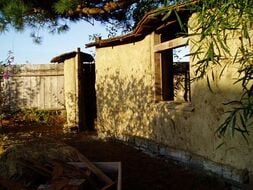
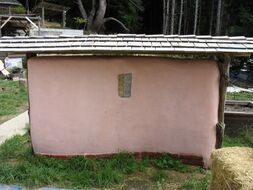
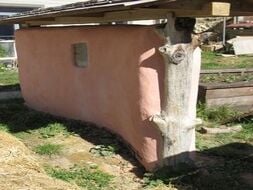
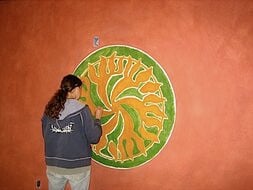
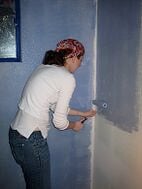
There are several eco-friendly paint options on the market, but many DIYers are choosing instead to make their own using natural materials.[1]

Natural paint is often a safer and more local alternative to conventional paints that can be high in VOCs and emboddied energy.

This page describes natural paints as a potential component of United States of America home construction. Only a few decades ago, the petrochemical industry largely took over the production of oil-based and water-based paints. The idea that paint should be able to breath was abandoned. Also, added synthetic chemicals are very harmful to humans and animals. Natural paints derived from plant and mineral materials have subtle, soothing colors, pleasant scents, and help create a healthy environment.[2] Natural paints avoid indoor air pollution and can have an unusual, attractive appearance.

A Brief History

Creating durable, beautiful paints out of natural ingredients is not a new phenomenon. For millenia, people have been using the materials around them to create paints to color their worlds. Examples of natural paints can be found in the earliest cave drawings. They can be found in the world's most prestigious museums. And they can be found in the average home.

Over time, synthetic, toxic and energy-intensive materials -- such as formaldehyde -- were added to the paints that people use in their homes.[3] These materials weren't added specifically to cause harm, but that didn't lessen their harmful effects. Some of these materials include synthetic dyes to increase color choices, additives to combat mold, and non-water-based binders such as petroleum products and heavy metals which were designed to withstand high use areas like kitchens.[4] A notable example is the lead-based paints that were once popular, but have now been linked to serious health risks.

But interest in natural paints has recently resurfaced in the face of growing concern for our environment, bringing people back to the techniques and materials that have stood the test of time. Still, it is important to understand that "natural" doesn't automatically mean "non-toxic" or "safe." Please use the information on this page to help inform your decisions about which natural paints are best for you and your home.

Below are examples of natural paints in action: beautiful, durable, and eco-groovy.

Natural Paint Basics

Paint generally has three main ingredients or parts.

  1. The first part is the pigment, which is responsible for the color of the paint.[13]
  2. The second part is the solvent. The solvent keeps the paint in liquid form and evaporates off as the paint dries.[4]Solvent can also be used during the painting process to clean paint spills and correct mistakes.[13]
  3. The third part of paint is the binder, which, as its name suggests, binds the paint together. This is the main body of paint.[13]

A lot of Paints have additional components in it, that are generally not neccessary but can improve the Paint. For example: fillers can be used to manipulate the texture and consistency of paint, and to reinforce the binder.[13] On the other hand paints like lime have only two components: water and binder (the binder is also the pigment and not separate).

Natural earth pigments add color to natural paints and are available at artist supply stores.[14]

Drawbacks of synthetic paints

VOCs/Indoor Air Quality

Waste

Impacts of natural paint

Advantages

Disadvantages

Manufacturer Type of Paint VOC Content (lb/gal) Approximate Cost ($/gal)
Krylon[26] Industrial, water-based epoxy paint 1.36 44
Benjamin Moore[27] Super Spec HP interior latex paint 0.48 34
The Natural Paint Company[28] Casein marble interior paint 0.00 82

Types

Water-based

Water-based paints are the best choices for an environmentally-friendly solvent[verification needed]. Distemper and lime wash are two popular examples.[13]

Casein or Milk

Casein paint is made from a protein commonly found in dairy, and is often called "milk paint" or "milk-based paint." This paint is mold resistant, durable and compostable.[13]However, if not allowed to dry properly, milk-based paint can sour or mold.[29]

Tempera or Egg

Egg-based paint is durable and quick to dry. It dries to a glossy finish.[13]

Flour

Painting with flour based paint in CCAT's utility room.

Flour paint is one of the most versatile paint types and can be used inside or outside, on wood, stone, drywall, wallpaper, earthen and gypsum plaster, masonry and to cover existing painted surfaces. This paint is very thick and can destroy brushes, but the recipe can be tweaked a little to achieve different textures. Flour paint typically consists of water, flour, colored clay and more uncolored clay filler.[30]

See CCAT natural paint project#Flour Paint for a project that used this Natural paint.

Oil-based

Commonly made from linseed oil, natural oil-based paints are durable and have a velvety texture.[13]

Recipes

Here are some recipes on Appropedia:

Examples

Manufacturer Product Qualities Advantages
Ecotrend Paint[31] Egg-based interior paint Anti-mold

Anti-bacterial

120 colors
No VOCs

No harmful chemicals

Odorless
Natural primers

Vegan primer

Interior paints of chalk, lime, plant-based casein, marble powder and clay
Unlimited palette choice

Stain-covering capability
No VOCs

Organic

Hypo-allergenic

See also

References

  1. ↑ Photo courtesy of Heather Brown.
  2. ↑ Building with Earth, Chelsea Green Publishing Company, 2001
  3. ↑ This information according to http://ezproxy.humboldt.edu/login?url=http://search.ebscohost.com/login.aspx?direct=true&db=afh&AN=4096867&site=ehost-live
  4. 1 2 3 This information according to http://greenhomeguide.com/know-how/article/selecting-green-paint
  5. ↑ This information according to http://web.archive.org/web/20110206120228/http://naturalpigments.com/education/article.asp?ArticleID=19
  6. ↑ This information according to http://en.wikipedia.org/wiki/Egg_tempera
  7. ↑ This information according to http://commons.wikimedia.org/wiki/File:Colin_Campbell_Cooper_-_Flatiron_Building.JPG
  8. ↑ This image from http://farm1.static.flickr.com/40/100761143_226e540b49.jpg
  9. ↑ This information according to http://www.ibiblio.org/wm/paint/auth/munch/
  10. ↑ This information according to http://commons.wikimedia.org/wiki/File:File.Nirmal_Painting.jpeg
  11. ↑ Photo courtesy of Bill Steen.
  12. 1 2 This information according to CCAT natural paint project.
  13. 1 2 3 4 5 6 7 8 This information is according to Natural paint basics
  14. ↑ Photo courtesy of Heather Brown.
  15. 1 2 This information is according to http://www.epa.gov/iaq/voc.html
  16. ↑ This information is according to Painting the Town Green Aberdeen Proving Ground's Paint Pilot Project
  17. 1 2 3 This information according to Storing and Disposing of Paint from Your Home by OCAPP
  18. ↑ This information according to http://www.fairfaxcounty.gov/dpwes/trash/disphhw.htm
  19. ↑ This information according to http://web.archive.org/web/20201017205522/https://www.des.nh.gov/organization/commissioner/p2au/pps/hhwp/paint/latex.htm
  20. 1 2 This information according to http://www.calrecycle.ca.gov/condemo/paint/
  21. 1 2 3 This information according to http://www.theecologist.org/green_green_living/home/268680/natural_house_paintsgood_enough_to_eat.html
  22. ↑ This information according to http://web.archive.org/web/20201017205522/https://www.des.nh.gov/organization/commissioner/p2au/pps/hhwp/paint/latex.htm
  23. 1 2 This information according to http://web.archive.org/web/20131127062230/http://www.mikewye.co.uk:80/TheBenefitsofNaturalPaints.pdf
  24. ↑ This information according to http://web.archive.org/web/20121115133357/http://www.bot.yildiz.edu.tr:80/ids09/_data/_readings/DESIGN%20AND%20DETAILING%20FOR%20DECONST.pdf
  25. 1 2 This information according to http://web.archive.org/web/20120728061951/http://www.seattle.gov/purchasing/pdf/RPNPaint.pdf
  26. ↑ This information according to http://www.utilitysafeguard.com/Krylon-Paint/Industrial-Coatings/Rust-Tough-Acrylic-Enamel_11/
  27. ↑ This information according to Benjamin Moore® Super Spec HP® Latex Flat Fire Retardant P59
  28. ↑ This information according to https://naturalpaint.com.au/
  29. ↑ This information according to Paula Baker-Laporte, Erica Elliot and John Banta, "Prescriptions for A Healthy House. A Practical guide for Architects, Builders & Homeowners." New Society Publishers, 2001.
  30. ↑ Steen, B., (2006). "Make Safe, Natural Paint." Mother Earth News (218), http://www.motherearthnews.com/DIY/2006-10-01/Make_Safe_Natural_Paint.aspx [accessed 2/3/2007].
  31. ↑ This information according to http://www.naturalinteriorpaint.com/about.html
Page data
Part of Engr308 Technology and the Environment
Keywords Building elements, Built environment, Indoor air pollution, Natural paint, Paint, HBCSL, Natural building, Earthen construction, Green living
SDG SDG11 Sustainable cities and communities
License CC-BY-SA-3.0
Language English ()
Related 0 subpages, 0 pages link here
Redirects Natural paint, Paint
Views 5,792 page views (analytics)
Created June 9, 2010 by Chris Waterguy
Last edit January 8, 2026 by MetadescriptionsBot