
| Part of | NREMT Skillset |
|---|---|
| Subskills | Scene Assessment Upon Arrival (PENMAN) Leg Fracture Manual Stabilization Circulatory Motor Sensory Testing (CMS) Sager Ischial Strap Positioning Sager Ankle Strap Positioning Sager Tension Adjustment Sager Foot Strap Application |
| Equipment | Prehospital PPE Sager Splint |
| Acting roles | EMT emergency medical technician paramedic |
| Pathologies | broken bone broken femur bruise contusion crepitus diaphoresis diaphoretic dislocation fracture hypotension lesion pain pale puncture swelling tachycardia tenderness |
| Body systems | skeletal system |
| Body parts | leg legs lower extremities |
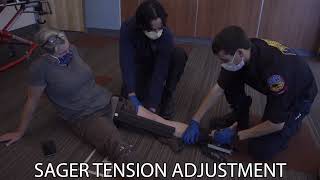

Sager Traction splint application is included in this California-based EMT program as it introduces an additional long bone fracture management skill with equipment found in many BLS ambulances. It is not required for skills verification for California Registration.[1]
The two main types of traction splints used in EMS programs around the country are the bipolar type (Hare) and the unipolar type (Sager) which is detailed here.
In a unipolar traction splint, a steel rod sits between a patient's legs and applies traction from the ankle with counter pressure directed onto the ischial tuberosity (resting where a bicycle seat would on the pelvis). Unipolar splints are more effective for proximal femur fracture than a bipolar splint, and a single splint can be used for a bilateral femur fracture. However, there is an increased risk of damage to the genitalia as the splint can move from the initial ischial tuberosity placement during transport, and it is not as comfortable for the patient.

